Eastern West Indies (4,365–2,638 BCE) Late Holocene…
4365 BCE to 2638 BCE
Eastern West Indies (4,365–2,638 BCE)
Late Holocene — Archaic Seafarers of the Caribbean Gateway
Geographic & Environmental Context
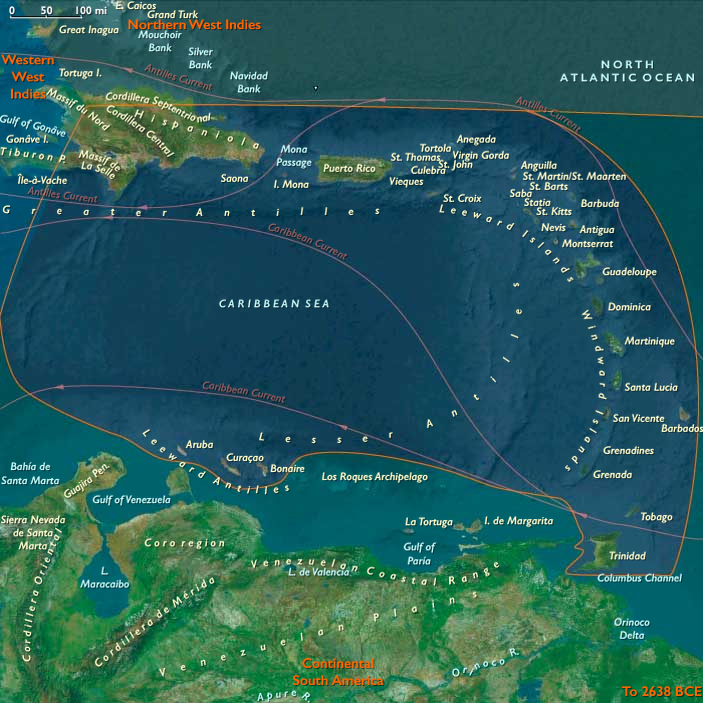
Eastern West Indies includes eastern Hispaniola, Puerto Rico, the Virgin Islands, the Lesser Antilles, and Trinidad & Tobago.
The region formed a long arc of islands extending from the Orinoco gateway into the northeastern Caribbean. Coral reefs, volcanic islands, mangrove lagoons, river mouths, coastal wetlands, and sheltered channels created a highly productive maritime environment.
Important environmental anchors included:
- the Vega Real and Santo Domingo lowlands of eastern Hispaniola,
- Puerto Rico's Cordillera Central and coastal plains,
- the Virgin Islands passages,
- the volcanic chains of the Lesser Antilles,
- and the Gulf of Paria–Trinidad corridor adjoining northern South America.
The archipelago functioned less as a series of isolated islands than as a connected maritime landscape.
Climate & Environmental Shifts
Late Holocene climatic conditions remained generally favorable.
Sea levels approached modern conditions, stabilizing reefs, lagoons, estuaries, and coastal wetlands throughout the island chain.
Periodic tropical storms reshaped beaches, mangrove margins, and coastal inlets, but ecological systems remained resilient. Coral reefs, seagrass beds, shellfish banks, and mangrove nurseries continued to support exceptionally productive marine food webs.
Subsistence & Settlement
Archaic populations remained concentrated along coasts, lagoons, river mouths, and sheltered bays.
Communities relied heavily upon:
- fishing,
- shellfish collection,
- reef harvesting,
- marine hunting,
- and gathering of coastal and inland plant resources.
Settlements generally remained small and dispersed. Seasonal mobility was common, and many communities shifted between multiple resource zones during the year.
Shell middens accumulated near favored campsites, marking generations of repeated occupation along productive shorelines.
Technology & Material Culture
Material culture remained largely preceramic.
Communities used:
- stone tools,
- shell tools,
- bone implements,
- woven cordage,
- wooden fishing equipment,
- and dugout canoes.
Watercraft technology became increasingly important as inter-island mobility expanded. Canoes linked reefs, islands, lagoons, and coastal settlements across much of the eastern Caribbean.
Ceramics had not yet become established across the region, although contacts with mainland South America may have transmitted ideas and materials through exchange networks.
Movement & Interaction Corridors
The eastern Caribbean formed one of the principal maritime corridors of the prehistoric Americas.
Major interaction routes linked:
- Trinidad and Tobago with the Orinoco region,
- the southern Lesser Antilles with northern South America,
- the Lesser Antilles with Puerto Rico,
- and Puerto Rico with eastern Hispaniola.
These canoe routes facilitated the movement of people, stone materials, shell ornaments, knowledge, and ritual traditions.
Rather than isolated island populations, many communities participated in a broader maritime interaction sphere.
Cultural & Symbolic Expressions
Ancestor veneration and place-based ritual traditions increasingly shaped community identity.
Shell middens often accumulated ceremonial significance through repeated occupation and remembrance.
Certain bays, reefs, river mouths, caves, and prominent coastal landforms likely acquired symbolic importance as navigation landmarks, gathering places, and locations of ritual activity.
Communal feasting, exchange, and seasonal aggregation probably reinforced social ties among neighboring island groups.
Environmental Adaptation & Resilience
Communities reduced risk through ecological diversification.
Marine fisheries, shellfish beds, mangrove resources, reef ecosystems, inland forests, and river valleys provided overlapping food sources that buffered populations against localized shortages and storm impacts.
Mobility itself served as a resilience strategy. Canoe networks allowed communities to shift resources, maintain social connections, and exploit multiple ecological zones across the archipelago.
Long-Term Significance
By 2,638 BCE, the Eastern West Indies had become a mature maritime landscape characterized by extensive canoe mobility, inter-island interaction, and sophisticated adaptation to tropical island ecosystems.
The networks established by Archaic populations laid the foundations for later ceramic and horticultural expansions originating from northern South America. When Saladoid colonists eventually entered the archipelago millennia later, they encountered an island world already shaped by long traditions of navigation, exchange, and coastal adaptation.
Images

Eastern West Indies in the Late Holocene
Subjects
Regions
West Indies
View →Subregions