Eleanor, the daughter of Reginald Cobham, 3rd…
1441 CE
Eleanor, the daughter of Reginald Cobham, 3rd Baron Sterborough, 3rd Lord Cobham, and his first wife, Eleanor Culpeper (d. 1422), daughter of Sir Thomas Culpeper, of Rayal, had in about 1422 become a lady-in-waiting to Jacqueline of Hainault, who, on divorcing John IV, Duke of Brabant, in 1421 had fled to England.
In 1423, Jacqueline had married Humphrey, Duke of Gloucester, the youngest son of King Henry IV, who, since the death of his elder brother, King Henry V, had been Lord Protector of the child king Henry VI and a leading member of his council.
Gloucester had gone to France to wrest control of his wife's estates in Hainault.
Eleanor became his mistress in 1425 on his return to England.
The Duke had his marriage to Jacqueline annulled in January 1428 and married Eleanor.
Over the next few years they were the center of a small but flamboyant court based at La Plesaunce in Greenwich, surrounded by poets, musicians, scholars, physicians, friends and acolytes.
Gloucester had placed his whole estate in a jointure with Eleanor in November 1435 and six months later, in April 1436, she was granted the robes of a duchess for the Garter ceremony.
The death in 1435 of Gloucester's elder brother, John, Duke of Bedford, had made Humphrey heir presumptive to the English throne.
Gloucester also claims the role of regent, hitherto occupied by his brother but is opposed in that endeavor by the council.
His wife Eleanor has some influence at court and seems to have been liked by Henry VI.
Eleanor had consulted astrologers to try to divine the future.
The astrologers, Thomas Southwell and Roger Bolingbroke, had predicted that Henry VI in July or August 1441 would suffer a life-threatening illness.
When rumors of the prediction reached the King's guardians, they also consulted astrologers who could find no such future illness in their astrological predictions, a comfort for the king who had been troubled by the rumors.
They also followed the rumors to their source and interrogated Southwell, Bolingbroke and John Home (Eleanor's personal confessor) and then arrested Southwell and Bolingbroke on charges of treasonable necromancy.
Bolingbroke had named Eleanor as the instigator so she too has been arrested and tried.
The charges against her have possibly been exaggerated to curb the ambitions of her husband.
Eleanor had denied most of the charges but confessed to obtaining potions from Margery Jourdemayne, "the Witch of Eye".
Her explanation was that they were potions to help her conceive.
Eleanor and her fellow conspirators are found guilty.
Southwell dies in the Tower of London, Bolingbroke is hanged, drawn and quartered, and Jourdemayne is burnt at the stake.
Eleanor has to do public penance in London, divorce her husband and is condemned to life imprisonment.
Locations
People
Regions
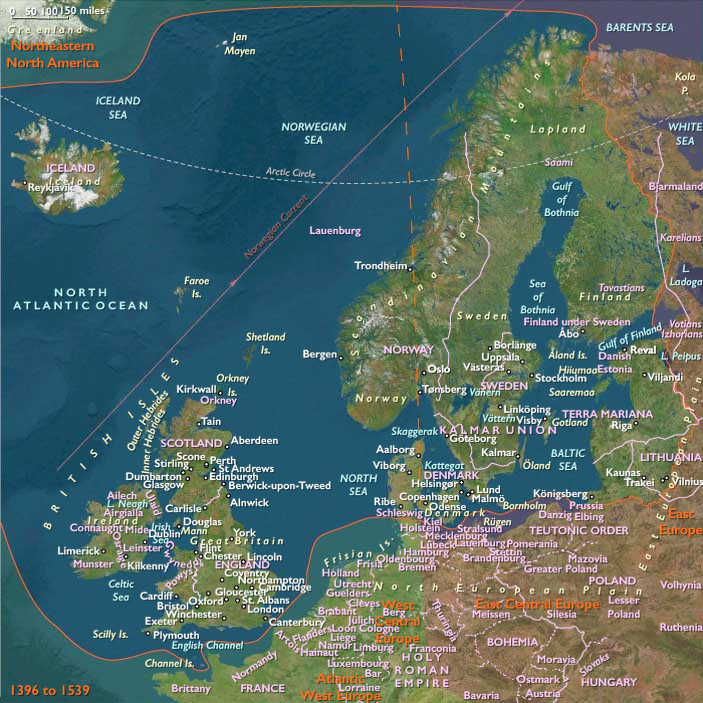
North Europe
View →Subregions