
Eleazar ben Judah takes part in a…
1223 CE
Eleazar ben Judah takes part in a synod at Mainz in 1223, which considers such questions as business relations with Christians and the inequitable exemptions of particularly favored Jews from the tax imposed by the government.
His greatest work is his ethical code Rokeach (Book of the Perfumer), for which he is sometimes known as Eleazar Rokeach.
The work is prefaced with a number of chapters dealing with the essential principles of Judaism, in which Eleazar attempts to explain mystical concepts, including the unity of God, in terms of Halakha (law).
Eleazar is an angelologist, not only in his mystic theories of theurgy (the art of persuading or compelling supernatural beings to one's bidding, but also in his writings on the kavod (”divine glory”), a concept also shared by his master, Judah ben Samuel the Hasid, who wrote a mystical work, existing only in citations, on the subject.
Eleazar believes that the kavod, a ruling angel, is an emanation from God and the knowable aspect of him, while God himself is infinitely transcendent and unknowable.
Locations
People
Commodities
Subjects
Regions
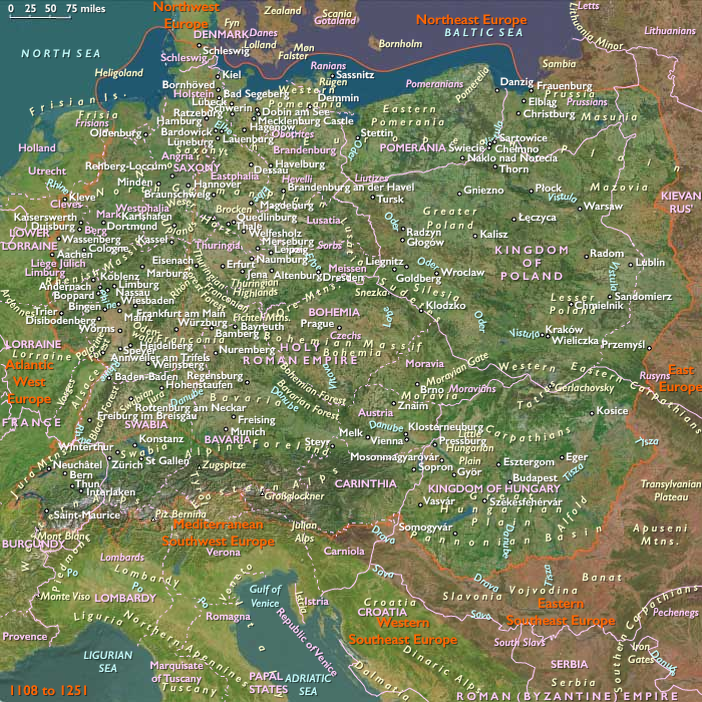
Central Europe
View →Subregions
West Central Europe
View →Related Events
No active filters.
Showing 10 events out of 47163 total
Pope Honorius III denies to declare the marriage of Andrew and Maria null and void; therefore Béla takes back his wife and, fearing his father's anger, escapes to Austria and the protection of Duke Leopold VI.
Finally, Andrew makes an agreement with his son with the mediation of the Pope and Béla again takes over the government of Slavonia, Dalmatia and Croatia.
William of Auvergne and Magisterium Divinale (c. 1223): A Bridge Between Augustinian and Aristotelian Thought
Around 1223, William of Auvergne (also known as William of Paris), a teacher at the University of Paris, wrote Magisterium Divinale (The Divine Teaching), a collection of philosophical and theological treatises. His work marked an early synthesis of Augustinian theology with Aristotelian and Arabic philosophy, positioning him as one of the first Western scholars to integrate these traditions into Christian thought.
William’s Intellectual Approach
-
Augustinian Foundations
- William remained firmly within the tradition of Saint Augustine, emphasizing the primacy of divine illumination, free will, and the soul’s yearning for God.
-
Use of Aristotelian and Arabic Thought
- Unlike many of his predecessors, William incorporated elements of Aristotelian philosophy, which had recently been reintroduced to the Latin West through Arabic translations and commentaries.
- He was influenced by Avicenna (Ibn Sina) and Al-Farabi, though he rejected Neoplatonic emanationism, which suggested that creation proceeded as a necessary overflow from God, rather than through divine will.
-
The Soul as the "Form" of the Body
- William accepted Aristotle’s definition of the soul as the form of the body, which would later become orthodox Christian doctrine through Thomas Aquinas.
- However, he rejected any aspect of Aristotle’s psychology that contradicted Christian teaching, ensuring that the soul remained a distinct, immaterial entity that could survive bodily death.
William’s Role in Early Scholasticism
-
A Forerunner to Aquinas
- William’s effort to balance faith and reason foreshadowed the later synthesis achieved by Thomas Aquinas.
- While William remained more Augustinian in tone, he paved the way for a more systematic Christian engagement with Aristotle.
-
Defense Against Non-Christian Philosophies
- William engaged in apologetics against Islamic and Jewish philosophy, refuting ideas from Averroes (Ibn Rushd) and Maimonides that he saw as inconsistent with Christian doctrine.
Legacy
- His writings helped establish the University of Paris as a center of Aristotelian-Christian synthesis, influencing later scholars.
- He became Bishop of Paris in 1228, where he continued to defend orthodox theology against heterodox ideas, particularly against rationalist interpretations of Aristotle.
- His works were an early example of scholasticism’s engagement with non-Christian sources, shaping the philosophical discourse of the 13th century.
William of Auvergne’s Magisterium Divinale (c. 1223) was a milestone in medieval thought, bridging Augustinian theology with Aristotelian philosophy while firmly defending the compatibility of reason and Christian doctrine.
King George IV, who has become an invalid as a result of his wounds, dies prematurely at the age of 31.
The surprise attacks by the Mongols have left the Georgians in confusion as to the identity of their attackers: the record of one contemporary chronicler indicates that he is unaware of the nature of the attackers and does not mention them by name.
In 1223, when the Mongols have seemingly deferred their plans regarding Georgia, King George IV's sister and successor Queen Rusudan writes, in a letter to Pope Honorius III, that the Georgians had presumed the Mongols were Christians because they fought Muslims, but they had turned out to be pagans.
The Rus princes have ignored the Cumans’ warnings for almost a year, as the Rus have suffered from Cuman raids for decades, but when news reaches Kiev that the Mongols are marching along the Dniester River, the Rus respond.
Mstislav gathers an alliance of the Kievan Rus' princes including Mstislav III of Kiev and Prince Yuri II of Vladimir-Suzdal, who promise support.
The Rus princes then begin mustering their armies and going towards the rendezvous point.
The move by the Rus' army is detected by the Mongols, who are on the east side of the Dnieper River waiting for reinforcements from Jochi, Genghis Khan's eldest son, who is campaigning around the Aral Sea.
Jochi, however, has become ill, which means no reinforcements will be coming.
At the same time, the Rus' attempt to trap the Mongols.
The Princes of Galich and Volhynia transport their armies south down the river, while the Princes of Kiev and Chernigov advance north up the river, and the army of Kursk advances from the front.
At the same time, the Cumans attempt to attack the Mongol army's rear.
When Jebe learns of this, he sends ten envoys to the Prince of Kiev.
The envoys state that the Mongols have no feud with Rus and are only attacking the Cumans; they add that the Mongols are marching east, away from the Rus' cities.
Mstislav of Kiev has the envoys executed, and the Mongols respond by sending another set of ambassadors, who declare war.
When Jebe and Subutai hear of the Rus' movements, they begin moving east, away from Rus', which is the only direction in which they can move.
However, they leave a rearguard of one thousand under the command of an officer, Hamabek, to report of the Rus movements.
Soon, Mstislav the Bold reaches the river opposite the rearguard, and it becomes apparent that no Prince had been appointed commander-in-chief.
Thus, all the Princes can act as they pleased.
Eventually, Mstislav crosses the river under heavy arrow fire.
When the Rus' land, however, their numbers are far superior, and the Mongols are killed to the last man.
The Mongol army, after drawing out the Rus armies for nine days in a feigned retreat, turns to face their pursuers along the Kalka River (the river's location is currently unknown, but it is thought to be the Kalchik River which flows into the Sea of Azov.
Three princes are captured and later killed at the battle site, and six more are killed in headlong pursuit back to the Dnieper River.
The chronicles name which princes took part and which died, but not much more in terms of the size of armies or casualties.
As to the actual battle itself, the chronicles report that the Polovtsy broke and ran without having fought and that their flight through the Russian ranks led to mass confusion and resulted in their slaughter by the Mongols.
The armies of Volhynia and Kursk make a gap in their line so that the fleeing Cumans can retreat.
However, the Mongol heavy cavalry charges through the newly formed gap.
The army of Chernigov, which is not aware that the battle had started, is advancing when they collide head-on with the retreating Cumans.
The Mongol cavalry takes advantage of the confusion in the Chernigov line and attacks, causing the line to collapse.
This, in turn, leads to the death of Prince Mstislav of Chernigov.
At the same time, the Mongol wings close around the shattered Rus' army, cutting off its retreat.
The surrounded Rus' are hit by volley after volley, accompanied by occasional cavalry charges.
As the Mongols are carrying this annihilation out, some of the army—led by Mstislav the Bold—manages to cut their way through the Mongol ring and escape.
Of the Rus' princes, the wounded Daniel of Volhynia and Mstislav the Bold manage to escape the battle by cutting loose all the boats on the Dnieper River the can find so they cannot be pursued.
Mstislav of Kiev arrives to see what remains of the Rus' army fleeing.
He retreats with his contingent of ten thousand men to his stockaded camp, on a hill by the Dnieper.
The pursuing Mongol army catches up with Mstislav of Kiev's forces and starts to besiege the camp.
Mstislav of Kiev and the Kievan army have managed to hold out for three days, but the prince decides to surrender to one of Jebe's allies, named Ploskanea, on the condition that he and his army will be able to return unharmed to Kiev.
Once in control of the camp, the Mongols slaughter the Kievan army and take Mstislav of Kiev and several other nobles prisoners.
The Mongols execute them in the traditional Mongol manner reserved for royalty and nobility; without shedding blood.
Mstislav and his nobles are buried and suffocated under the Mongol general's victory platform at the victory feast.
The battle has been a very costly defeat for the Rus' princes, given that many of the Rus principalities have lost much of their armies, with the notable exception of Vladimir-Suzdal, whose prince, Yuri II, had sent a small unit that arrived too late to take part in the disastrous battle.
What the Rus' feared would happen does not as the Mongols pursue the Prince of Galich and plunder a few towns in the south before turning around.
The Mongol army crosses the Volga River near modern-day Volgograd and …
…passes through Volga Bulgaria, where they are defeated in an ambush by the Bulgars.
The Mongol army encounters the Bulgars in another battle in which they route the Bulgars, then follow this up by attacking the Kankali Cumans, who had supported their fellow Cumans in the Caucasus a year before.
They fight against the Cuman army near the Ural Mountains, defeating and killing the Khan before making them pay tribute.
Following this victory, the Mongols had turned east to meet Genghis Khan and the rest of the Mongol army in the steppes to the east of the Syr Darya River.
The importance of the expedition is immense.
The expedition is history's longest cavalry raid, with the Mongols riding fifty-five hundred miles (eight thousand nine hundred kilometers) in three years.
Subutai also stations numerous spies in Russia, who will provide frequent reports on what is happening in Europe and Russia.
The Death of Philip II and the Accession of Louis VIII (July 14, 1223)
On July 14, 1223, King Philip II of France died at the age of 58, marking the end of a transformative reign that had solidified Capetian power and greatly expanded the French kingdom. His son, Louis VIII, immediately succeeded him as King of France, continuing his father's efforts to strengthen royal authority and diminish English and feudal influence in France.
Philip II’s Legacy
-
The First King to Style Himself as "King of France"
- Philip was the first Capetian ruler to officially use the title "King of France" (Rex Franciae), rather than "King of the Franks", reinforcing the idea of a centralized, national monarchy.
-
Territorial Expansion
- His victory at the Battle of Bouvines (1214) secured Normandy, Anjou, Maine, Touraine, and Poitoufrom the English Plantagenets, permanently weakening English claims in France.
- His wars with John of England led to the collapse of the Angevin Empire on the continent.
-
Administrative and Legal Reforms
- Philip strengthened royal administration, centralizing power through a more efficient bureaucracy.
- He expanded the use of royal officials (baillis and prévôts) to manage territories directly under the Crown, reducing feudal autonomy.
-
Military Innovations
- Philip organized a semi-permanent royal army, shifting France away from reliance on feudal levies.
- He was one of the first European rulers to use infantry effectively, as demonstrated at Bouvines.
-
Urban and Economic Growth
- He revitalized Paris, improving its fortifications, roads, markets, and bridges, helping it emerge as a true capital city.
- He introduced monetary reforms, stabilizing the French economy and reducing noble resistance to royal taxation.
The Accession of Louis VIII
- Philip was succeeded without dispute by his son, Louis VIII, who had already acted as regent and led military campaigns, including the Capetian invasion of England in 1216–1217.
- Louis VIII would continue his father’s policies, particularly against the English in Aquitaine and the remnants of the Albigensian resistance in the south.
Philip II’s death in 1223 marked the end of an era, but his reign laid the foundations for France’s rise as the dominant power in medieval Europe. His conquests, reforms, and military successes ensured that the Capetian monarchy would continue to grow in strength under his successors.
The Coronation of Louis VIII and His Campaign Against the Angevins (1223–1224)
Following the death of Philip II on July 14, 1223, Louis VIII was crowned King of France on August 6, 1223, at Notre-Dame de Reims, the traditional site of French royal coronations. His accession marked the continuation of Capetian expansionist policies, particularly against the Angevin remnants in France.
The Coronation at Reims (August 6, 1223)
- The ceremony at Reims Cathedral reinforced Louis VIII’s legitimacy, following the tradition established since the coronation of Clovis I (496 CE) and formalized under Charlemagne’s successors.
- Louis was anointed with the holy chrism, symbolizing the divine sanction of his kingship.
- His coronation marked the first time a Capetian king did not have to struggle for succession, reflecting the strength and stability of the monarchy after Philip II’s reign.