
Edward I and the Decline of Jewish…
1279 CE
Edward I and the Decline of Jewish Status in England (1275–1279)
By the late 13th century, England’s Jewish population had long been a direct source of royal revenue, as Jews were considered the personal property of the Crown. This meant that the king could tax them at will, making them a valuable financial asset.
However, by 1280, their economic utility to the monarchy had diminished due to excessive taxation and restrictions, while their role in moneylending had made them deeply unpopular among the general population. This resentment set the stage for increasing persecution and eventual expulsion.
The Statute of the Jewry (1275) and the Suppression of Usury
- In 1275, Edward I issued the Statute of the Jewry, prohibiting usury (moneylending with interest), which had been the primary livelihood of many Jews, as Christians were forbidden from practicing it.
- The statute encouraged Jews to take up other trades, such as agriculture and crafts, but in reality, they were barred from guilds and landownership, leaving them with few viable alternatives.
- The law also reinforced segregation, requiring Jews to wear identifying badges and restricting their places of residence.
The Coin-Clipping Crackdown and Mass Executions (1279)
- In 1279, during a crackdown on coin-clipping—the illegal practice of shaving silver or gold from coins to melt down and sell—Edward I launched a widespread campaign of arrests.
- Jews were disproportionately accused and targeted, with all heads of Jewish households in England arrested.
- Around 300 Jews were executed, making it one of the largest mass executions of Jews in medieval Europe.
- The event was part of a broader effort to undermine Jewish influence and appease anti-Jewish sentiment, while also serving as a political tool to consolidate royal power.
Legacy and Escalation of Persecution
- By expelling the Jews from Gascony in 1287, Edward tested the waters for a wider expulsion.
- The persecution and legal restrictions culminated in 1290, when Edward I issued the Edict of Expulsion, formally banishing all Jews from England—an expulsion that remained in effect for over 350 years.
The events of 1275–1279 reflected a shift in royal policy, where Jews were no longer economically indispensable and instead became political scapegoats, paving the way for their ultimate expulsion.
Locations
People
Groups
Commodities
Regions
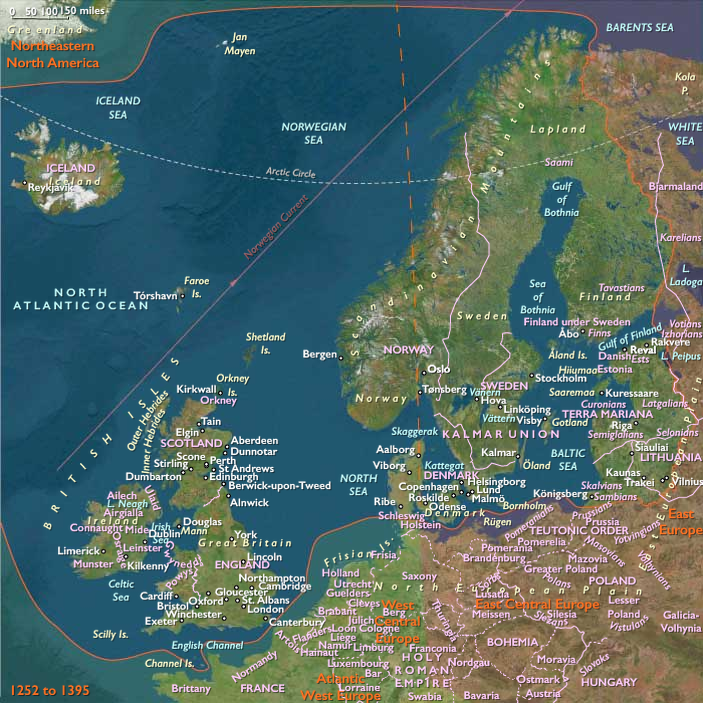
North Europe
View →Subregions
