
Event
Sir Humphrey Gilbert, an English soldier and…
Sir Humphrey Gilbert, an English soldier and navigator, argues in 1576 that “Mangia [South China], Quinzay [Hang-chou] and the Moluccas are nearer to us by the North West than by the North East.”
English seaman Martin Frobisher as early as 1560 or 1561 had formed a resolution to undertake a voyage in search of a Northwest Passage as a trade-route to India and China (referred to at this time as Cathay).
He had been referred to as Captain Martin Frobisher by 1565, and in 1571—1572 as being in the public service at sea off the coast of Ireland.
It has taken him fifteen years to gain the necessary funding for his project.
Mainly by the help of the Earl of Warwick, he is in 1576 put in command of an expedition of small ships, consisting of two tiny barks, the Gabriel and Michael, of about twenty to twenty-five tons each, and a pinnace of ten tons, with an aggregate crew of thirty-five.
He weighs anchor at Blackwall, and, after having received a good word from Queen Elizabeth I of England at Greenwich, sets sail on June 7.
Traveling by way of the Shetland Islands, Frobisher had lost the pinnace in a storm and been forced to abandon the Michael, but on July 28 the Gabriel sights the coast of Labrador.
Some days later the expedition reaches the mouth of Frobisher Bay, a relatively large inlet of the Labrador Sea in the southeastern corner of Baffin Island, Nunavut, Canada, and because ice and wind prevent further travel north, Frobisher determines to sail westward up this passage (which he conceives to be a strait) to see “whether he mighte carry himself through the same into some open sea on the back side.” Frobisher reaches Butcher's Island on August 18, where the expedition meets some of the local natives.
Frobisher sends five of his men in kayaks to survey the land, telling them strictly not to wander out of his sight.
They do, and Frobisher, assuming they had been captured, takes hostages and leaves.
The men will never be seen again, but Inuit legend tells that the men lived among them.
Frobisher turns homewards, and on October 9 reaches London.
Among the things which had been hastily brought away by the men was some "black earth," and just as it seemed as if nothing more was to come of this expedition, it is rumored abroad that the apparently valueless "black earth" is really a lump of gold ore.
It is difficult to say how this rumor arose, and whether there is any truth in it, or whether Frobisher is a party to a deception, in order to obtain means to carry out the great idea of his life.
He persuades himself, and others back home, that the bay now named for him is the Northwest Passage.
-
{# Image navigates to the detail page; the magnifying-glass chip is the only Fancybox lightbox trigger (kept a separate sibling — anchors can't nest). #}
 The North Atlantic Lands
World
-
{# Image navigates to the detail page; the magnifying-glass chip is the only Fancybox lightbox trigger (kept a separate sibling — anchors can't nest). #}
 Northern North America
Region
-
{# Image navigates to the detail page; the magnifying-glass chip is the only Fancybox lightbox trigger (kept a separate sibling — anchors can't nest). #}
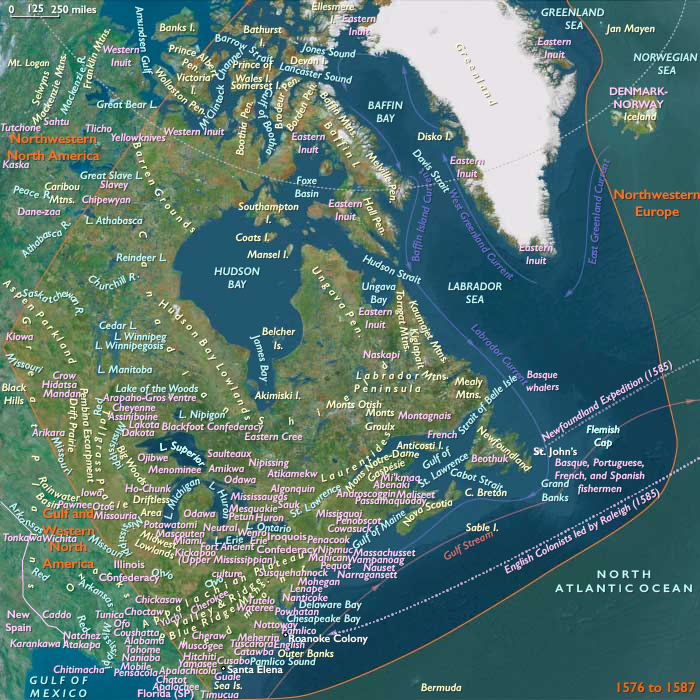 Northeastern North America
Subregion
