
Etruscan expansion is focused both to the…
549 BCE to 538 BCE
Etruscan expansion is focused both to the north beyond the Apennines and into Campania.
Some small towns in the sixth century BCE disappear during this time, ostensibly consumed by greater, more powerful neighbors.
However, there exists no doubt that the political structure of the Etruscan culture is similar, albeit more aristocratic, to Magna Graecia in the south.
The mining and commerce of metal, especially copper and iron, has led to an enrichment of the Etruscans and to the expansion of their influence in the Italian peninsula and the western Mediterranean sea.
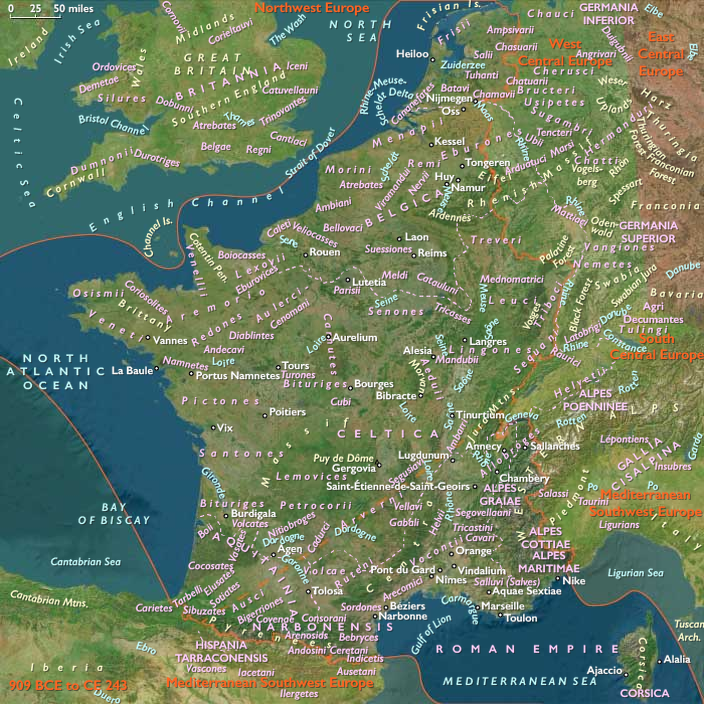
Here their interests collide with those of the Greeks, especially in the sixth century BCE, when Phoceans of Italy have founded colonies along the coast of France, Catalonia and Corsica.
This leads the Etruscans to ally themselves with the Carthaginians, whose interests also collide with the Greeks.
Massalia has become a thriving trading center and a major rival of Carthage for the Spanish markets and the tin trade through Gaul.
The Phocaeans had also planted a colony in Alalia in Corsica around 562 BCE.
When the city of Phocaea itself falls to Cyrus the Great of Persia in 546 BCE, most Phocaeans move to Alalia, partly because they are on good terms with the Greek colonies along the Strait of Messina and have even been granted toll-free passage.
The Phocaeans also found Elea in southern Italy (Magna Grecia) in 540 BCE.
The Phoecaeans have managed to establish their base at a time when Carthage is engaged in defending Punic colonies in Sicily (Greeks had started to encroach on Punic cities in 580 BCE) and conquering territory in Sardinia.
Tyre is facing Persian domination and the Etruscans are engaged in expansion across Italy, starting with the formation of the Etruscan League.
The Greeks have started to prey on Carthaginian and Etruscan trade from Corsica, which continues unchecked for five years.
However, fearing that the Greeks would threaten their colonies in North Italy and Sardinia next, the Etruscans and Carthaginians join forces to oppose the Greeks around 540 BCE.
It is not known if the Carthaginians ally with the Etruscan League or with individual Etruscan cities.
In the Battle of Alalia, which takes place between 540 BCE and 535 BCE off the coast of Corsica between Greeks and the allied Etruscans and Carthaginians, a Punic-Etruscan fleet of on3e hundred and twenty ships is defeated by a Greek force of Phocean ships while emigrating to the western Mediterranean and the nearby colony of Alalia (now Aléria).
It is assumed that the Phocaean Greeks had sixty pentekonters (ships with forty-eight oars and two rudders for steering), and the allied fleet was twice as large, also made of pentekonters.
Details of the battle are sketchy, but it is known that the Greeks had driven the allied fleet off, but had lost almost two-thirds of their own fleet in doing so: a Cadmean victory, according to Herodotus.
The rams of the surviving ships had been severely damaged.
Realizing that they cannot withstand another attack, the Greeks evacuate Corsica, and initially seek refuge in Rhegion in Italy.
Carthaginian and Etruscan battle losses are not known.
A legend describes how Greek prisoners were stoned to death at Caere by the Etruscans, while the Carthaginians sold their prisoners into slavery.
This battle is also known as "The Battle of Sardinia Sea".
Corsica passes into Etruscan hands, while Carthage retains Sardinia.
Locations
Groups
Topics
Commodities
Subjects
Regions
West Europe
View →Subregions
