European expansion into the upper Ohio valley…
August 1779 CE
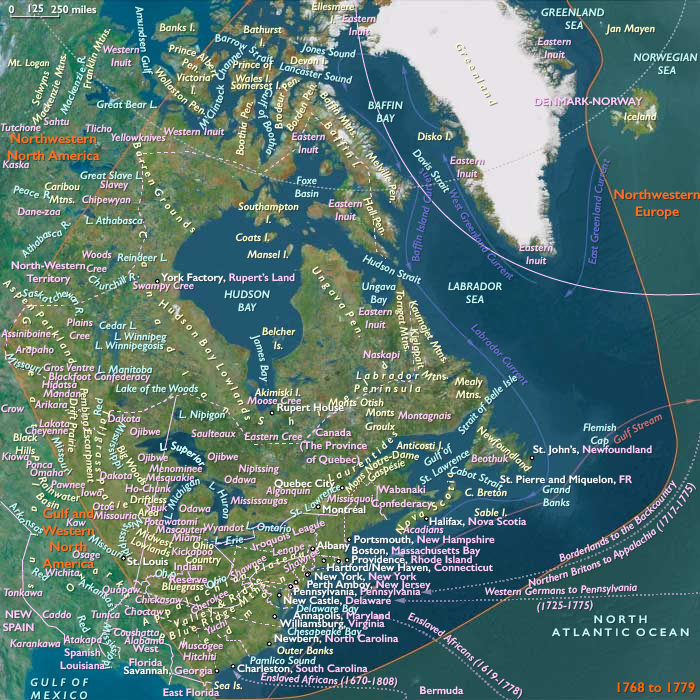
European expansion into the upper Ohio valley has increased.
Beyond the Appalachians, colonists have begun to settle the area around Fort Pitt (modern Pittsburgh), extending the dominion of the Pennsylvania colony.
An estimated four thousand to five thousand families had settled between 1768 and 1770 in western Pennsylvania, of which about a third were English, a third were Scots-Irish, and the rest were Welsh, German and others.
These groups tend to settle together in small farming communities, but often their households are not within hailing distance.
The life of a settler family is one of relentless hard work: clearing the forest, stumping the fields, building cabins and barns, planting, weeding, and harvesting.
In addition, almost everything has to be manufactured by hand, including furniture, tools, candles, buttons, and needles.
Settlers have to deal with harsh winters, and with snakes, black bears, mountain lions, and timber wolves.
The settlers often build their cabins near, or even on top of, springs, because of the fear of raids by Native Americans.
They also build blockhouses, where neighbors rally during conflicts.
Increasing violence with especially the Shawnee, Miami, and Wyandot tribes had led to Dunmore's War in 1774, and conflict with Native Americans is to continue throughout the American Revolution.
Fort Pitt had become a United States fort in 1777 when Brigadier General Edward Hand had taken command.
Colonel Daniel Brodhead, From his headquarters at Fort Pitt, has directed numerous raids against hostile native tribes, often leading the expeditions personally.
His most famous raid comes against the Seneca tribe between August 11 and September 14, 1779, when Brodhead leads six hundred and five soldiers and militia into the trackless wilderness of northwestern Pennsylvania to destroy Seneca villages along the upper Allegheny.
People
Groups
Topics
Commodities
Regions
Northern North America
View →Subregions