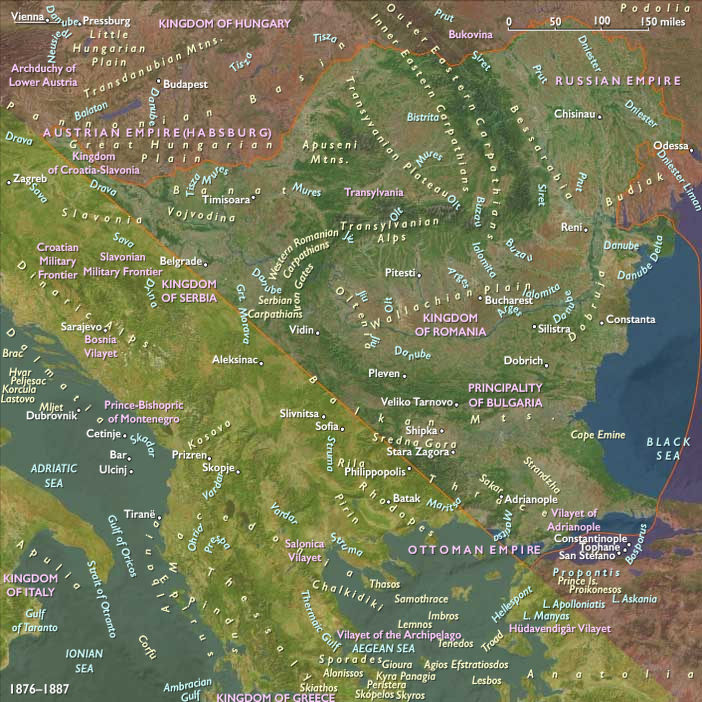
Russia eventually enters into a settlement under…
March 1878 CE
Russia eventually enters into a settlement under the Treaty of San Stefano on March 3 (February 19, Old Style), by which the Ottoman Empire will recognize the independence of Romania, Serbia, Montenegro, and the autonomy of Bulgaria.
This peace settlement, imposed on the Ottoman government by Russia at this high point of its influence on Balkan affairs, provides for a new disposition of the European provinces of the Ottoman Empire that ends any effective Turkish control over the Balkans.
Its most important provision establishes, under Russian protection, a huge autonomous Bulgarian principality, which includes most of Macedonia (except Thessaloníki and the Chalcidice Peninsula) and extends from the Danube to the Aegean and from the Vardar and Morava valleys to the Black Sea. The boundaries stated in the treaty, almost as extensive as the First Bulgarian Empire, represent the fulfillment of Bulgaria's territorial aspirations (and will remain for generations the national ideal of the people).
Despite the Romanian army's heroism at Plevna and its decisive contribution to Russian victory, Russia refuses to allow Romania to participate in peace negotiations.
However, the independence of Romania is recognized, together with that of Serbia and Montenegro.
The boundaries of Serbia and Montenegro are extended so as to be contiguous, while Romania is compelled to cede southern Bessarabia to Russia, receiving the Dobruja from Turkey in exchange.
Bosnia-Herzegovina is to be autonomous.
Parts of Asiatic Turkey are ceded to Russia, and the Ottoman sultan gives guarantees for the security of his Christian subjects.
The treaty is opposed by Austria-Hungary, which dislikes encouragement of Slav nationalism, and by the British, who fear the new Bulgarian state will become a Russian satellite and a threat to Constantinople, thereby upsetting the European balance of power.
Locations
Groups
Regions
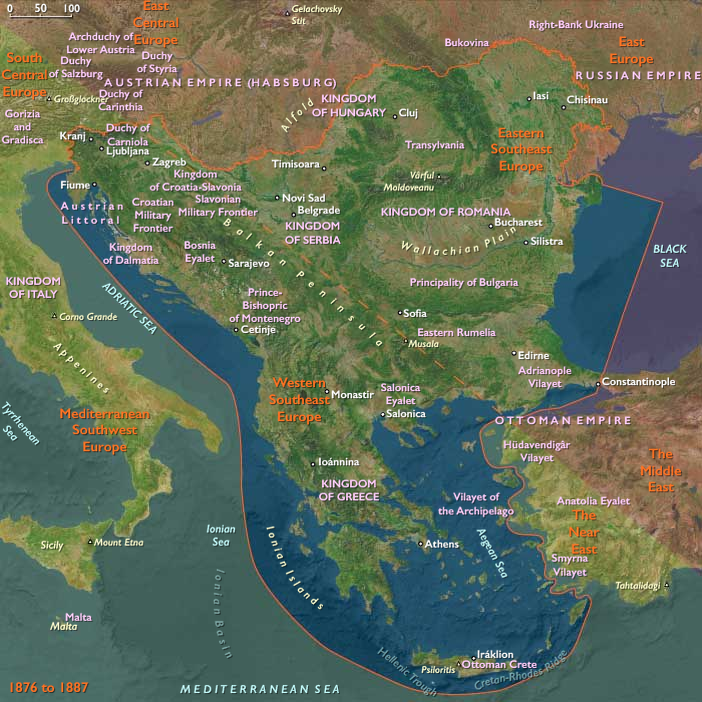
Southeast Europe
View →Subregions