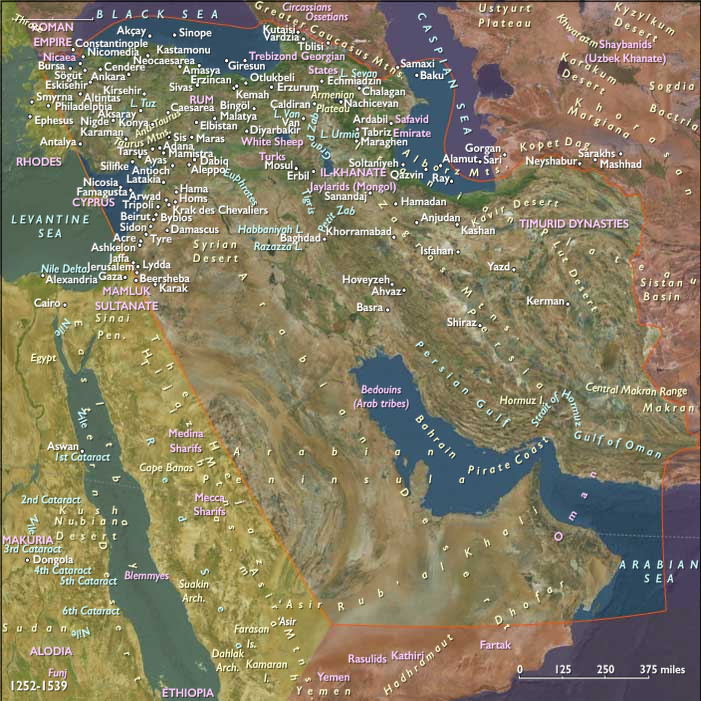
Evidence of communal activity in the area…
July 1507 CE
Evidence of communal activity in the area around Muscat, located on the Gulf of Oman at the southeastern end of the Arabian Peninsula, dates back to the sixth millennium BCE in Ras al-Hamra, where burial sites of fishermen have been found.
The graves appear to be well formed and indicate the existence of burial rituals.
South of Muscat, remnants of Harappan pottery indicate some level of contact with the Indus Valley Civilization.
Muscat's notability as a port was acknowledged as early as the first century CE by Greek geographer Ptolemy, who referred to it as Cryptus Portus (the Hidden Port), and by Pliny the Elder, who called it Amithoscuta.
The port had fallen to a Sassanid invasion in the third century CE, under the rule of Shapur I, while conversion to Islam had occurred during the seventh century.
Muscat's importance as a trading port continued to grow in the centuries that followed, under the influence of the Azd dynasty, a local tribe.
The establishment of the First Imamate in the ninth century CE had been the first step in consolidating disparate Omani tribal factions under the banner of an Ibadi state.
However, tribal skirmishes had continued, allowing the Abbasids of Baghdad to conquer Oman.
The Abbasids occupied the region until the eleventh century, when they were driven out by the local Yahmad branch of the Azd tribe.
Power over Oman has shifted from the Yahmad tribe to the Azdi Nabahinah clan, during whose rule the people of coastal ports such as Muscat have prospered from maritime trade and close alliances with the Indian subcontinent, at the cost of the alienation of the people of the interior of Oman.
The Portuguese admiral Afonso de Albuquerque, en route to assume the viceroyalty of Portuguese India after capturing Socotra at the mouth of the Gulf of Aden, takes seven ships and five hundred men in an advance towards Ormuz in the Persian Gulf, one of the chief eastern centers of commerce.
On his way, he sails to Muscat in July 1507 in an attempt to establish trade relations.
As he approaches the harbor, his ships are fired on.
He then decides to conquer the city, most of which burns to the ground during and after the fighting.
The Portuguese will maintain their hold on Muscat for over a century.
Locations
Groups
Topics
Commodities
Subjects
Regions
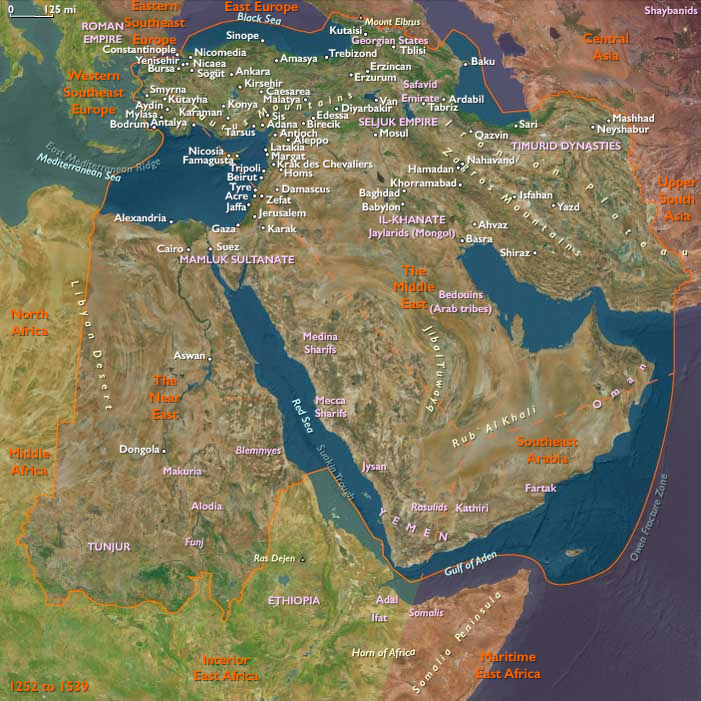
The Near and Middle East
View →Subregions