
Feodor proves incapable of effective rule, and…
1586 CE
Feodor proves incapable of effective rule, and the nobility establishes a dual regency of his uncle and Godunov, who becomes sole regent in 1586.
Godunov will oversee the elevation of the Russian Orthodox church to a patriarchate.
People
Subjects
Regions
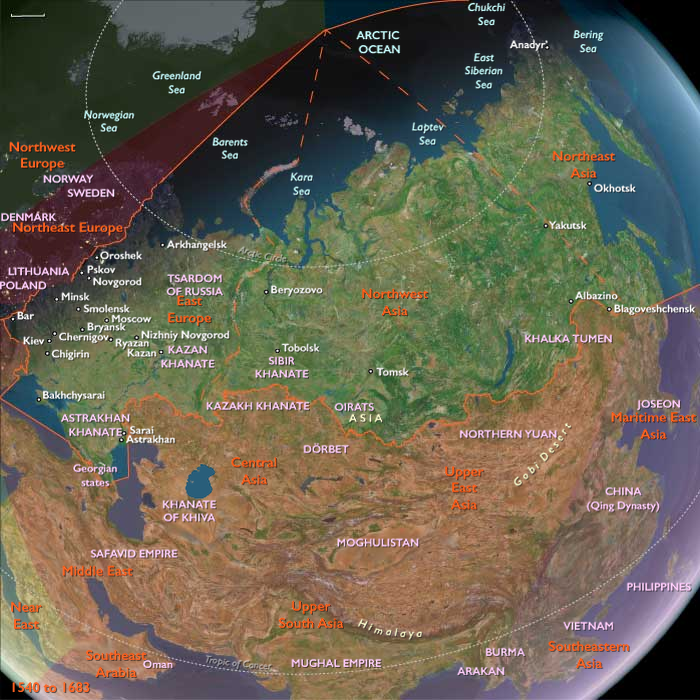
Northeastern Eurasia
View →Subregions
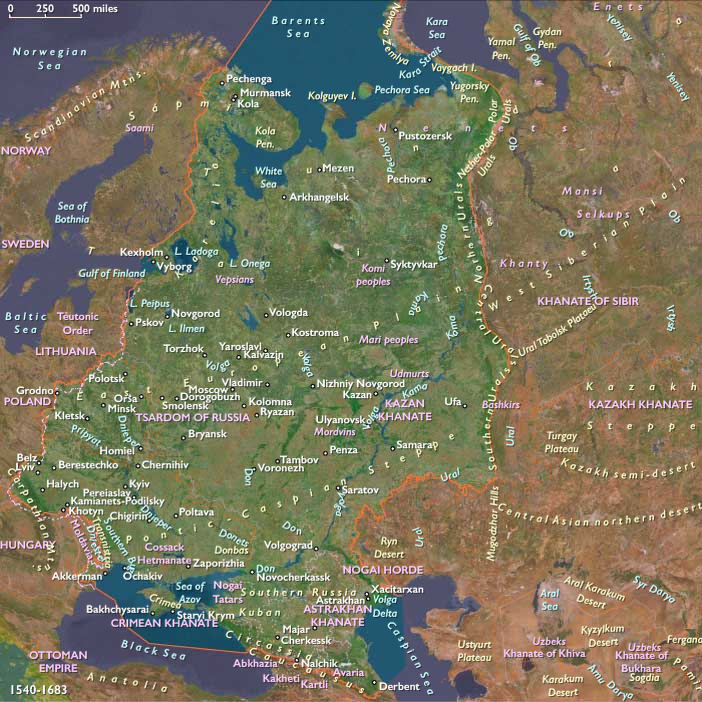
East Europe
View →Related Events
Showing 10 events out of 164 total
In March 1604 Sir Henry Middleton commands the second voyage.
General William Keeling, a captain during the second voyage, leads the third voyage aboard the Red Dragon from 1607 to 1610 along with the Hector under Captain William Hawkins and the Consent under Captain David Middleton.
Hereafter two ships, Ascension and Union (captained by Richard Rowles) sail from Woolwich on March 14, 1607–08.
Initially, the company struggles in the spice trade because of the competition from the already well-established Dutch East India Company.
The company opens a factory in Bantam on the first voyage, and imports of pepper from Java will be an important part of the company's trade for twenty years.
The factory in Bantam will be closed in 1683.
During this time ships belonging to the company arriving in India dock at Surat, which is established as a trade transit point in 1608.
The Dutch in Indonesia join forces in 1600 with the local Hituese (near Ambon) in an anti-Portuguese alliance, in return for which the Dutch are given the sole right to purchase spices from Hitu.
Dutch troops drive the Portuguese from the Moluccas.
The spice trade during the sixteenth century had been dominated by the Portuguese, who used Lisbon as a staple port.
Before the Dutch Revolt, Antwerp had played an important role as a distribution center in northern Europe, but after 1591 the Portuguese had used an international syndicate of the German Fuggers and Welsers, and Spanish and Italian firms that used Hamburg as its northern staple, to distribute their goods, thereby cutting out Dutch merchants.
At the same time, the Portuguese trade system was so inefficient that it was unable to supply growing demand, in particular the demand for pepper.
The lagging supply of pepper had therefore caused a sharp rise in pepper prices at the time.
Likewise, as Portugal had been "united" with the Spanish crown, with which the Dutch Republic was at war, in 1580, the Portuguese Empire had become an appropriate target for military incursions.
These three factors form the motive for Dutch merchants to enter the intercontinental spice trade themselves.
At this time, it is customary for a company to be set up only for the duration of a single voyage, and to be liquidated on the return of the fleet.
Investment in these expeditions is a very high-risk venture, not only because of the usual dangers of piracy, disease and shipwreck, but also because the interplay of inelastic demand and relatively elastic supply of spices could make prices tumble at just the wrong moment, thereby ruining prospects of profitability.
To manage such risk the forming of a cartel to control supply would seem logical.
This first had occurred to the English, who had bundled their forces into a monopoly enterprise, the East India Company, in 1600, thereby threatening their Dutch competitors with ruin.
The Dutch government follows suit in 1602, sponsoring the creation of a single "United East Indies Company" that is also granted a monopoly over the Asian trade.
The charter of the new company empowers it to build forts, maintain armies, and conclude treaties with Asian rulers.
It provides for a venture that is to continue for twenty-one years, with a financial accounting only at the end of each decade.
Accordingly, the Verenigde Oost-Indische Compagnie (Dutch East India Company or VOC) is founded on March 20, 1602, with the goal of sharing the costs of the exploration of the East Indies and ultimately re-establishing the spice trade, a vital source of income to the new Republic of the Seven United Provinces.
The States-General gives a charter to the Company to conduct all commerce between the Dutch Republic and the lands between the Cape of Good Hope and the Strait of Magellan.
The Republic is at this time fighting the Habsburgs for their independence and the reason why the Dutch seek to control the spice trade is one of economic survival.
Prior to the union of the Portuguese and Spanish Crowns, Portuguese merchants had used the Low Countries as a base for the sale of their spices in northern Europe.
After the Spaniards wrested control over the Portuguese Empire, they had declared an embargo on all trade with the rebellious provinces.
This meant the trade would now be directed through the Spanish Netherlands, which, according to the Union of Arras or (Union of Atrecht) had been pledged to the Spanish monarch and are Roman Catholic, as opposed to the Dutch Protestant north.
This also meant that the Dutch had lost their most profitable trade partner and their most important source of financing the war against Spain.
Additionally they had lose their distribution monopoly with France, the Holy Roman Empire and northern Europe.
Their North Sea fishing and Baltic cereal trading activities simply do not suffice to maintain the republic.
The Dutch have made naval power, essential to the Dutch economy and independence, a high priority.
Since the English, with Dutch aid, had in 1588 defeated the Spanish Armada, the Dutch are hopeful of some success.
Three Dutch ships under the eventual command of Admiral Jacob van Heemskerk at dawn of February 25, 1603, spot the carrack Santa Catarina at anchor off the eastern coast of Singapore,
The ship is traveling from Macau to Melaka, laden with products from China and Japan, including twelve hundred bales of Chinese raw silk, worth 2.2 million guilders.
Her cargo is particularly valuable because it contains several hundred ounces of musk.
After a couple of hours of fighting, the Dutch manage to subdue the crew, who forfeit the cargo and the ship in return for the safety of their lives.
This marks the start of the Dutch–Portuguese War that is to end the Portuguese monopoly on trade in the East Indies.
The first permanent Dutch trading post in Indonesia is established in 1603 in Banten, West Java.
The Amsterdam Admiralty Court confiscates the captured Portuguese carrack Santa Caterina on September 4, 1604.
Its captor, Captain Heemskerk, is an employee of the United Amsterdam Company (part of the Dutch East India Company), and though he had not had authorization from the company or the government to initiate the use of force, many shareholders are eager to accept the riches that he has brought back to them.
Not only is the legality of keeping the prize questionable under Dutch statute, but a faction of shareholders (mostly Mennonite) in the Company also object to the forceful seizure on moral grounds, and of course, the Portuguese demand the return of their cargo.
The scandal leads to a public judicial hearing and a wider campaign to sway public (and international) opinion.
It is in this wider contest that representatives of the Company call upon the jurist Hugo Grotius to draft a polemical defense of the seizure.
The result of Grotius' efforts in 1604-1605 is a long, theory-laden treatise that he provisionally entitles De Indis (On the Indies).
Grotius, in seeking to ground his defense of the seizure in terms of the natural principles of justice, has cast a net much wider than the case at hand; his interest is in the source and ground of war's lawfulness in general.
The treatise is never to be published in full during Grotius' lifetime, perhaps because the court ruling in favor of the Company preempts the need to garner public support.
The manuscript will not be made public until it is uncovered from Grotius' estate in 1864 and published under the title, De Jure Praedae (On the Right of Capture).
The principles that Grotius developed there, however, laid the basis for his mature work on international justice, De jure belli ac pacis, and one chapter of the earlier work did make it to the press in the form of the influential pamphlet, The Free Sea (Mare Liberum, published 1609).
Dutch control of Ambon is achieved in alliance with Hitu when in February 1605 they prepare to attack a Portuguese fort in Ambon but the Portuguese garrison surrenders.