
Ferdinand II of Aragon, jealous of Fernandez…
1507 CE
Ferdinand II of Aragon, jealous of Fernandez de Córdoba, accuses his viceroy of profligately spending the public treasury to reward his captains and soldiers; the death of Queen Isabel I of Castile had deprived him of a protector, and he is recalled in 1507.
Although Ferdinand praises Córdoba, he will give him nothing else to do until his death.
Locations
Subjects
Regions
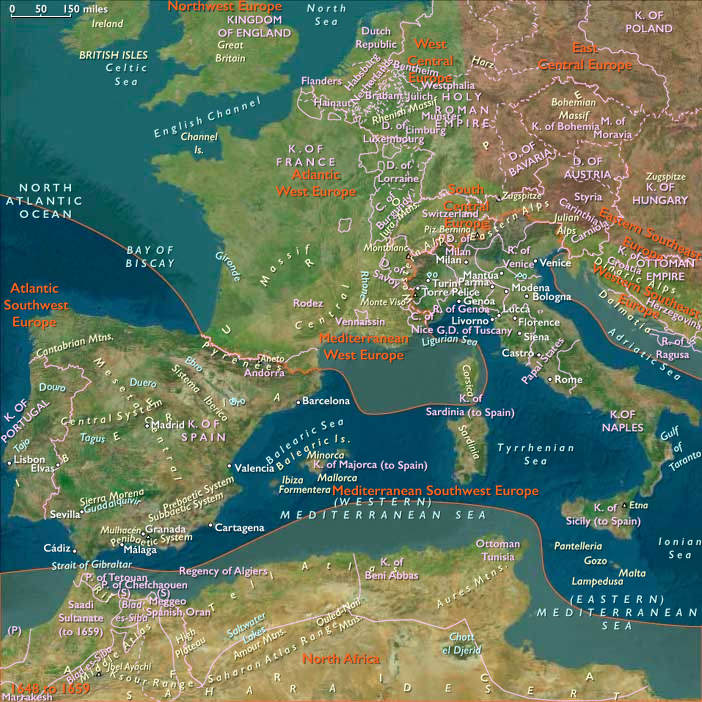
Southwest Europe
View →Subregions
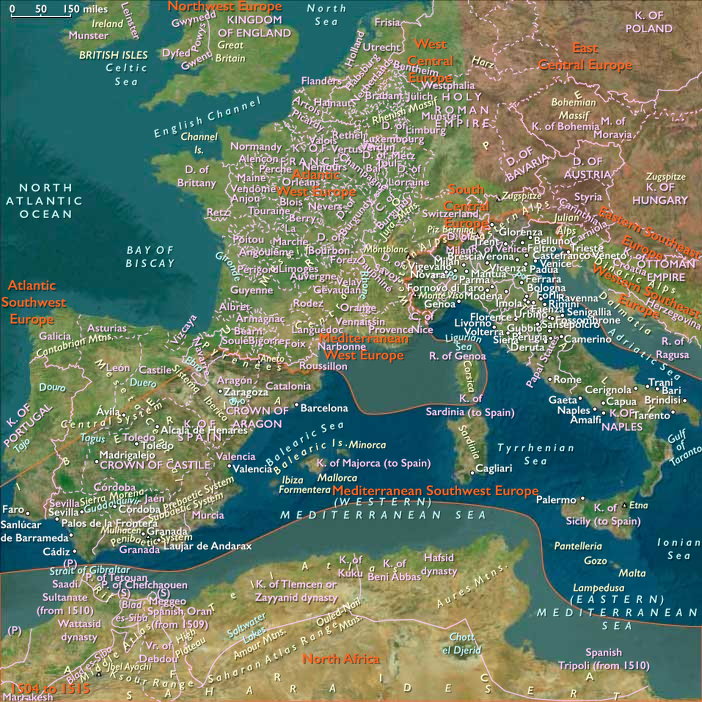
Mediterranean Southwest Europe
View →Related Events
No active filters.
Showing 10 events out of 39487 total
The Lan Na kingdom had been strongest under Tilokaraj (1441–1487), but has since been subjected to old-style princely struggles that have prevented the kingdom from defending itself against powerful growing neighbors.
The Shans have broken free of the control that Tilokaraj had established.
The last strong ruler is Paya Kaew, who is the great-grandson of Tilokaraj.
Continually menaced by the larger Thai polity of Ayutthaya and thus maintaining an aggressive stance towards his neighbor, Kaew takes the offensive into Ayutthayan territory in 1507.
The Ayutthayans, however, repel his forces in hard fighting near Sukhothai.
The Shan state of Mohnyin, centered in the region of present northeastern Burma (Myanmar), has cast off its status as a Chinese tributary and intensifies its raids into the Burmese kingdom of Ava.
Ava attempts unsuccessfully, in 1507, to appease the Shans, who continue their attacks.
The Burmese kingdom of Toungoo to the south declines to answer Ava’s request of support.
Sigismund, also recently crowned King of Poland, sends envoys to Moscow in 1507 requesting the to return of the territories acquired by the 1503 truce.
At the same time, Crimean Khan Meñli I Giray breaks off his alliance with Moscow due to its campaign against Kazan.
Sigismund receives an iarlyk from the Khan for the Muscovite territories of Novgorod, Pskov, Ryazan.
Sigismund urges the Lithuanian parliament in February 1507 to declare war on the Grand Duchy of Muscovy, which subsequently will strengthen Polish-Lithuanian suzerainty in the east.
Sigismund prepares for a massive military campaign against Russia.
Some fighting ensues, but no significant battles occur.
Sigismund, elected King of Poland in December 1506 during the session of the Polish Senate in Piotrków, on January 20, 1507, arrives in Kraków and is crowned four days later in Wawel Cathedral by Primate Andrzej Boryszewski.
Hans Baldung-Grien, the son of a lawyer, was born Hans Baldung at Schwäbisch Gmünd in Swabia in 1484 and soon moved with his family to Strassburg (now Strasbourg).
He is the only male member of his family not to attend university, a background unusual for an artist at the time.
His uncle had become a doctor to the Emperor.
He is to spend the greater part of his life at Strasbourg and Freiburg im Breisgau.
The earliest pictures assigned to him by some are altarpieces with the monogram H. B. interlaced, and the date of 1496, in the monastery chapel of Lichtenthal near Baden-Baden.
Another early work is a portrait of the emperor Maximilian, drawn in 1501 on a leaf of a sketchbook now in the print-room at Karlsruhe.
Likely following initial training in Strasbourg, Baldung had joined Dürer's Nuremberg workshop in 1503 and had stayed until 1507.
Here, he has been given his nickname “Grien.”
This name foremost comes from his preference to the color green, because he usually wears green clothes.
He receives this nickname also to distinguish him from the two other Hans’ in the apprenticeship, Hans Schäufelein and Hans Suess von Kulmbach.
He will later included it in his monogram, and it has also been suggested that it came from "grienhals", a German word for witch.
Hans quickly has picked up Dürer's influence and style, and they have become good friends.
He seems to have been left in charge of the workshop during Dürer's second trip to Italy.
Near the end of his apprenticeship, Grien had overseen the production of stained glass, woodcuts and engravings, and therefore developed an affinity for them.
The Martyrdom of St. Sebastian and the Epiphany (now Berlin, 1507), were painted for the market-church of Halle in Saxony.
Husayn Beg campaigns in 1507 in western Iran, where he is ambushed by a group of Kurds and as a result loses three hundred men.
During the same year, …
…Ismail appoints the Iranian Amir Najm al-Din Mas'ud Gilani as the new vakil.
This is because Ismail had begun favoring the Iranians more than the Qizilbash, who although they had played a crucial role in Ismail's campaigns, possess too much power and are no longer very trustworthy.
Eastern Persia has experienced its own cultural flowering under Sultan Husayn Mirza Bayqara, the Timurid ruler of Herat, who has controlled the region from 1469.
The Uzbeks had in 1501 conquered Transoxiana from the Timurid Babur.
Under Muhammad Shaybani, the Uzbeks could now threaten Khurasan.
Husayn, suffering from the effects of advanced age, had made no move against them, even after Babur advised him to act, and the Uzbeks had began conducting raids into Khurasan.
Finally changing his mind, he had begun to march against them but died in 1506 just after beginning his advance.
The inheritance of his empire had been disputed between his sons Badi' and Muzaffar Husain.
Babur, who had begun an expedition in support of Husayn, noted the infighting between the brothers, decided the area is impossible to defend, and retreated.
The next year, Muhammad Shaybani conquers Herat and causes Husayn's successors to flee, putting an end to Timurid rule in Khurasan.
The Zamorin meanwhile succeeds in persuading the Kōlattiri of Cannanore of the true imperialistic motives of Portuguese in Kerala.
The Kōlattiri is already annoyed and angered with the Portuguese for their violation of the safe conduct guaranteed to the ships of Muslim merchants of Cannanore.
The Kōlattiri puts up a common fight against the Portuguese besieging Fort St. Angelo at the Siege of Cannanore.
Almeida's mission is strengthened in 1507 by the arrival of Tristão da Cunha's squadron.
Afonso de Albuquerque's squadron had however split from that of Cunha off east Africa and is independently conquering territories to the west.