
The Marriage of Isabella and Ferdinand (1469)…
October 1469 CE
The Marriage of Isabella and Ferdinand (1469) and the Castilian Succession Crisis
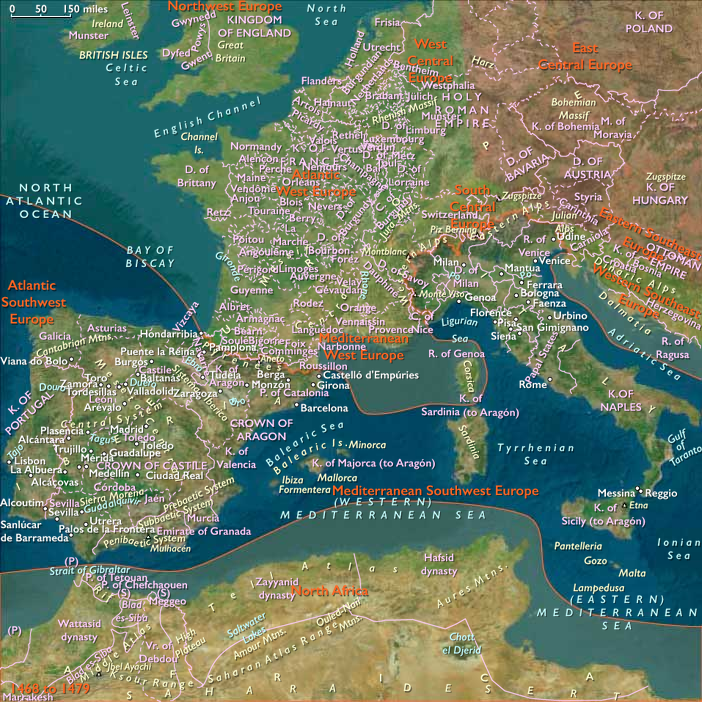
The marriage of Isabella of Castile and Ferdinand of Aragon in October 1469 was a pivotal moment in Iberian history, leading to the eventual unification of Spain. However, it also triggered a succession crisis that resulted in the War of the Castilian Succession (1475–1479).
Background: Isabella’s Position in Castile
- Isabella was the half-sister of King Henry IV of Castile, whose reign was marked by instability and factional struggles.
- She had been the subject of various political intrigues, with different factions seeking to control her future marriage.
- In 1468, after a period of negotiations and rebellions, Henry IV recognized Isabella as his heir, replacing his alleged daughter Joanna la Beltraneja.
The Secret Marriage of Isabella and Ferdinand (October 19, 1469)
- Ferdinand of Aragon was the heir to the Crown of Aragon, and his marriage to Isabella was intended to strengthen Castile and Aragon.
- The wedding took place in Valladolid on October 19, 1469, when Isabella was 18 years old and Ferdinand was 17.
- However, this marriage violated an earlier agreement with Henry IV, who had sought to control Isabella’s choice of husband.
King Henry IV’s Retaliation: Naming Joanna la Beltraneja as Heir
- Angered by Isabella’s unauthorized marriage, Henry IV revoked her status as heir.
- Instead, he reinstated his daughter, Joanna la Beltraneja, as the rightful successor to the Castilian throne.
- Joanna, who was only seven years old at the time, was rumored to be the illegitimate child of Henry IV’s wife and a court noble, hence the nickname "la Beltraneja" (after her supposed real father, Beltrán de la Cueva).
Consequences: The Castilian Succession Crisis
- Henry IV’s decision set the stage for a power struggle between Isabella and Joanna, leading to the War of the Castilian Succession (1475–1479).
- Isabella and Ferdinand’s marriage ultimately secured their rule over Castile, and in 1479, Ferdinand became King of Aragon, marking the beginning of the unification of Spain.
The marriage of Isabella and Ferdinand was not just a personal alliance but a political masterstroke, paving the way for the Catholic Monarchs’ rule, the completion of the Reconquista, and the rise of Spain as a global power.
Locations
People
Groups
Topics
Commodities
Subjects
Regions
Southwest Europe
View →Subregions
