The Battle of Vimeiro (August 21, 1808) – A Decisive British Victory
Following his victory at Roliça on August 17, 1808, Sir Arthur Wellesley established a strong defensive position near Vimeiro, ensuring he could cover the beachhead at Maceira Bay, where British reinforcements were landing. By August 20, 1808, most of Wellesley’s 18,000 British and Portuguese troops had arrived, and he planned to advance south toward Lisbon.
Meanwhile, French General Jean-Andoche Junot, realizing the British position threatened his hold on Portugal, gathered his 14,000 troops and launched a counteroffensive on August 21.
The Battle – Junot’s Bold but Flawed Attack
Despite being outnumbered, Junot attempted to turn Wellesley’s right flank, correctly identifying the unoccupied northeastern ridge as the British weak point. However, his attack suffered from poor coordination, weakening its effectiveness.
- The French launched piecemeal assaults, preventing them from fully exploiting numerical advantages in specific sectors.
- Wellesley responded quickly, moving troops to reinforce the vulnerable flank.
- British light infantry skirmishers, operating in large numbers, outmatched their French counterparts, disrupting French movements.
- Two British brigades never even engaged, demonstrating how efficiently Wellesley used his forces to counter each French attack.
The result was a comprehensive defeat for Junot, forcing his battered army into retreat.
Aftermath – French Capitulation and the Controversial Convention of Sintra
- Following his humiliating defeat, Junot offered full capitulation.
- However, instead of forcing an unconditional surrender, the new British commander Sir Hew Dalrymple(who had just arrived to take command) granted the French highly favorable terms.
- The Convention of Sintra (August 30, 1808) allowed the French to evacuate Portugal without being taken prisoner, with British ships transporting them back to France.
- This lenient agreement outraged many in Britain, as it seemed to waste Wellesley’s decisive victory.
Conclusion – A Turning Point in the Peninsular War
Despite the controversy surrounding the Convention of Sintra, the Battle of Vimeiro marked the first major defeat of French forces in the Peninsular War, proving that:
- Wellesley was a highly capable field commander, able to defeat numerically inferior but well-trained French forces.
- Portuguese troops could contribute effectively to the British war effort.
- British forces could stand against Napoleon’s armies, encouraging greater British commitment to the Peninsular War.
The Battle of Vimeiro effectively ended the first French occupation of Portugal, but the broader struggle for control of Iberia was far from over.

 The North Atlantic Lands
World
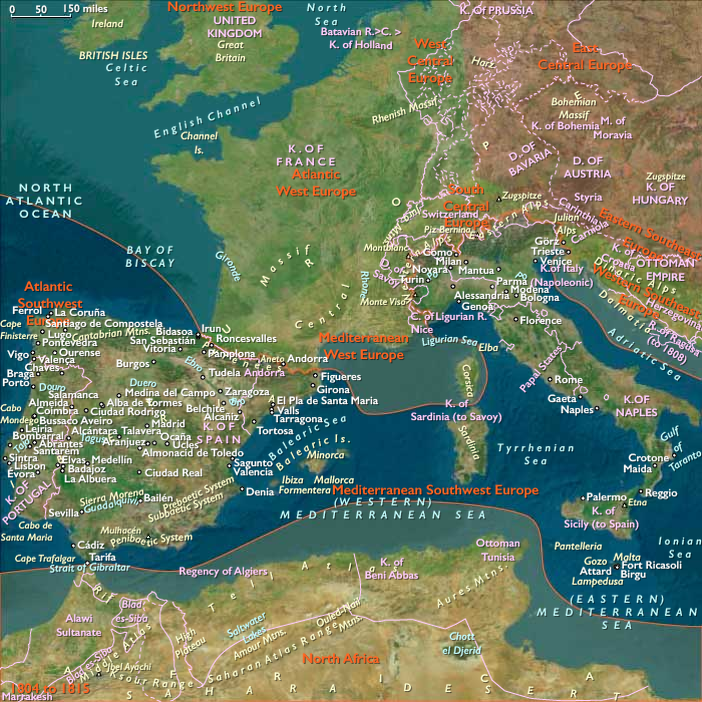 Southwest Europe
Region
 Atlantic Southwest Europe
Subregion
