
Martin Bucer Joins the Dominican Order (1506)…
1506 CE
Martin Bucer Joins the Dominican Order (1506)
In 1506, at the age of fifteen, Martin Bucer (Butzer) entered the Dominican Order, marking the beginning of a significant religious and intellectual journey. Bucer's decision to become a Dominican friar reflected the profound influence of monastic education and religious scholarship prevalent throughout Atlantic West Europe during this period.
As a Dominican, Bucer gained rigorous scholastic training, immersing himself deeply in philosophy, theology, and biblical studies—foundational experiences that would later shape his influential role in the religious transformations of the Reformation. His early exposure to Dominican teachings and humanist scholarship profoundly influenced his theological outlook and approach to religious reform.
Intellectual and Cultural Significance:
Bucer’s early Dominican formation laid crucial intellectual groundwork for his later engagement with humanist ideas and religious reform. His rigorous monastic education and exposure to biblical scholarship prepared him to become one of the Reformation’s leading theologians and reformers, especially known for his emphasis on moderation, dialogue, and unity among emerging Protestant movements.
Consequences and Legacy:
Martin Bucer’s entry into the Dominican Order in 1506 had long-term implications for European religious history. The scholarly rigor and theological sophistication he acquired as a Dominican eventually enabled him to become a pivotal mediator and influential figure in the religious debates of the Protestant Reformation, significantly impacting the development of Protestant theology and church practices in Atlantic West Europe.
People
Regions
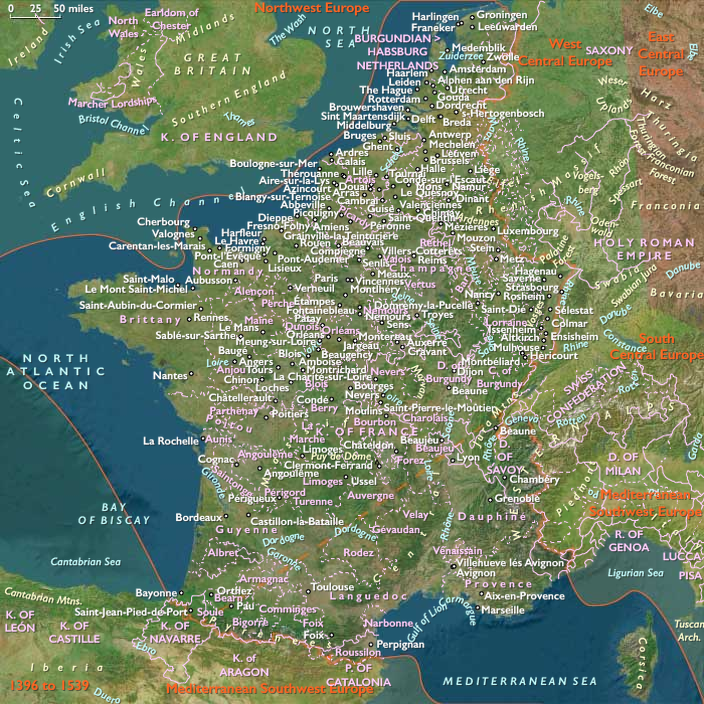
West Europe
View →Subregions
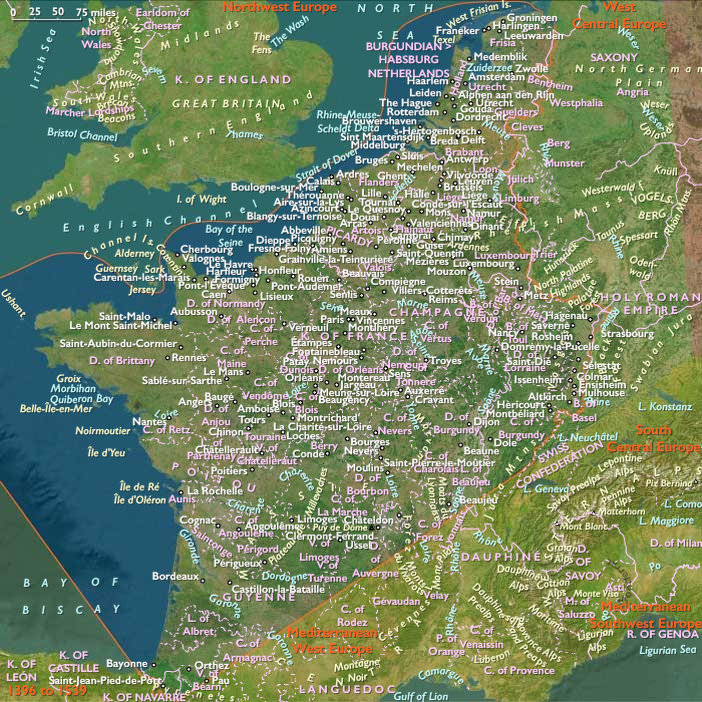
Atlantic West Europe
View →Related Events
No active filters.
Showing 10 events out of 39515 total
The Pinsk Marshes, also known as the Pripet Marshes and the Rokitno Marshes, are a vast natural region of wetlands along the forested basin of the Pripyat River and its tributaries from Brest to the west to Mogilev to the northeast and Kiev to the southeast.
The region’s largest city is Pinsk, a city in present Belarus, in the Polesia region, traversed by the river Pina, at the confluence of the Strumen and Pripyat rivers.
First mentioned in the chronicles of 1097 as Pinesk, a town belonging to Sviatopolk of Turau, the name is derived from the river Pina.
Pinsk's early history is closely linked with the history of Turau.
Until the mid-twelfth, century Pinsk had been the seat of Sviatopolk's descendants, but a cadet line of the same family had established their own seat at Pinsk after the Mongol invasion of Rus in 1239.
The Pinsk principality has an important strategic location, between the principalities of Navahrudak and Halych-Volynia, which fight each other for other Ruthenian territories.
Pinsk had not taken part in this struggle, although it was inclined towards the princes of Navahrudak, which is shown by the fact that the future prince of Navahrudak and Voyshalk of Lithuania spent some time in Pinsk.
In 1320 Pinsk had been won by the rulers of Navahrudak, who incorporated it into their state, known as the Grand Duchy of Lithuania.
For the past two centuries, Pinsk has been ruled by princes under Lithuanian suzerainty.
On August 9, 1506, the owner of Pinsk, Prince Feodor Ivanovich Yaroslavich, in his own name and in that of his wife, Princess Yelena, grants to the Jewish community of Pinsk two parcels of land for a house of prayer and a cemetery, and confirms all the rights and privileges given to the Jews of Lithuania by King Alexander Jagiellon.
Conflicts in the Lithuanian Council of Lords have begun to emerge between the quickly-rising Michael Glinski and Jan Zabrzeziński.
In summer 1506, Grand Duke Alexander's health deteriorates and he decides to convene a Seimas in Lida so that he can transfer the Lithuanian throne to his brother Sigismund, but the convention is disrupted on July 25 by news of a Tatar invasion.
According to scout reports, about twenty thousand Tatars have looted the neighborhood of Slutsk and approached Navahrudak and Lida.
The raid had started at the end of May.
At Loyew, they cross the Dnieper and around July 20–22 establish their main camp at Kletsk—the town had been devastated by them in 1503 and poses no serious threat.
Alexander leaves for Vilnius after putting Stanislaw Kiszka, Great Hetman of Lithuania, and Glinski in charge of the defense.
Sigismund, the son of King Casimir IV Jagiellon and Elisabeth of Austria, had followed his brothers John I of Poland and Alexander I of Poland to the Polish throne.
Their elder brother Vladislaus II of Bohemia and Hungary had become king of Hungary and Bohemia.
Sigismund had been christened as the namesake of his mother's maternal grandfather, Holy Roman Emperor Sigismund, who had died in 1437.
After his father's death, Sigismund was the only son who did not hold any land titles.
In the years 1495-1496, he had addressed his older brother, the Lithuanian Grand Duke Alexander, and demanded the separation of a domain from the Lithuanian Duchy, but had been refused.
Queen Dowager Elisabeth Habsburg had also tried without success to ensure the succession of Sigismund to the throne of Austria.
Also, the disastrous and unsuccessful invasion of Bukovina led by his oldest brother King John I Albert had dispelled the plans for placing Sigismund on the Moldavian throne.
Eventually, Sigismund had come under the care of Vladislaus II, King of Bohemia and Hungary, from whom he had received the duchy of Glogów in 1499 and Opava in 1501, and in 1504 had become governor of Silesia and Lower Lusatia.
After the death, at forty-five, of King Alexander on August 19, 1506, Vasili III of Moscow, who had succeeded his father Ivan III in 1505, advances his bid for the Polish throne, but Polish nobles chose Sigismund.
Sigismund arrives in Vilnius, where he is elected by the Lithuanian Ducal Council on September 13, 1506, as Grand Duke of Lithuania, contrary to the Union of Mielnik, which involves a joint Polish-Lithuanian election of a monarch.
Stoss has created the altar for Bamberg Cathedral and various other sculptures in Nuremberg, including the Annunciation and Tobias and the Angel.
In 1506, he is arrested a second time.
Emperor Maximilian writes a letter of pardon, but it is rejected by the council of the Imperial free city of Nuremberg as meddling in its internal affairs.
Stoss is able to resettle in Nuremberg from 1506, but is shunned by the council and is to receive few large commissions from this time forward.
Portuguese admiral Tristão da Cunha, commanding, with Afonso de Albuquerque, a fleet of sixteen ships sailing for India in 1506, is the first to sight a remote group of small volcanic islands in the south Atlantic Ocean; rough seas prevent a landing.
He names the main island after himself, Ilha de Tristão da Cunha, which will be anglicized from its earliest mention on British Admiralty charts to Tristan da Cunha Island.
Of Giovanni Bellini, now seventy-six, Dürer comments in a letter written during his visit to Florence in 1506, "he is very old, and still he is the best painter of them all."
The Portrait of Pietro Bembo, also called Portrait of the Young Pietro Bembo, an oil painting by Raphael, is ostensibly a portrait of Venetian Cardinal Pietro Bembo, Raphael's longtime friend.
Raphael did make a black chalk drawing of Bembo during Bembo's visit to Urbino in 1506.
The picture is to hang in Bembo's home for years before it disappears.
The lack of resemblance of this picture to its namesake, particularly in the nose, has led to other subjects being proposed, including Agnolo Doni, whom Raphael paints around the same time.
Carol Kidwell states in a 2004 biography of Bembo, that the subject "appears a happy courtier, not a man set on making his mark in the world, and he wears a red beret while Venetian noblemen wore black." (Completed around 1506, the painting hangs in the Museum of Fine Arts in Budapest.)
Raphael during his years in Florence paints “Saint George and the Dragon,” executed in 1506 as a gift from Duke Guidobaldo of Urbino to King Henry VII of England
Giorgione and the young Titian revolutionize the genre of the portrait.
It is exceedingly difficult and sometimes simply impossible to differentiate Titian's early works from those of Giorgione.
None of Giorgione's paintings are signed and only one bears a reliable date: his portrait of Laura (June 1, 1506), one of the first to be painted in the "modern manner", distinguished by dignity, clarity, and sophisticated characterization.
Italian scholar and engineer Fra Giovanni Giocondo, who has worked throughout Italy and in France for Charles VIII and Louis XII, mostly as an advisor, works on the defenses of Venice in about 1506.
The marble “Laocoon” group, which stands eight feet (two point forty-two meters) tall and was sculpted in the first century BCE, attributed by Pliny the Elder to Rhodian sculptors Agesander, Athenodorus, and Polydorus, is discovered in Rome in 1506.
Widely admired and copied, it attracts much attention from Italian humanists, whose collection of antique statues reflects a growing interest in the classical world of Greece and Rome.
Primarily concerned with art, both the written works of classical authors and the material works of classical sculpture and architecture, this search for and collection of these works of art during the Renaissance gives rise to classical archaeology.
The Portrait of a Cardinal by Raphael depicts an unidentified cardinal in the court of Pope Julius II. (The portrait will be acquired by Charles IV of Spain when he is still a prince, and the picture will be attributed to Antonio Moro, due to its technique, considered unusual in Raphael. It is housed today in the Prado Museum in Madrid.)
Pope Julius II, as the centerpiece of his vast scheme for reconstruction of the Vatican buildings, plans the rebuilding of the dilapidated old St. Peter's church, a Constantinian basilica that is no longer large enough for the vast number of pilgrims who flock there on feast days.
The job of dismantling the old church is begun in 1506.
Donato Bramante proposes for the new Saint Peter's Basilica a central plan, which has recently come back into vogue.
The so-called Parchment Plan of Saint Peter's, drawn by Bramante and Leonardo da Vinci, displays the standard Renaissance scheme: a ring of satellite domes and vaults buttresses the dominating central dome, toward which the soul of the inspired observer is meant to ascend in contemplation.
Earlier Roman and Byzantine domes, designed to be viewed from the interior, thus had relatively little external impact, while the Renaissance dome, elevated on a drum, forms a striking and clearly distinguishable silhouette that dominates the urban skyline.
Leonardo returns in June 1506 to Milan in June 1506, called here to work for the new French government.
The small portrait known as the Mona Lisa or "la Gioconda", the laughing one, is arguably the most famous painting in the world today.
Its fame rests, in particular, on the elusive smile on the woman's face, its mysterious quality brought about perhaps by the fact that the artist has subtly shadowed the corners of the mouth and eyes so that the exact nature of the smile cannot be determined.
The shadowy quality for which the work is renowned came to be called sfumato or Leonardo's smoke.
Other characteristics found in this work are the unadorned dress, in which the eyes and hands have no competition from other details, the dramatic landscape background in which the world seems to be in a state of flux, the subdued coloring and the extremely smooth nature of the painterly technique, employing oils, but laid on much like tempera and blended on the surface so that the brushstrokes are indistinguishable.
Gian Paolo Baglioni, the son of Rodolfo Baglioni, lord of Perugia, had initially fought mostly in Umbria, especially against the family rivals, the Oddi.
He was hired by Florence in 1498 to hold minor operations in Umbria.
He had in July 1500 escaped an assassination attempt by Grifone and Carlo Baglioni.
He has since been at the service of the Papal States, fighting mostly along with Vitellozzo Vitelli until the latter’s murder in 1502.
Among his deeds of this period, is the cruel reconquest of Camerino, after the brief rule of Cesare Borgia, for the Da Varano family.
After a period of independence and ruthless actions, he submits in 1506 to Pope Julius II.