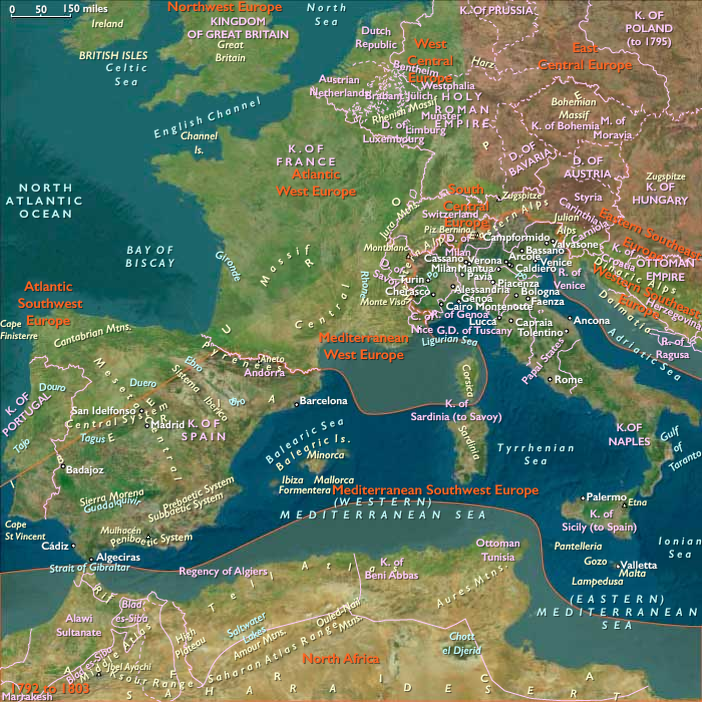
Bonaparte, following his successful conclusion of the…
May 1797 CE
Bonaparte, following his successful conclusion of the treaty of Leoben with Austria, marches on Venice and forces its surrender, ending eleven hundred years of independence; he also authorizes the French to loot treasures, such as the Horses of Saint Mark.
The last doge of Venice, Ludovico Manin, steps down.
The Venetian Ghetto is thrown open.
Bonaparte's application of conventional military ideas to real-world situations effects his military triumphs, such as creative use of artillery as a mobile force to support his infantry.
He is adept at espionage and deception and can win battles by concealment of troop deployments and concentration of his forces on the 'hinge' of an enemy's weakened front.
If he cannot use his favorite envelopment strategy, he takes up the central position and attacks two cooperating forces at their hinge, swing round to fight one until it flees, then turn to face the other.
In this Italian campaign, Bonaparte's army has captured one hundred and fifty thousand prisoners, five hundred and forty cannons and one hundred and seventy standards.
The French army has fought sixty-seven actions and wins eighteen pitched battles through superior artillery technology and Bonaparte's tactics.
Locations
People
Groups
Topics
Commodities
Subjects
Regions
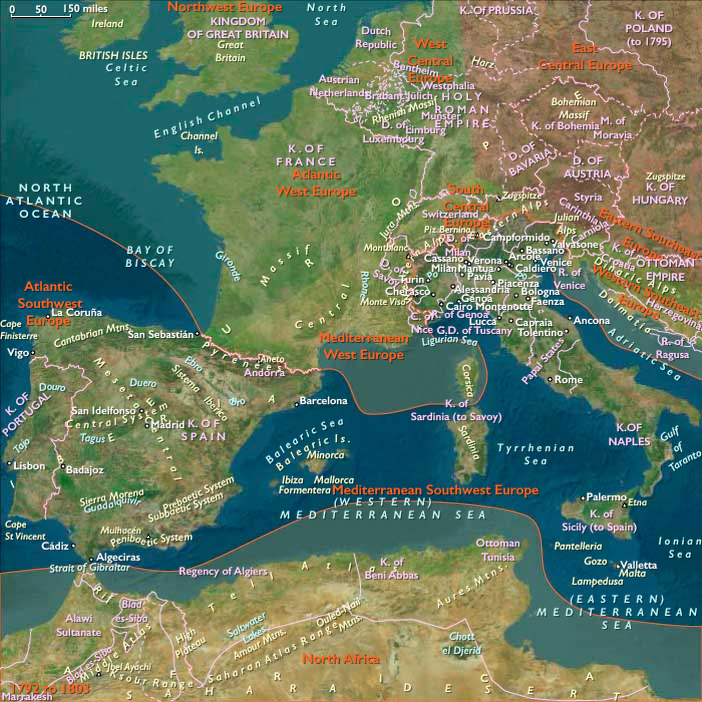
Southwest Europe
View →Subregions