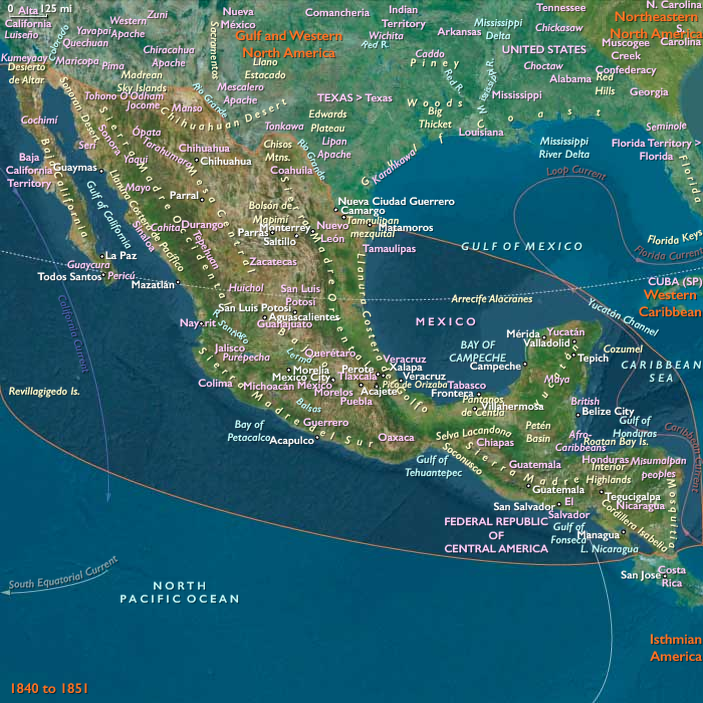
Southern Mexico has a large indigenous population…
June 1847 CE
Yucatán in particular has closer ties to Cuba and to the United States than it does to central Mexico.
On a number of occasions in the early era of the Mexican Republic, Yucatán had seceded from the federation.
There were also rivalries between regional elites, with one faction based in Mérida and the other in Campeche.
These issues factor into the Mexican–American War.
By 1847, the Yucatan Republic has effectively two capitals in the two cities.
At the same time, in their struggle against the central government, both leaders have integrated large numbers of Maya into their armies as soldiers.
The Maya, having taken up the arms given them in the course of the war, decide not to set them down again.
The U.S. is concerned with the extension of British power in the Caribbean, especially Spanish Cuba, as well as the strategic Yucatán peninsula.
In 1847 Maya revolt against the white elites of the peninsula in a racial war known as the Caste War of Yucatan.
Jefferson Davis, now a senator from Mississippi, argues in congress that the president needs no further powers to intervene in Yucatan since the war with Mexico is underway.
Davis's concern is strategic and part of his vision of Manifest Destiny, considering the Gulf of Mexico "a basin of water belonging to the United States" and continuing "the cape of Yucatan and the island of Cuba must be ours" rather than under British influence.
In the end, the U.S. does not intervene in Yucatán, but it has figured in congressional debates about the Mexican–American War.
At one point, the government of Yucatán will petition the U.S. for protection during the Caste War, but the U.S. will not respond.
Locations
Groups
Topics
Regions
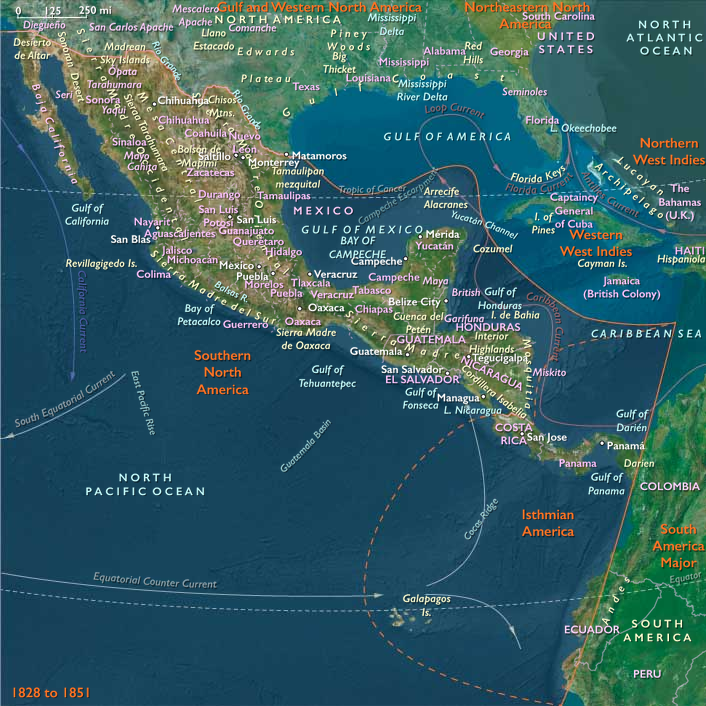
Middle America
View →Subregions