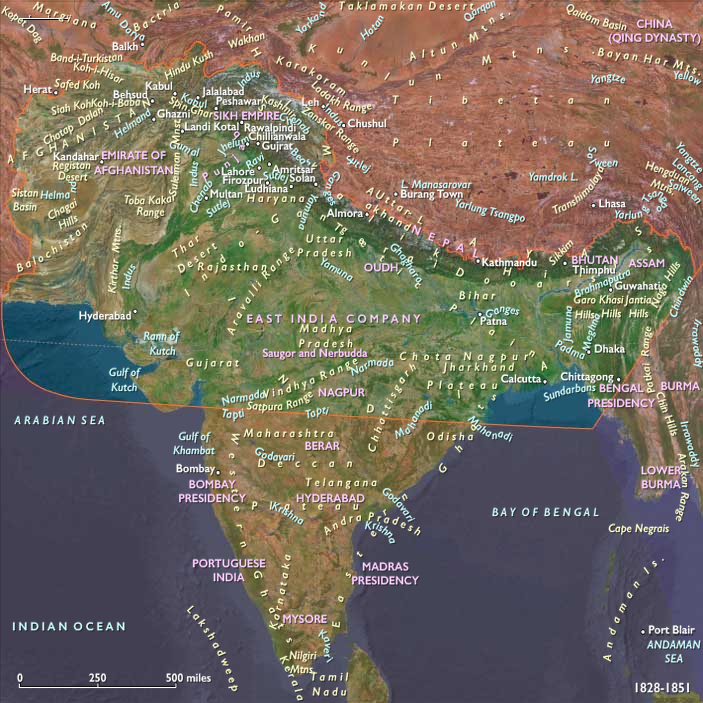
The Sikh empire has been severely weakened…
1841 CE
The Sikh empire has been severely weakened by internal divisions and political mismanagement following the death of Maharaja Ranjit Singh in 1839.
Meanwhile, immediately after the death of Ranjit Singh, the East India Company had begun increasing its military strength, which was, at the time of his death, spread dangerously thin on the borders of the Punjab.
Ranjit's unpopular legitimate son, Kharak Singh, was removed from power within a few months, and later died in prison.
He was replaced by his able son Nau Nihal Singh, who also died within a few months in suspicious circumstances—crushed by a falling archway at the Lahore fort while returning from Kharak Singh's cremation.
There are at this time two major factions within the Punjab contending for power and influence, the Sindhanwalias and the Dogras.
The Dogras succeed in raising an illegitimate son of Ranjit Singh, Sher Singh, to the throne in January 1841.
The most prominent Sindhanwalias have taken refuge on British territory, but have many adherents among the Army of the Punjab.
The army, which has expanded rapidly in the aftermath of Ranjit Singh's death, as landlords and their retainers have taken up arms, now claims itself to be the Khalsa, or embodiment of the Sikh nation.
Its regimental panchayats (committees) form an alternate power source within the kingdom, declaring that Guru Gobind Singh's ideal of the Sikh commonwealth has been revived, with the Sarbatt Khalsa or the Sikh as a whole assuming all executive, military and civil authority in the State.
The British decry this as a "... dangerous military democracy ...".
British representatives and visitors in the Punjab describe the regiments as preserving "puritanical" order internally, but also as being in a perpetual state of mutiny or rebellion against the central Darbar (Court).
In one notorious instance of unrest, Sikh soldiers run riot, looking for anyone who looks as if they can speak Persian (the language used by the clerks who administer the Khalsa's finances) and putting them to the sword.
Locations
People
Groups
Regions
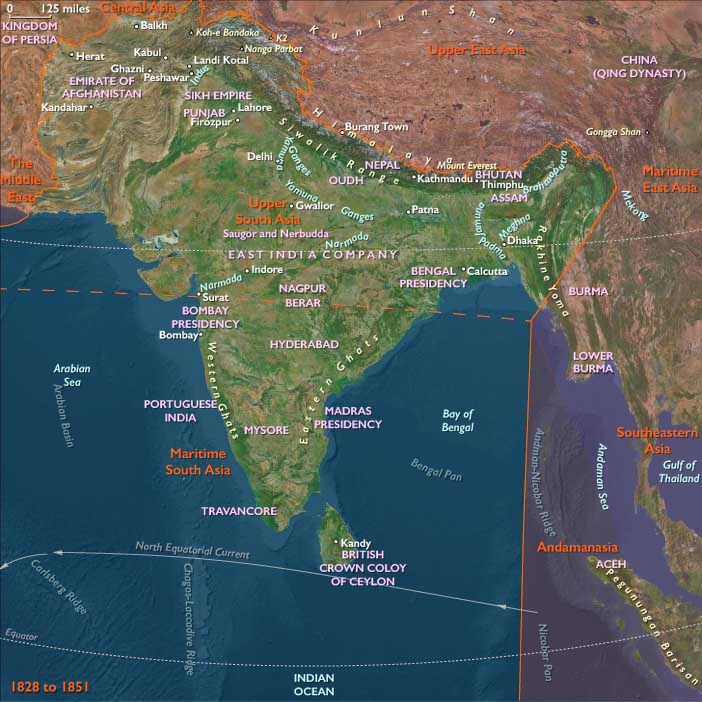
South Asia
View →Subregions