The East Roman Empire must redraw its …
Years: 1072 - 1083
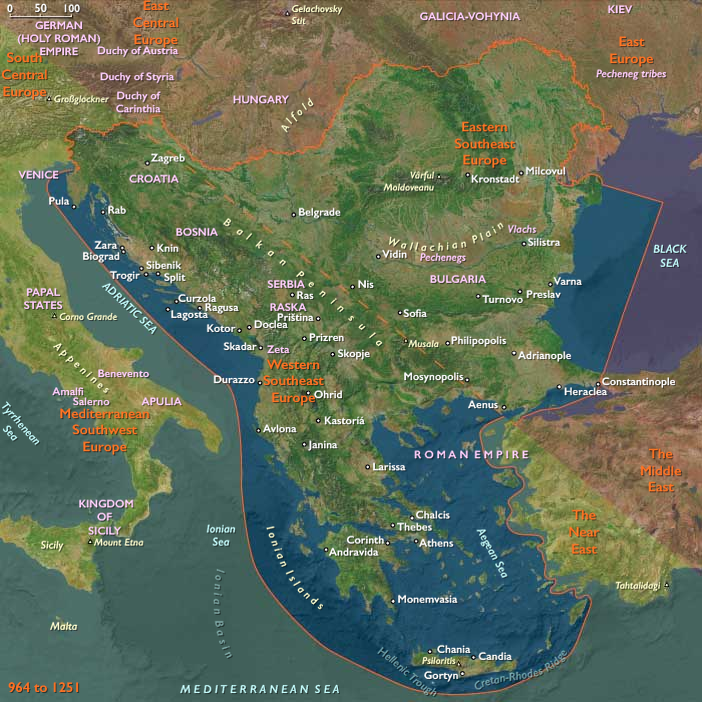
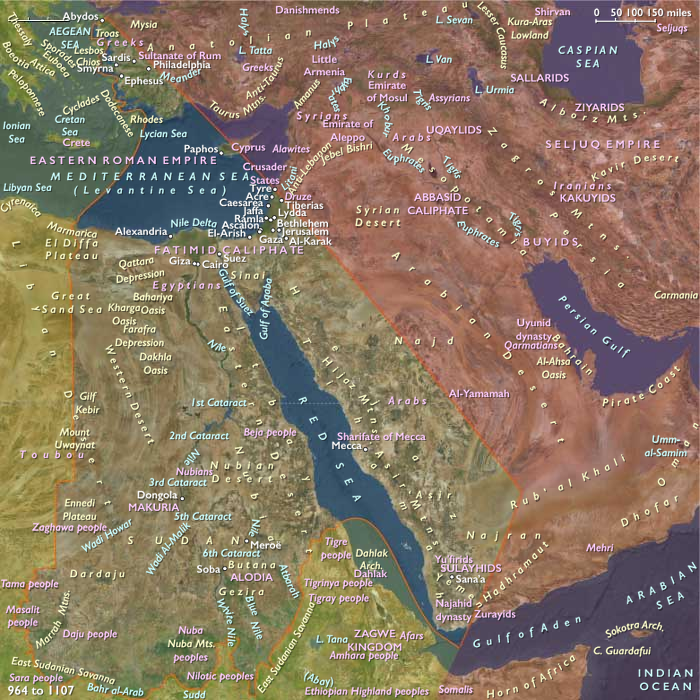
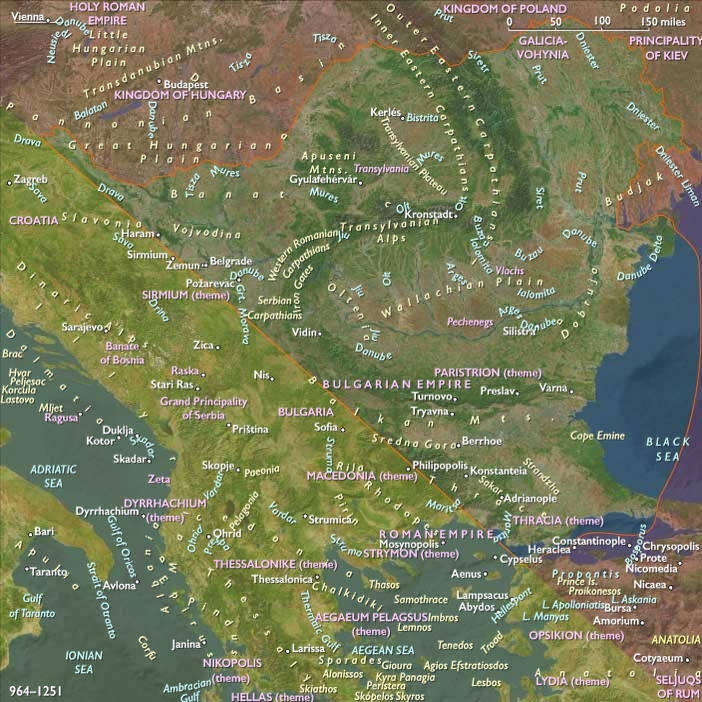
The East Roman Empire must redraw its borders at the Bosporus after the disastrous Battle of Manzikert.
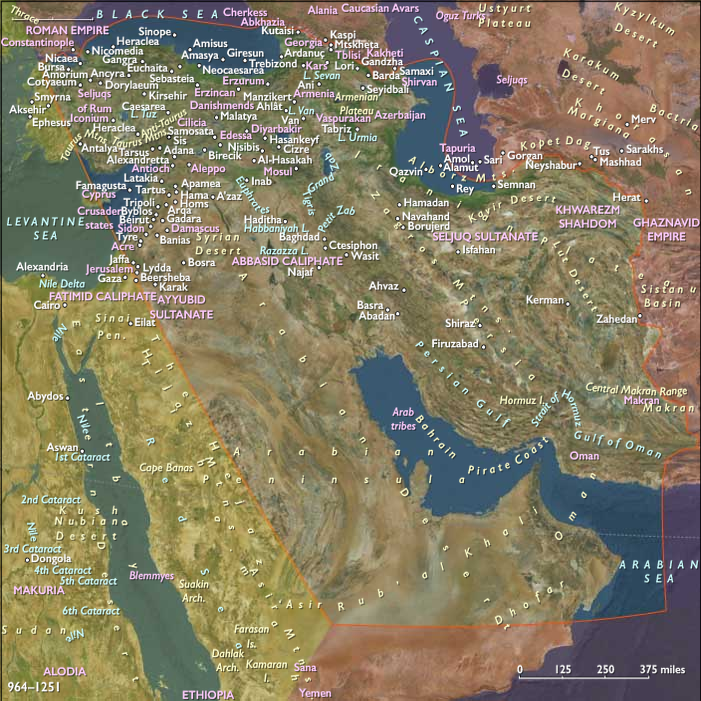
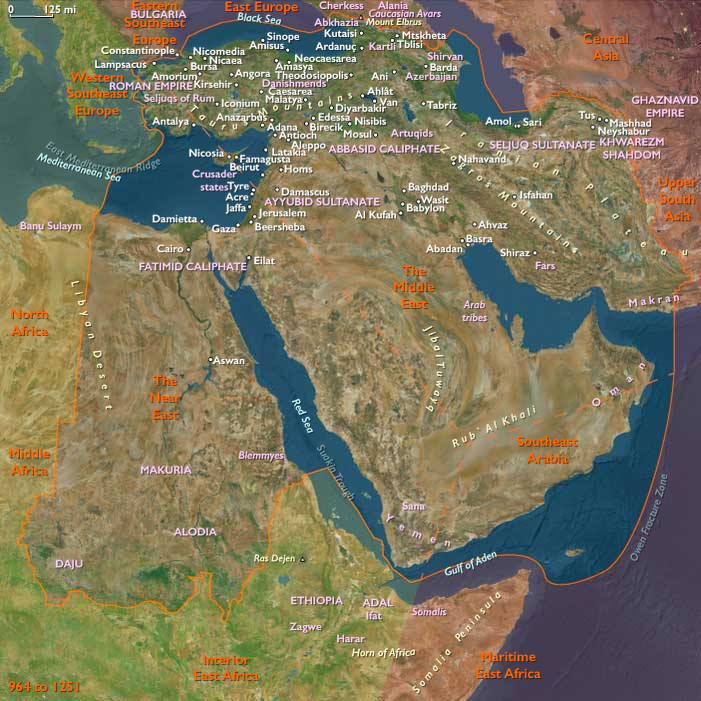
The Empire, its eastern boundary now synonymous with the Ionian coast of Classical Greece, has lost almost the whole of Asia Minor to the Seljuq Sultanate.
Alp Arslan's victories have changed the balance in near Asia completely in favor of the Seljuq Turks and Sunni Muslims.
The victory at Manzikert in 1071 signals the beginning of Turkish ascendancy in Anatolia, although the Eastern Roman Empire will continue for nearly four more centuries, and the Crusades will contest the issue for some time.
Most historians, including Edward Gibbon, date the defeat at Manzikert as the beginning of the end of the Eastern Roman Empire.
Certainly the entry of Turkic farmers following their horsemen ends the themes in Anatolia that had furnished the Empire with men and treasure.
Many in the East Roman Empire do not see this Seljuq victory as a total disaster, and when the Turks begin occupying the countryside in Anatolia, they begin to garrison the imperial cities as well, not as foreign conquerors but as mercenaries requested by various Greek factions—one Emperor, in 1078, even gives the defense of the city of Nicaea to the invading Turks.
The decline of the embattled Empire is not yet irretrievable.
The shrinking of its boundaries has reduced the empire from its status as a dominating world power to that of a small Greek state fighting for survival.
That survival now depends on the new political, commercial, and ecclesiastical forces in the West, for it can no longer draw on its former military and economic resources in Anatolia.
With the rise of Alexios I Komnenos to power in 1081, imperial stability is restored by an ensured succession in the Komnenos family, who will rule for more than one hundred years, from 1081 to 1185.
People
Groups
- Oghuz Turks
- Islam
- Muslims, Sunni
- Turkmen people
- Seljuq Empire (Isfahan)
- Christians, Eastern Orthodox
- Roman Empire, Eastern: Doukid dynasty
- Roman Empire, Eastern: Komnenos dynasty, restored
Topics
Commodoties
Subjects
Regions
Subregions
Related Events
Filter results
Showing 10 events out of 11 total
William I’s 1073 Campaign in Maine and the Changing Balance of Power in Northern France
With his conquest of England largely complete, William I ("the Conqueror") turned his focus back to continental affairs, returning to Normandy in early 1073 to confront Fulk IV ("le Réchin"), Count of Anjou, who had invaded Maine. In a swift and decisive campaign, William reclaimed Le Mans by March 30, 1073, securing his dominance in northern France. However, opposition to Norman power remained, as the new Count of Flanders, Robert I ("the Frisian"), took in Edgar the Ætheling, while also forging an alliance with King Philip I of France.
The 1073 Campaign: William's Reconquest of Maine
- Fulk IV of Anjou, having taken advantage of William’s absence in England, invaded Maine, a region that William had subjugated in 1063–1064.
- William, always conscious of the strategic importance of Maine, launched a swift counteroffensive, returning to Normandy in early 1073.
- His forces moved quickly, retaking Le Mans by March 30, 1073, forcing Fulk to withdraw.
- This victory restored Norman control over Maine, strengthening William’s influence in northern France and keeping Anjou in check.
Growing Anti-Norman Resistance: Flanders and France
Even as William’s power in Normandy and Maine was secured, new threats emerged on the continent:
-
Robert I of Flanders and Edgar the Ætheling
- Robert I ("the Frisian"), Count of Flanders, took in Edgar the Ætheling, the last surviving heir of the Anglo-Saxon royal house, offering him protection and support.
- This move signaled Robert’s hostility toward Norman rule in England, as Edgar had previously led failed rebellions against William.
-
The Flemish-Capetian Alliance: Bertha’s Marriage to Philip I
- Robert I strengthened his ties with King Philip I of France by marrying his half-sister, Bertha, to Philip.
- This union aligned Flanders with the Capetian monarchy, creating a new anti-Norman alliance in northern France.
- Philip I had long been opposed to Norman expansion, and this marriage further cemented his resistance to William’s continental ambitions.
Impact and Consequences
- William’s victory in Maine secured his power in northern France, reinforcing his territorial dominance over Anjou.
- However, new alliances against him—particularly between Flanders and France—posed fresh challenges to Norman authority.
- Edgar the Ætheling’s presence in Flanders meant that William still had to contend with potential threats to his rule in England, as exiled Anglo-Saxon nobles sought support for rebellion.
While William’s swift reconquest of Maine in 1073 strengthened his continental holdings, the emerging anti-Norman coalition between Flanders and France meant that William could not ignore European affairs, even as he worked to consolidate control over his English kingdom.
Elias I Becomes Count of Maine and Resumes War with Normandy (1092)
In 1092, Elias I of Maine succeeded his cousin Hugh V, after the latter sold the county to him for ten thousand shillings. With the backing of Fulk IV of Anjou, Elias continued the long-standing war with Robert Curthose, Duke of Normandy, resisting Norman efforts to reassert control over Maine.
The Sale of Maine to Elias I (1092)
- Hugh V of Maine, unable to hold onto his county, chose to sell Maine rather than continue his struggle against Normandy.
- Elias I of Maine, a relative of Hugh, purchased the county for ten thousand shillings, securing legitimate rule over Maine.
- Normandy had previously controlled Maine (under William the Conqueror), but the county had always been unstable and contested.
Support from Anjou and War with Normandy
- Elias immediately sought the support of Fulk IV of Anjou, who had long opposed Norman expansion.
- With Angevin backing, Elias resumed hostilities against Duke Robert Curthose, who was struggling to maintain control over Normandy itself.
- This marked another phase in the ongoing conflict between Anjou, Maine, and Normandy, a rivalry that had persisted for decades.
Consequences and Strategic Importance
- The sale of Maine to Elias I ended Hugh V’s ineffective rule and gave the county a more capable leader.
- Elias’ war against Normandy weakened Robert Curthose, whose control over his duchy was already fragile.
- The continued Angevin support for Maine set the stage for further conflicts between Anjou and Normandy, shaping the political landscape of northwestern France for decades.
By 1092, Elias I had secured legitimate rule over Maine and, with Angevin support, continued to resist Norman domination, keeping Robert Curthose embroiled in yet another struggle for control of his lands.
he Anglo-Norman Succession Crisis and William Rufus’ Wars in Normandy and Maine (1088–1099)
The division of William the Conqueror’s lands between his sons William Rufus (England) and Robert Curthose (Normandy) created a dilemma for the Anglo-Norman nobility, many of whom held land on both sides of the English Channel. With the two brothers as natural rivals, these nobles feared being forced to choose between them, potentially losing favor, lands, or influence in one realm or the other.
The solution, as many saw it, was to reunite England and Normandy under a single ruler, a goal that would drive rebellions, wars, and shifting alliances throughout the late 11th and early 12th centuries.
The 1088 Rebellion: A Noble Uprising in Favor of Robert Curthose
- In 1088, Bishop Odo of Bayeux, the powerful half-brother of William the Conqueror, led a noble rebellion against William Rufus in favor of Robert Curthose.
- Many Anglo-Norman nobles, preferring a weaker ruler in Robert, sought to unite England and Normandy under his rule.
- However, Robert failed to appear in England to lead the revolt, causing wavering support among the rebels.
- William Rufus secured victory by offering silver and promises of better governance, winning over key English nobles and knights.
- With the rebellion crushed, William solidified his control over England, strengthening his ability to challenge Robert in Normandy.
The 1091 Invasion of Normandy and Treaty with Robert
- With England secure, William Rufus invaded Normandy in 1091, decisively defeating Robert’s forces.
- Robert was forced to cede territory to William, further weakening his control over the duchy.
- Despite this, the two brothers reconciled, agreeing to support each other in reclaiming lost territories—especially Maine, which had fallen out of Norman hands.
- The plan to recover Maine was ultimately abandoned, but William continued his aggressive defense of Normandy and his French interests.
The 1099 War for Maine and William Rufus’ Final Campaign
- In 1099, Elias de la Flèche, Count of Maine, sought to retake Le Mans, a vital city lost to Norman rule.
- William Rufus, determined to defend his possessions, responded with fierce military action, reaffirming Norman control in the region.
- His relentless campaigning demonstrated his commitment to maintaining dominance over Normandy and Maine, even as his reign approached its final year.
Legacy and Consequences
- The conflict between William Rufus and Robert Curthose foreshadowed later struggles for control over England and Normandy, particularly after William’s death in 1100.
- The unresolved division of William the Conqueror’s lands ensured continued wars and rivalries, culminating in Henry I’s eventual seizure of Normandy in 1106.
- William’s military campaigns in Normandy and Maine reinforced the importance of the Anglo-Norman realm, influencing continental politics for decades to come.
Though William Rufus never succeeded in fully uniting England and Normandy, his aggressive campaigns, political maneuvering, and relentless defense of Norman lands made him one of the most formidable rulers of his time.
Fulk V of Anjou Switches Sides: A Turning Point for Henry I (May 1119 CE)
By May 1119, King Henry I of England successfully turned the tide of the war in Normandy by enticing Fulk V of Anjou to abandon the Capetian alliance and support the Anglo-Norman cause. This diplomatic maneuver significantly weakened the anti-Norman coalition, allowing Henry to consolidate his hold over Maine and focus on crushing his remaining enemies.
The Betrothal of William Adelin and Matilda of Anjou
- To secure Fulk's loyalty, Henry finally agreed to the long-negotiated betrothal of his son and heir, William Adelin, to Fulk’s daughter, Matilda.
- In addition to the marriage alliance, Henry paid Fulk a large sum of money, effectively buying Anjou’s neutrality.
- With this agreement, Fulk V abandoned his support for King Louis VI of France and ceased hostilities with Henry, weakening the Capetian side of the war.
Fulk Departs for the Levant, Leaving Maine Under Henry’s Control
- Following the agreement, Fulk left for the Levant, where he would eventually become King of Jerusalem (1131).
- With Fulk’s departure, the County of Maine fell into Henry’s hands, further solidifying Anglo-Norman control over the region.
Strategic Consequences
- Henry no longer faced threats from Anjou, allowing him to redirect his military efforts against the remaining rebel barons and Capetian-backed forces.
- With Maine under his control, Henry strengthened the Norman frontier, creating a buffer zone against future incursions from France.
- The anti-Norman alliance began to fracture, shifting momentum in Henry’s favor and paving the way for his decisive victory at Brémule later in 1119.
The Anglo-Angevin marriage alliance between William Adelin and Matilda was a crucial political victory for Henry I, securing Normandy’s stability and eliminating one of his most dangerous rivals in the ongoing war with Louis VI of France.
Henry I’s Campaign in Northwestern France and the Angevin Marriage Alliance (1123–1128 CE)
By 1123, King Henry I of England had launched a military campaign into northwestern France to secure control over Maine, a strategically vital region on the Norman-Angevin frontier. Despite previous diplomatic efforts to stabilize relations with Anjou, Henry faced continued opposition from Fulk V, Count of Anjou, who contested English dominance in the region.
The Unstable Angevin-English Marriage Alliances
Henry I had initially sought to cement peace with Anjou through a dynastic marriage:
- He arranged for his only legitimate son, William Adelin, to marry Fulk’s daughter, Matilda of Anjou.
- However, after William's death in the White Ship disaster in 1120, the planned alliance fell apart.
- To salvage relations, Henry negotiated a new marriage alliance, this time between his daughter Matilda(widow of the Holy Roman Emperor Henry V) and Fulk’s eldest son, Geoffrey Plantagenet.
The marriage was agreed upon despite:
- The ongoing war of attrition between Henry and Fulk over Maine.
- The significant age difference between Matilda (born in 1102) and Geoffrey (born in 1113).
- Matilda’s pride in her imperial title, which made her resentful of being married to a mere count, a status she considered beneath her dignity.
The Marriage of Matilda and Geoffrey Plantagenet (1128 CE)
Despite the ongoing conflict, the marriage finally took place in 1128, designed to:
- Reinforce Norman control over Maine by tying Anjou to Henry’s dynasty.
- Establish Geoffrey as a future ruler of both Anjou and Maine, securing a buffer against Capetian expansion.
- Strengthen Angevin claims in Normandy, which would later become crucial in the Anglo-French wars of the 12th century.
However, the war between Henry and Fulk V did not immediately end. Instead, it continued as a war of attrition, with both sides launching sporadic raids and sieges but failing to achieve a decisive victory.
Long-Term Consequences
- The marriage between Matilda and Geoffrey Plantagenet laid the foundation for the Plantagenet dynasty, which would dominate England and large parts of France for the next three centuries.
- Matilda’s unyielding personality and sense of imperial status complicated her relationship with Geoffrey, leading to power struggles in their marriage.
- Following Henry I’s death in 1135, Matilda’s claim to the English throne would spark a brutal civil war against Stephen of Blois, a period known as The Anarchy (1135–1153).
- The ultimate result of this union was the birth of Henry II, the first Plantagenet King of England, whose rule would profoundly reshape Anglo-French politics.
Although designed to bring peace, the marriage of Matilda and Geoffrey instead deepened the tensions between Normandy, Anjou, and England, ensuring that conflict would persist for years to come.
The Final Years and Death of Geoffrey Plantagenet, Count of Anjou (1145–1151 CE)
By 1151, Geoffrey Plantagenet, Count of Anjou, Duke of Normandy, and father of the future Henry II of England, had spent years consolidating his rule over Anjou, Maine, and Normandy, while dealing with baronial revolts and internal family conflicts. His reign had been marked by relentless warfare, strategic diplomacy, and an ambitious vision for the Plantagenet dynasty.
The Third Baronial Rebellion in Anjou (1145–1151)
- Between 1145 and 1151, Geoffrey faced his third major baronial rebellion in Anjou, a region known for its fractious nobility.
- The rebellion, likely fueled by resentment toward Geoffrey’s strong-handed rule and his expansion into Normandy, was a major distraction that slowed his efforts to strengthen his control over his territories.
- Geoffrey also had longstanding tensions with his younger brother, Elias, whom he imprisoned until 1151, further complicating his rule.
- The ongoing unrest in Anjou prevented Geoffrey from turning his attention to England, where his wife, Empress Matilda, was still struggling against King Stephen for the English crown.
Geoffrey’s Sudden Death (September 7, 1151)
- According to the chronicler John of Marmoutier, Geoffrey was returning from a royal council when he fell ill with a fever.
- He reached Château-du-Loir, where he collapsed on a couch, realizing that his condition was fatal.
- Before dying, Geoffrey made bequests of gifts and charities, ensuring that his religious and political obligations were fulfilled.
- He died suddenly on September 7, 1151, at the age of thirty-eight.
Burial and Legacy
- Geoffrey was buried at St. Julien’s Cathedral in Le Mans, the traditional burial site of the Counts of Anjou.
- His death marked a turning point in the struggles for Angevin power:
- His son, Henry Plantagenet (later Henry II of England), inherited Normandy, Anjou, and Maine, consolidating the foundation for the Angevin Empire.
- Henry soon crossed into England, where he would eventually claim the throne, beginning the Plantagenet dynasty’s rule over England.
Though Geoffrey never ruled England, his military conquests, political strategies, and territorial consolidations laid the groundwork for his son, Henry II, to create one of the largest realms in Western Europe—the Angevin Empire.
Attempts to Promote the Sainthood of Henry the Young King and His Funeral Procession (1183 CE)
Following the death of Henry the Young King on June 11, 1183, his mother, Eleanor of Aquitaine, and a faction of his friends attempted to promote his sainthood, portraying him as a penitent prince cut down in his youth. Despite his rebellion against his father, Henry II, they emphasized his acts of repentance, including his prostration before the crucifix and his request for his crusader’s cloak to be taken to the Holy Sepulchre.
A notable advocate for Henry’s sanctity was Thomas of Earley, Archdeacon of Wells, who soon after Henry’s death published a sermon describing miraculous events that supposedly occurred during the transport of his body to Normandy.
The Funeral Procession and Miraculous Accounts
Henry had left specific burial instructions:
- His entrails and other body parts were to be buried at the Abbey of Charroux.
- The rest of his body was to be laid to rest in Rouen Cathedral, the capital of Normandy.
However, his funeral did not proceed smoothly.
Difficulties During the Procession
- His mercenary captains seized a member of his household, demanding payment for debts the late prince had owed them.
- The knights accompanying his corpse were so impoverished that they had to rely on charity for food at the monastery of Vigeois.
- Wherever the procession stopped, large and emotional gatherings formed, demonstrating the people’s deep reaction to Henry’s death.
Burial at Le Mans Instead of Rouen
- Upon reaching Le Mans, the local bishop halted the procession and ordered Henry’s body buried in Le Mans Cathedral.
- This was likely a political decision, as Henry’s death had caused civil unrest, and keeping his remains in Le Mans may have been an attempt to defuse tensions in the region.
Legacy and Abandoned Efforts at Canonization
- Despite attempts to promote Henry as a saint, his reputation as a rebellious son and failed ruler prevented his canonization.
- Nevertheless, his funeral procession and reported miracles fueled legends about his piety in death, reinforcing his tragic image as a young king who never ruled.
Henry the Young King’s tumultuous life was mirrored in his death, as unpaid debts, political unrest, and miraculous tales ensured that his legacy was contested even in burial.
Richard and Philip II’s Final Campaign Against Henry II (1189 CE)
By 1189, the conflict between Henry II of England and his son Richard, Duke of Aquitaine, had reached its breaking point. After years of tensions and betrayals, Richard openly joined forces with Philip II of France, launching a final campaign to bring his father to submission.
The Franco-Scottish Army Prepares for Battle: The Campaign Leading to Verneuil (August 1424)
By August 1424, the newly reinforced Franco-Scottish army was ready to take action against the English forces of John of Lancaster, Duke of Bedford. Their initial objective was to relieve the castle of Ivry, near Le Mans, which was under siege by the English. However, before they could arrive, Ivry surrendered, forcing the allied commanders to reconsider their strategy.
I. The Franco-Scottish Army Marches to Relieve Ivry
- The army was led by:
- Archibald Douglas, Earl of Douglas (now Duke of Touraine).
- John Stewart, Earl of Buchan.
- They left Tours on August 4, 1424, aiming to join forces with French commanders:
- John, Duke of Alençon.
- The Viscounts of Narbonne and Aumale.
However, before they could reach Ivry, the castle surrendered to the English, creating uncertainty over their next move.
II. The War Council: A Divided Strategy
- The allied commanders held a council of war, debating their next course of action:
- The Scots and younger French officers were eager to engage the English in battle, hoping for another decisive victory like Baugé (1421).
- The senior French nobility, led by Narbonne, remained cautious, recalling the disastrous French defeat at Agincourt (1415) and fearing another catastrophe.
- As a compromise, the allied leaders decided to target English-held fortresses along the Norman border, instead of directly confronting Bedford’s main army.
III. The Decision to Attack Verneuil
- The first target chosen was Verneuil, a key stronghold in western Normandy.
- The attack on Verneuil was intended to:
- Disrupt English control over Normandy.
- Draw Bedford’s army into a battle on favorable terms for the Franco-Scottish forces.
- This decision would lead directly to the Battle of Verneuil (August 17, 1424), a brutal confrontation that would prove to be one of the most decisive battles of the Hundred Years’ War.
IV. Consequences and the Path to Verneuil
- The decision to march on Verneuil set the stage for one of the bloodiest battles in the conflict, where the fate of the Scottish forces in France would be decided.
- The Franco-Scottish army, emboldened by previous victories, was determined to challenge English supremacy in northern France.
The march to relieve Ivry in August 1424 ended in failure, but the shift to attacking Verneuil led directly to one of the most significant battles of the war, where both Scotland and France would face their greatest test against the English under Bedford.
Death of Charles of Maine and the Angevin Legacy in France and Italy (1481)
Charles IV of Anjou, son of the Angevin prince Charles of Le Maine, inherited his father’s significant territories—including the counties of Maine, Guise, Mortain, and Gien—in 1472. Through his marriage in 1474 to Joan of Lorraine, daughter of Frederick II of Vaudémont, Charles reinforced ties between Angevin and Lorrainian interests, highlighting the interwoven dynastic politics characteristic of late medieval France.
Dynastic Ambitions and Angevin Legacy
In 1480, upon the death of his uncle, René of Anjou, Charles inherited additional territories, becoming the Duke of Anjou and Provence, as well as inheriting René’s symbolic title, Duke of Calabria, signifying Angevin claims to the Kingdom of Naples. These inherited claims placed Charles prominently within the complex power struggles over southern Italy, where Angevin ambitions had historically competed against Aragonese interests.
Testamentary Decision and Succession
Upon his death on December 10, 1481, Charles dramatically altered the geopolitical landscape through his testamentary decision to will his considerable territories—including the strategically important Duchy of Provence—to his royal cousin, Louis XI of France. This decision was historically pivotal: it decisively transferred Angevin territorial and dynastic ambitions into the French royal line, bringing Provence firmly within royal French control.
Geopolitical and Strategic Implications
Charles’s testament significantly expanded French royal power, providing Louis XI and his successors with a strategic and territorial foothold in southern France and enabling ambitious interventions in the politics of the Italian peninsula. The French monarchy thus acquired an enduring claim to Naples and Italian affairs, catalyzing future Italian military expeditions—most notably Charles VIII’s Italian campaign (1494–1498)—thereby transforming France’s international ambitions and shaping the future direction of European diplomacy.
Economic and Cultural Consequences
The inheritance of Provence and other Angevin territories not only augmented the French crown territorially but also enriched it culturally and economically. Provence, in particular, brought substantial economic benefits through its thriving Mediterranean commerce, fostering increased cultural exchange between France and Italy, and helping introduce Italian Renaissance humanist ideals into France.
Long-Term Historical Significance
Charles’s death in 1481 and his decision to transfer his inheritance directly to the French crown represented a turning point in European geopolitical history. This testament set the stage for the subsequent French invasions of Italy under Charles VIII in 1494, beginning a half-century of French involvement in Italy, profoundly shaping European power dynamics. Thus, the inheritance of Charles of Maine decisively impacted French territorial ambition, royal centralization, and the future cultural trajectory of France, placing it at the heart of European politics in the decades to come.
Years: 1072 - 1083
People
Groups
- Oghuz Turks
- Islam
- Muslims, Sunni
- Turkmen people
- Seljuq Empire (Isfahan)
- Christians, Eastern Orthodox
- Roman Empire, Eastern: Doukid dynasty
- Roman Empire, Eastern: Komnenos dynasty, restored