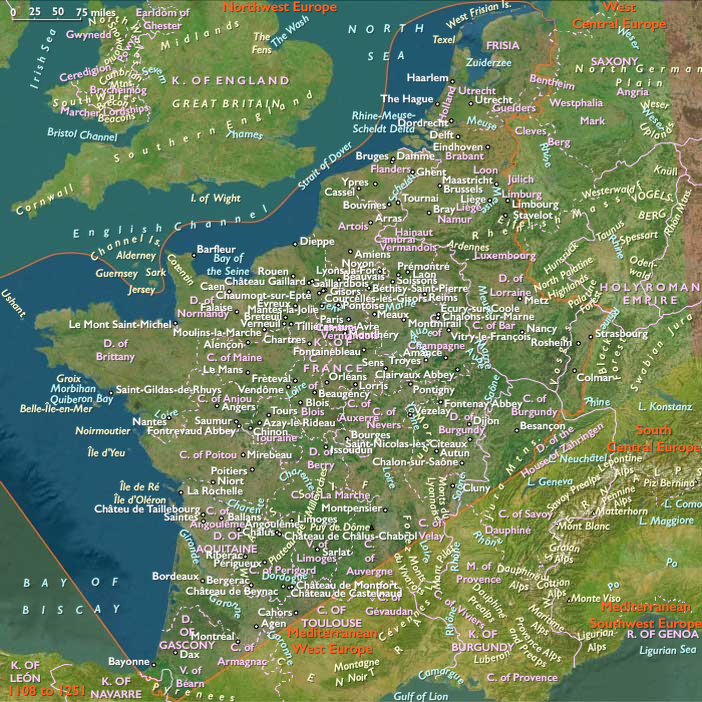
Henry I’s Campaign in Northwestern France and…
June 1128 CE
Henry I’s Campaign in Northwestern France and the Angevin Marriage Alliance (1123–1128 CE)
By 1123, King Henry I of England had launched a military campaign into northwestern France to secure control over Maine, a strategically vital region on the Norman-Angevin frontier. Despite previous diplomatic efforts to stabilize relations with Anjou, Henry faced continued opposition from Fulk V, Count of Anjou, who contested English dominance in the region.
The Unstable Angevin-English Marriage Alliances
Henry I had initially sought to cement peace with Anjou through a dynastic marriage:
- He arranged for his only legitimate son, William Adelin, to marry Fulk’s daughter, Matilda of Anjou.
- However, after William's death in the White Ship disaster in 1120, the planned alliance fell apart.
- To salvage relations, Henry negotiated a new marriage alliance, this time between his daughter Matilda(widow of the Holy Roman Emperor Henry V) and Fulk’s eldest son, Geoffrey Plantagenet.
The marriage was agreed upon despite:
- The ongoing war of attrition between Henry and Fulk over Maine.
- The significant age difference between Matilda (born in 1102) and Geoffrey (born in 1113).
- Matilda’s pride in her imperial title, which made her resentful of being married to a mere count, a status she considered beneath her dignity.
The Marriage of Matilda and Geoffrey Plantagenet (1128 CE)
Despite the ongoing conflict, the marriage finally took place in 1128, designed to:
- Reinforce Norman control over Maine by tying Anjou to Henry’s dynasty.
- Establish Geoffrey as a future ruler of both Anjou and Maine, securing a buffer against Capetian expansion.
- Strengthen Angevin claims in Normandy, which would later become crucial in the Anglo-French wars of the 12th century.
However, the war between Henry and Fulk V did not immediately end. Instead, it continued as a war of attrition, with both sides launching sporadic raids and sieges but failing to achieve a decisive victory.
Long-Term Consequences
- The marriage between Matilda and Geoffrey Plantagenet laid the foundation for the Plantagenet dynasty, which would dominate England and large parts of France for the next three centuries.
- Matilda’s unyielding personality and sense of imperial status complicated her relationship with Geoffrey, leading to power struggles in their marriage.
- Following Henry I’s death in 1135, Matilda’s claim to the English throne would spark a brutal civil war against Stephen of Blois, a period known as The Anarchy (1135–1153).
- The ultimate result of this union was the birth of Henry II, the first Plantagenet King of England, whose rule would profoundly reshape Anglo-French politics.
Although designed to bring peace, the marriage of Matilda and Geoffrey instead deepened the tensions between Normandy, Anjou, and England, ensuring that conflict would persist for years to come.
Locations
Groups
Commodities
Subjects
Regions
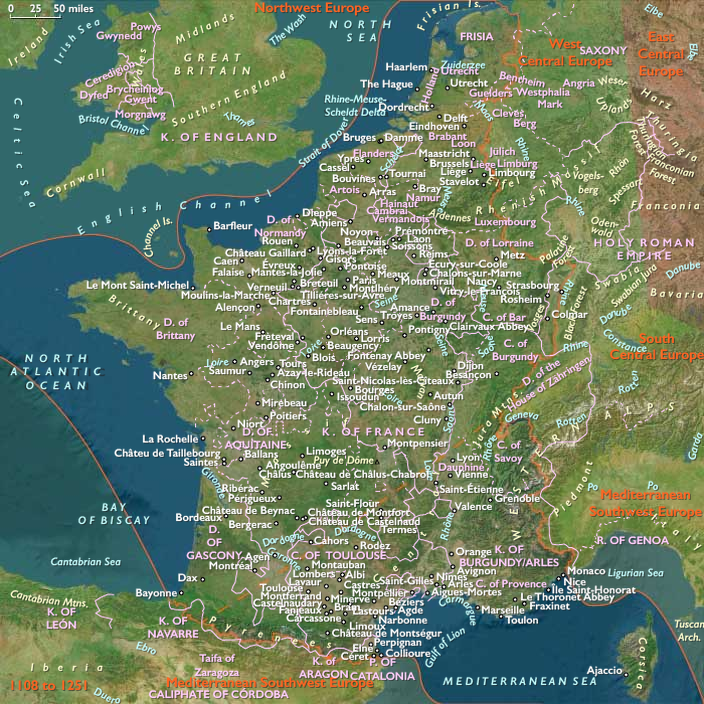
West Europe
View →Subregions