Tyre not only attains an independent position …
Years: 1197BCE - 1054BCE
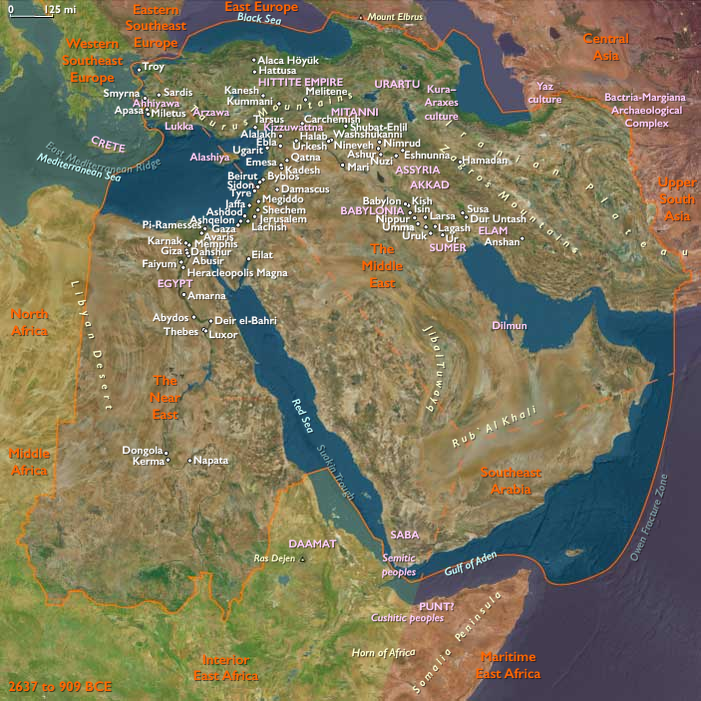
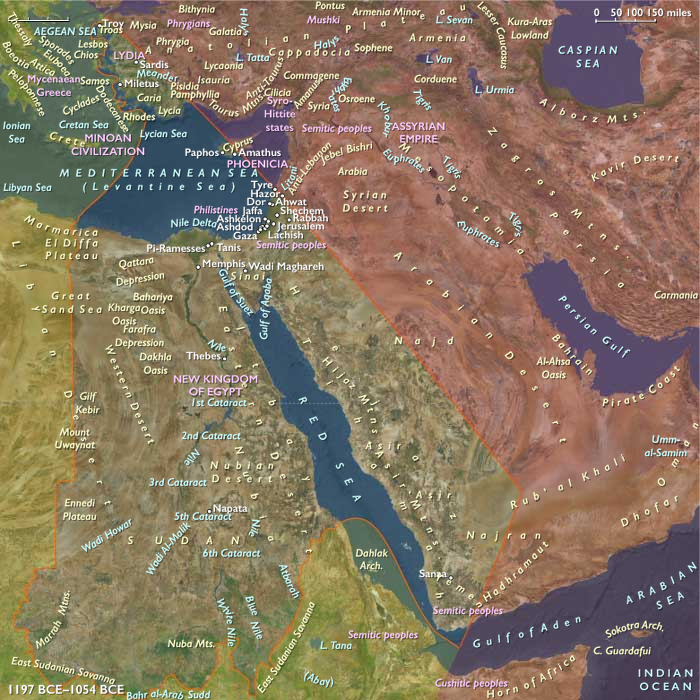
Tyre not only attains an independent position but also apparently dominates Sidon following the disruption of Egypt and other Near Eastern powers in the age of the Sea Peoples.
Locations
Groups
- Canaanite culture, ancient
- Mycenaean Greece
- Egypt (Ancient), New Kingdom of
- Phoenicians
- Tyre, Kingdom of (Phoenicia)
- Philistines
- Hebrews
- Egypt (Ancient), Third Intermediate Period of
Topics
- Younger Subboreal Period
- Sea Peoples, Movements of the
- Greek Dark Ages
- Iron Age, Near and Middle East
Commodoties
Subjects
Regions
Subregions
Related Events
Filter results
Showing 10 events out of 32 total
Near East (909 BCE – 819 CE) Early Iron and Antiquity — Greeks of Ionia, Levantine Tyre, Roman–Byzantine Egypt, Arabia’s Caravans
Geographic and Environmental Context
The Near East includes Egypt, Sudan, Israel, most of Jordan, western Saudi Arabia, western Yemen, southwestern Cyprus, and western Turkey (Aeolis, Ionia, Doris, Lydia, Caria, Lycia, Troas) plus Tyre (extreme SW Lebanon).-
Anchors: the Nile Valley and Delta; Sinai–Negev–Arabah; the southern Levant (with Tyre as the sole Levantine node in this subregion); Hejaz–Asir–Tihāma on the Red Sea; Yemen’s western uplands/coast; southwestern Cyprus; western Anatolian littoral (Smyrna–Ephesus–Miletus–Halicarnassus–Xanthos; Troad).
Climate & Environment
-
Nile’s late antique variability; Aegean storms seasonal; Arabian aridity persistent but terraces/cisterns mitigated.
Societies & Political Developments
-
Western Anatolia Greek city-states (Ionia–Aeolia–Doria, with Troad): Miletus, Ephesus, Smyrna, etc.
-
Tyre (sole Near-Eastern Levantine node here) dominated Phoenician seafaring.
-
Egypt (Ptolemaic → Roman → Byzantine): Nile granary and Christianizing hub.
-
Arabian west: caravan kingdoms and Hejaz–Asir oases; western Yemen incense terraces and caravan polities.
-
Southwestern Cyprus embedded in Hellenistic–Roman maritime circuits.
Economy & Trade
-
Grain–papyrus–linen from the Nile; olive–wine Aegean; incense–myrrh from Yemen; Red Sea lanes linked to Aden–Berenike nodes (outside core but connected).
-
Tyre exported craft goods and purple dye.
Technology & Material Culture
-
Iron agriculture and tools; triremes and merchant galleys; advanced terracing, cisterns; lighthouse/harbor works.
Belief & Symbolism
-
Egyptian polytheism → Christianity (Alexandria); Greek civic cults; Tyrian traditions; Arabian deities; monasticism along Nile/Desert.
Adaptation & Resilience
-
Canal maintenance buffered Nile shocks; terraces/cisterns stabilized Arabian farming; Aegean coastal redundancy protected shipping routes.
Transition
By 819 CE, the Near East was a multi-corridor world of Nile granaries, Ionia’s city-coasts, Tyre’s Phoenician legacy, and Arabian incense roads — a foundation for the medieval dynamics ahead (Ayyubids in Syria/Egypt next door, Abbasids beyond, and the Ionian–Anatolian littoral under Byzantine/Nicaean arcs).
Middle East (909 BCE – 819 CE) Early Iron and Antiquity — Urartu, Achaemenids, Parthians, Sasanian Frontiers
Geographic and Environmental Context
The Middle East includes Iraq, Iran, Syria, Armenia, Georgia, Azerbaijan, eastern Jordan, most of Turkey’s central/eastern uplands (including Cilicia), eastern Saudi Arabia, northern Oman, Qatar, Bahrain, the UAE, northeastern Cyprus, and all but the southernmost Lebanon.-
Anchors: the Tigris–Euphrates alluvium and marshes; the Zagros (Luristan, Fars), Alborz, Caucasus (Armenia–Georgia–Azerbaijan); northern Syrian plains and Cilicia; Khuzestan and Fars lowlands; the Arabian/Persian Gulf littoral (al-Ahsa–Qatar–Bahrain–UAE–northern Oman); northeastern Cyprus and the Lebanon coastal elbow (north).
Climate & Environment
-
Continental variability; oases survived by canal upkeep; Gulf fisheries stable; Caucasus snows fed headwaters.
Societies & Political Developments
-
Urartu (9th–6th c. BCE) fortified Armenian highlands;
-
Achaemenid Persia (6th–4th c. BCE) organized satrapies across Iran, Armenia, Syria uplands, Cilicia; Royal Road linked Susa–Sardis through our zone.
-
Hellenistic Seleucids, then Parthians (3rd c. BCE–3rd c. CE) and Sasanians (3rd–7th c. CE) ruled Iran–Mesopotamia; oases prospered under qanat/karez and canal regimes.
-
Transcaucasus (Armenia, Iberia/Georgia, Albania/Azerbaijan) oscillated between Iranian and Roman/Byzantine influence; northeastern Cyprus joined Hellenistic–Roman networks.
-
Arabian Gulf littoral hosted pearling/fishing and entrepôts (al-Ahsa–Qatif–Bahrain).
Economy & Trade
-
Irrigated cereals, dates, cotton, wine; transhumant pastoralism; Gulf pearls and dates.
-
Long-haul Silk Road and Royal Road flows; qanat irrigation expanded in Iran.
Technology & Material Culture
-
Iron plowshares, tools, and weapons; fortifications; qanat engineering; road stations (caravanserais earlier variants).
-
Arts: Urartian bronzes; Achaemenid stonework; Sasanian silver; Armenian and Georgian ecclesiastical arts (late).
Belief & Symbolism
-
Zoroastrianism, Armenian/Georgian Christianity, local cults; Jewish and early Christian communities in oases/ports; syncretism in frontier cities.
Adaptation & Resilience
-
Canal/qanat redundancy, pasture–oasis integration, distributed entrepôts (northeastern Cyprus, Gulf) hedged war and drought.
Transition
By 819 CE, the Middle East was a layered highland–oasis–Gulf system under Sasanian–Byzantine frontiers giving way to Islamic polities.
Armenia, after contact with centers of early Christianity at Antioch and Edessa, accepts Christianity as its state religion in 306 (the traditional date—the actual date may have been as late as 314), following miracles said to have been performed by Saint Gregory the Illuminator, son of a Parthian nobleman.
Thus Armenians claim that Tiridates III (238- 314) was the first ruler to officially Christianize his people, his conversion predating the conventional date (312) of Constantine the Great's legalization of Christianity on behalf of the Roman Empire.
The Middle East: 376–387 CE
Imperial Struggles and Renewed Roman–Sassanid Tensions
The period 376 to 387 CE witnesses renewed geopolitical tensions and strategic realignments in the Middle East, marking another chapter in the enduring rivalry between the Roman Empire and the Sassanid Persians. While previously established diplomatic accords between Emperor Valens and King Shapur II had provided a temporary respite, the late fourth century again sees escalating friction as both powers seek to extend influence and consolidate control over contested territories, notably Armenia and Mesopotamia.
The death of Shapur II in 379 CE, after a long and vigorous reign, leads to a brief period of internal instability within the Persian Empire. His successors, Ardashir II (379–383 CE) and Shapur III (383–388 CE), face internal challenges, including court intrigues and regional rebellions, limiting Persia’s immediate ability to capitalize on Roman distractions elsewhere.
On the Roman side, the disastrous defeat at Adrianople in 378 CE, in which Emperor Valens is killed, diverts Roman military resources to the northern frontier to counter Gothic incursions. This crisis compels Emperor Theodosius I (379–395 CE) to seek diplomatic solutions rather than prolonged warfare with Persia. Armenia, the perennial focal point of rivalry, is once again partitioned in 387 CE through the diplomatic initiative known as the Peace of Acilisene, with Rome and Persia agreeing to divide the kingdom along a negotiated boundary. The western portion of Armenia falls under Roman influence, while Persia secures the larger, strategically significant eastern region.
Culturally, this era remains a vibrant period of religious and intellectual consolidation in the Middle East. Christianity further solidifies its presence within the Roman sphere, strengthening its ecclesiastical institutions and establishing theological foundations that significantly influence both eastern and western Christendom. Meanwhile, Persia maintains its tradition of religious pluralism, with Zoroastrianism flourishing alongside Jewish and emerging Christian communities.
The Peace of Acilisene thus represents a pivotal diplomatic achievement, temporarily stabilizing the eastern frontier. However, the division of Armenia underscores a persistent geopolitical rivalry that will continue to shape regional dynamics for centuries to come.
The compromise peace with the Persians concluded in 387 gives Rome a small section of Armenia, where the emperor founds Theodosiopolis (Erzurum)
The Persians had been forced by Diocletian to relinquish Armenia, and Tiridates III, the son of Tiridates II, had in about 287 been restored to the throne under Roman protection; his reign had determined the course of much of Armenia's subsequent history, and his conversion by St. Gregory the Illuminator and the adoption of Christianity as the state religion (c. 314) has created a permanent gulf between Armenia and Persia.
Saint Mesrop, also known as Mashtots, devises an alphabet for the Armenian language early in the fifth century CE, and religious and historical works begin to appear as part of the effort to consolidate the influence of Christianity.
For the next two centuries, political unrest will parallel the exceptional development of literary and religious life that becomes known as the first golden age of Armenia.
The Middle East: 388–399 CE
Stability and Religious Consolidation
The period from 388 to 399 CE in the Middle East is characterized primarily by a temporary stabilization of geopolitical tensions between the Roman and Sassanid Empires following the significant Peace of Acilisene in 387 CE. This agreement, which divides Armenia into distinct Roman and Persian spheres of influence, ushers in a brief phase of diplomatic calm, allowing both empires to consolidate their control and focus internally.
Armenian Division and Regional Stability
Armenia, previously a focal point of Roman–Persian rivalry, is now officially partitioned between Rome and Persia. The Roman-controlled west and the Sassanian-dominated east coexist under a pragmatic arrangement that significantly reduces regional tensions. This division helps maintain a fragile peace that will endure for some decades, stabilizing the volatile Caucasian frontier.
Expansion and Strengthening of Christianity
Christianity continues its expansive growth during this era, further solidifying its influence in regional politics and culture. Armenia, under Roman influence, remains committed to Christianity, deepening its religious and cultural ties to Byzantium. Similarly, Christianity further entrenches itself in Georgia, bolstered by the earlier conversion under King Mirian III. These Christian communities continue to develop distinctive traditions, which will profoundly shape their national identities.
Persian Religious and Cultural Consolidation
Within the Sassanid Empire, the Zoroastrian priesthood continues to hold significant influence, reinforcing the empire's internal stability through strict social and religious structures. The Persian authorities intensify their efforts to promote Zoroastrian beliefs and Persian cultural norms across their territories, particularly within the Persian Gulf region, maintaining the agricultural colonies and strategic arrangements with local tribes established previously.
Economic and Urban Prosperity
Greater Syria, under Roman governance, experiences continued economic prosperity and urban development. Important trade centers such as Damascus, Palmyra, and Busra ash Sham thrive due to well-established infrastructure and effective administrative practices. The sustained economic vitality of these cities reinforces the Roman administrative efficiency established by Emperor Constantine, with Syria continuing to serve as a crucial economic and cultural bridge between East and West.
Thus, the era from 388 to 399 CE in the Middle East represents a brief but critical interlude of geopolitical calm and internal consolidation, laying a stable foundation for the transformative developments of subsequent decades.
Armenia during the reign of Shapur III had been divided between the Roman and Persian empires according to the terms of a peace treaty, but this arrangement has barely survived his reign.
Khosrov III, the Arsacid King of Armenia under Persian suzerainty, has by about 390 grown wary of his subordination to Persia and entered into a treaty with the Roman Emperor Theodosius who in return for this allegiance had deposed Arshak III in Roman Armenia and made Khosrov the king of a united Armenia.
Enraged, Bahram IV takes Khosrov prisoner in 392 and confines him to the Castle of Oblivion, placing his brother Varahran-Shapur upon the Armenian throne.
Khosrov appeals to Theodosius for help but the latter refuses to intervene, as it would constitute a breach of the peace of 384.
The Middle East: 400–411 CE
Renewed Tensions and Religious Dynamics
The period from 400 to 411 CE sees the fragile stability achieved by the earlier Peace of Acilisene begin to erode, leading to renewed tensions between the Roman (Byzantine) and Sassanid Empires. Although no full-scale war erupts immediately, mutual suspicion and border skirmishes become increasingly frequent, especially along the contested territories of Armenia and Mesopotamia.
Armenia as a Flashpoint
The divided Armenia continues to be a significant point of friction. Roman control in the west remains relatively stable, supported by strong cultural and religious ties to Christianity, which deepen Armenia's alignment with Byzantium. Conversely, Sassanian-controlled eastern Armenia endures intensified Persian cultural and religious influence, emphasizing Zoroastrian orthodoxy and Persian administrative methods. The cultural and religious divergence between these two regions deepens, highlighting Armenia's role as a persistent geopolitical flashpoint.
Christianity's Institutional Growth
Christianity continues its robust institutional development in the Roman territories, shaping regional identities and governance structures. The influence of prominent religious figures, particularly bishops and theologians, expands considerably, consolidating Christian doctrinal authority. Churches and monasteries flourish, becoming not only centers of worship but also vital hubs for education, manuscript preservation, and social services.
Zoroastrian Orthodoxy and Persian Governance
In the Sassanian Empire, the Zoroastrian priesthood's influence grows further under state sponsorship, playing an integral role in governance and social regulation. Religious authorities closely align with the imperial administration to ensure social conformity and stability, reinforcing Persian identity throughout the empire. This period witnesses an increased emphasis on reinforcing traditional Iranian culture and Zoroastrian practices across Persian-held territories.
Economic Continuity and Urban Development
Greater Syria, despite geopolitical uncertainties, maintains considerable economic prosperity under Roman administration. Major cities such as Damascus, Palmyra, and Busra ash Sham continue to thrive, benefiting from established trade routes and robust infrastructure. These cities reinforce their roles as vibrant commercial and cultural centers, fostering continued urban growth and economic stability in the region.
Thus, the era from 400 to 411 CE is characterized by a precarious balance between escalating geopolitical tensions and vigorous religious and economic developments, setting the stage for significant future transformations in the Middle East.

The Middle East: 412–423 CE
Cultural and Religious Flourishing
Between 412 and 423 CE, the Middle East experiences vibrant cultural and religious development despite ongoing geopolitical tensions. In particular, the Jewish communities of Babylonia and Palestine significantly enrich their religious and cultural life. This period witnesses the compilation and embellishment of the Jewish Hagadah texts, which complement the ethical and theological discourses of the Talmud with lively anecdotes, legends, and illustrative stories. These texts become central to Jewish religious study, providing moral instruction and fostering cultural cohesion across dispersed Jewish communities.
Continued Roman–Sassanian Tensions
Although no major wars erupt during this era, friction between the Roman (Byzantine) and Sassanid Empirespersists, particularly along their shared border regions in Armenia and Mesopotamia. Frequent small-scale clashes and mutual provocations maintain a climate of tension, highlighting the strategic importance and ongoing volatility of these contested areas.
Religious Institutions and Authority
Within Roman-held territories, the institutional influence of Christianity continues to expand, driven by prominent bishops and theologians who further consolidate doctrinal authority and ecclesiastical power. Churches and monasteries serve as critical centers of education, manuscript preservation, and community support, strengthening Christian cultural identity across the region.
Zoroastrian Consolidation
In the Sassanian Empire, the integration of Zoroastrian orthodoxy within Persian governance structures advances significantly. The state-supported priesthood deepens its role in societal regulation and governance, reinforcing traditional Iranian identity and maintaining cultural unity throughout Persian-controlled territories.
Economic Stability and Urban Vitality
Cities such as Damascus, Palmyra, and Busra ash Sham under Roman rule continue their economic and cultural flourishing. Robust trade routes and strong infrastructure support ongoing prosperity, enabling these urban centers to sustain their significance as vibrant commercial and cultural hubs.
Thus, the years 412 to 423 CE mark an era of significant religious, cultural, and economic dynamism, even as geopolitical tensions between the major regional powers persist, shaping the future trajectory of the Middle East.
Years: 1197BCE - 1054BCE
Locations
Groups
- Canaanite culture, ancient
- Mycenaean Greece
- Egypt (Ancient), New Kingdom of
- Phoenicians
- Tyre, Kingdom of (Phoenicia)
- Philistines
- Hebrews
- Egypt (Ancient), Third Intermediate Period of
Topics
- Younger Subboreal Period
- Sea Peoples, Movements of the
- Greek Dark Ages
- Iron Age, Near and Middle East