The eighteenth century has brought Bulgaria a…
1792 CE to 1803 CE
The eighteenth century has brought Bulgaria a transition from static subservience within a great Asian empire toward intellectual and political modernization and reestablishment of cultural ties with Western Europe.
The monasteries of an increasingly independent Bulgarian church have fostered national thought and writing; Western influences have altered the nature of commerce and landholding in the Balkans; and the forcible assimilation of Bulgarian culture into a cosmopolitan Asian society has ended, allowing Bulgarian national consciousness to reawaken.
Social anarchy at the same time inhibits the liberation process.
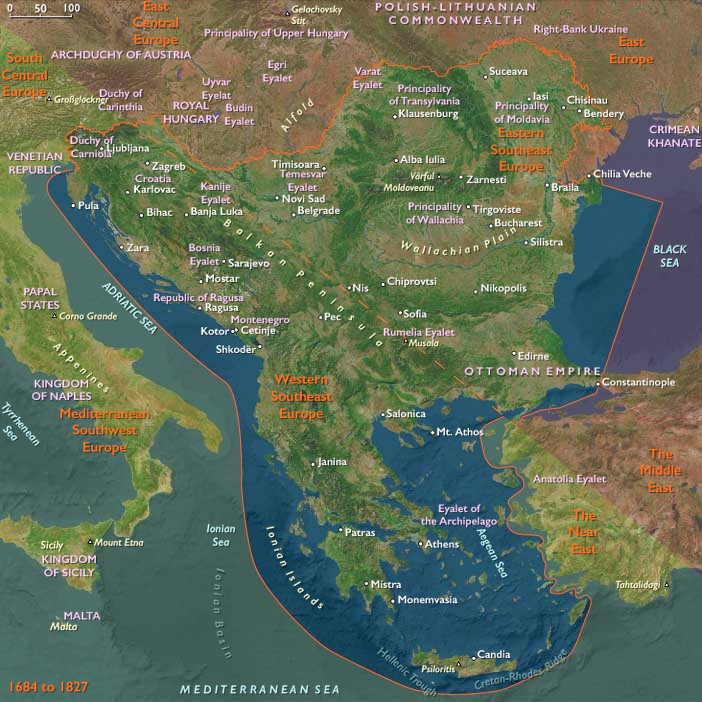
These developments set the stage for a full national revival, but the end of centralized Ottoman power over Bulgarian territory will bring several decades of anarchy, called the kurdzhaliistvo, at the end of the eighteenth century.
As at the end of the Second Bulgarian Empire four hundred years earlier, local freebooters control small areas, tyrannize the population, and fight among themselves.
The Russian-Ottoman treaties signed in 1774 and 1791, giving Russia the right to protect Christians living under Ottoman rule, had granted semiautonomy to the Romanian regions of Wallachia and Moldavia, which gives hope that Russia might provide similar help to Bulgaria during the kurdzhaliistvo.
Intellectual ties between Bulgaria and Russia will promote the adoption of Russian revolutionary thought along with Western influences.
Groups
Commodities
Subjects
Regions
Southeast Europe
View →Subregions