Fort Ticonderoga's location does not appear to…
May 1775 CE
After the 1763 Treaty of Paris, in which the French ceded their North American territories to the British, the fort was no longer on the frontier of two great empires, guarding the principal waterway between them.
The French had blown up the fort's powder magazine when they abandoned the fort, and it had fallen further into disrepair since then.
In 1775 it is garrisoned by only a small detachment of the 26th Regiment of Foot, consisting of two officers and forty-six men, with many of them "invalids" (soldiers with limited duties because of disability or illness).
Twenty-five women and children live here as well.
Because of its former significance, Fort Ticonderoga still has a high reputation as the "gateway to the continent" or the "Gibraltar of America", but in 1775 it is, according to historian Christopher Ward, "more like a backwoods village than a fort."
Even before shooting started in the American Revolutionary War, American Patriots had been concerned about Fort Ticonderoga.
The fort is a valuable asset for several reasons.
Within its walls is a collection of heavy artillery including cannons, howitzers, and mortars, armaments that the Americans have in short supply.
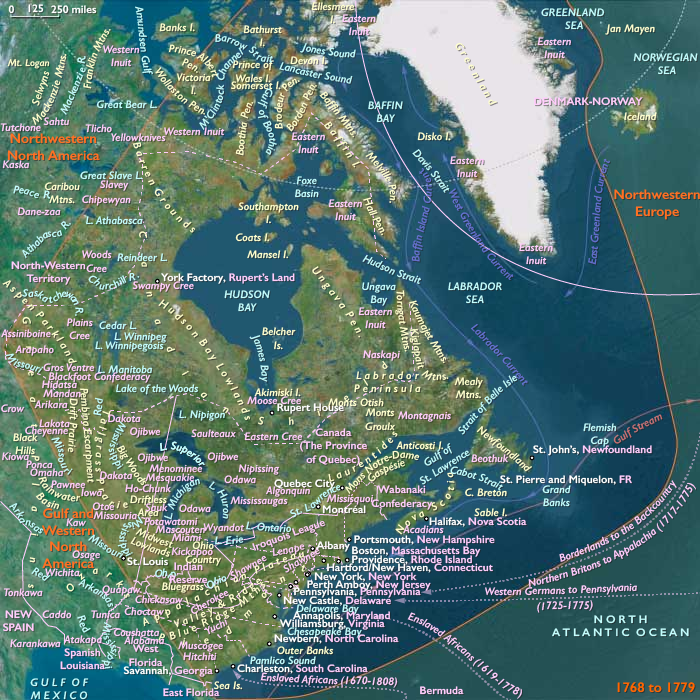
The fort is situated on the shores of Lake Champlain, a strategically important route between the Thirteen Colonies and the British-controlled northern provinces.
British forces placed here will expose the colonial forces in Boston to attack from the rear.
After the war began with the Battles of Lexington and Concord on April 19, 1775, the British General Thomas Gage realizes the fort will require fortification, and several colonists have the idea of capturing the fort.
Gage, writing from the besieged city of Boston following Lexington and Concord, instructs Quebec's governor, General Guy Carleton, to rehabilitate and refortify the forts at Ticonderoga and Crown Point.
Carleton will not receive this letter until May 19, well after the fort has been captured.
Benedict Arnold had frequently traveled through the area around the fort, and is familiar with its condition, manning, and armaments.
En route to Boston following news of the events of April 19, he mentions the fort and its condition to members of Silas Deane's militia.
The Connecticut Committee of Correspondence acts on this information; money is "borrowed" from the provincial coffers and recruiters are sent into northwestern Connecticut, western Massachusetts, and the New Hampshire Grants (now Vermont) to raise volunteers for an attack on the fort.
John Brown, an American spy from Pittsfield, Massachusetts who had carried correspondence between revolutionary committees in the Boston area and Patriot supporters in Montreal, is well aware of the fort and its strategic value.
Ethan Allen and other Patriots in the disputed New Hampshire Grants territory also recognize the fort's value, as it has played a role in the dispute over that area between New York and New Hampshire.
Whether either took or instigated action prior to the Connecticut Colony's recruitment efforts is unclear.
People
Groups
Thirteen Colonies, The
View →
Connecticut (English Crown Colony)
View →
New York, Province of (English Colony)
View →
New Hampshire, English royal Province of
View →
Massachusetts, Province of (English Crown Colony)
View →
Britain, Kingdom of Great
View →
British people
View →
Quebec (British Province)
View →
Green Mountain Boys
View →
Patriots (American Revolution)
View →
Topics
Subjects
Regions
Northern North America
View →Subregions