
Event
James Watt and Matthew Boulton form a…
James Watt and Matthew Boulton form a hugely successful partnership that will last for the next twenty-five years.
John Roebuck, the founder of the celebrated Carron Iron Works and a partner with James Watt in developing the latter's steam engine, had gone bankrupt, and Boulton, who owns the Soho Manufactory works near Birmingham, had acquired his patent rights.
An extension of the patent to 1800 is successfully obtained in 1775.
Through Boulton, Watt finally has access to some of the best iron workers in the world.
The difficulty of the manufacture of a large cylinder with a tightly fitting piston is solved by John Wilkinson, who has developed precision boring techniques for cannon making at Bersham, near Wrexham, North Wales.
Watt had tried unsuccessfully for several years to obtain accurately bored cylinders for his steam engines, and has been forced to use hammered iron, which is out of round and causei leakage past the piston.
In 1774 Wilkinson had invented a boring machine in which the shaft that holds the cutting tool extends through the cylinder and is supported on both ends, unlike the cantilevered borers currently in use.
With this machine he is able to bore the cylinder for Boulton & Watt's first commercial engine, and is given an exclusive contract for the provision of cylinders.
Until this era, advancements in drilling and boring practice had lain only within the application field of gun barrels for firearms and cannon; Wilkinson's achievement is a milestone in the gradual development of boring technology, as its fields of application broaden into engines, pumps, and other industrial uses.
-
{# Image navigates to the detail page; the magnifying-glass chip is the only Fancybox lightbox trigger (kept a separate sibling — anchors can't nest). #}
 The North Atlantic Lands
World
-
{# Image navigates to the detail page; the magnifying-glass chip is the only Fancybox lightbox trigger (kept a separate sibling — anchors can't nest). #}
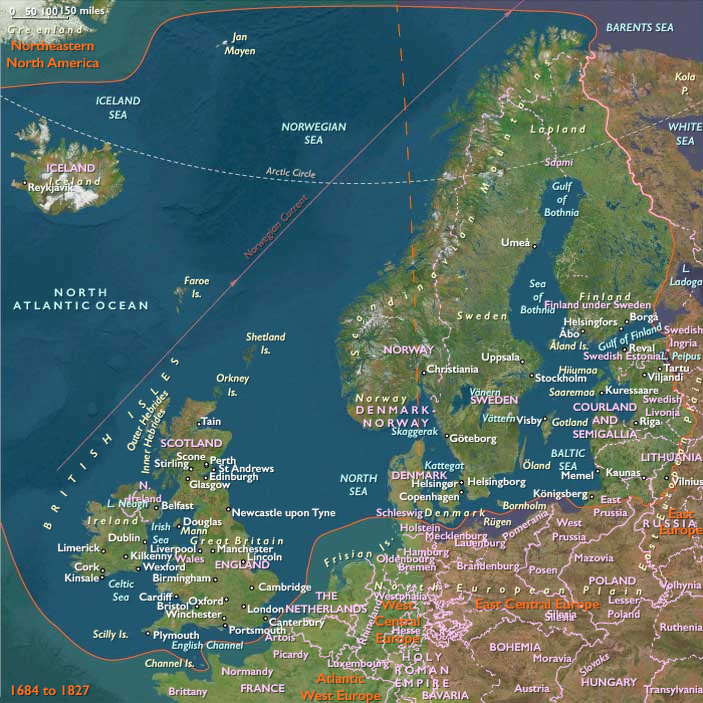 North Europe
Region
-
{# Image navigates to the detail page; the magnifying-glass chip is the only Fancybox lightbox trigger (kept a separate sibling — anchors can't nest). #}
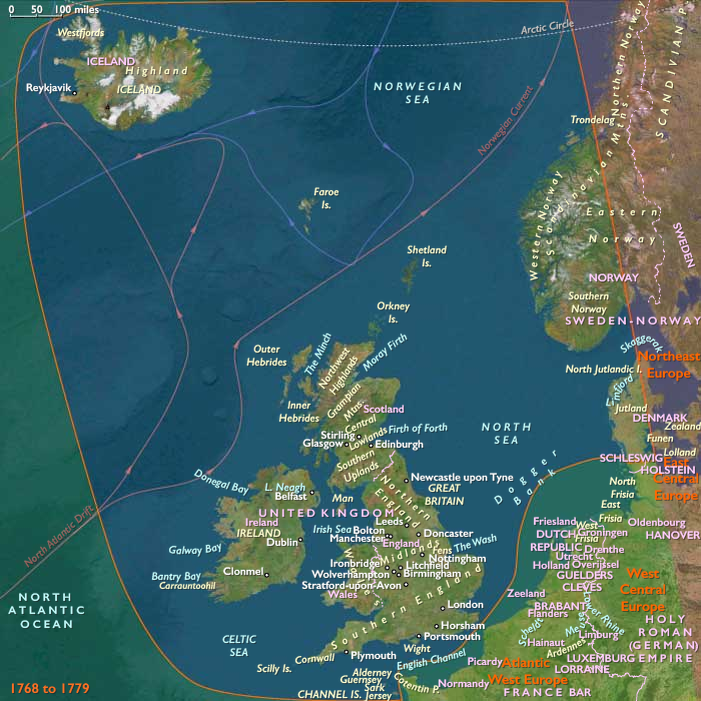 Northwest Europe
Subregion
