
Johannes Gutenberg, a Mainz-born goldsmith member enrolled…
1457 CE
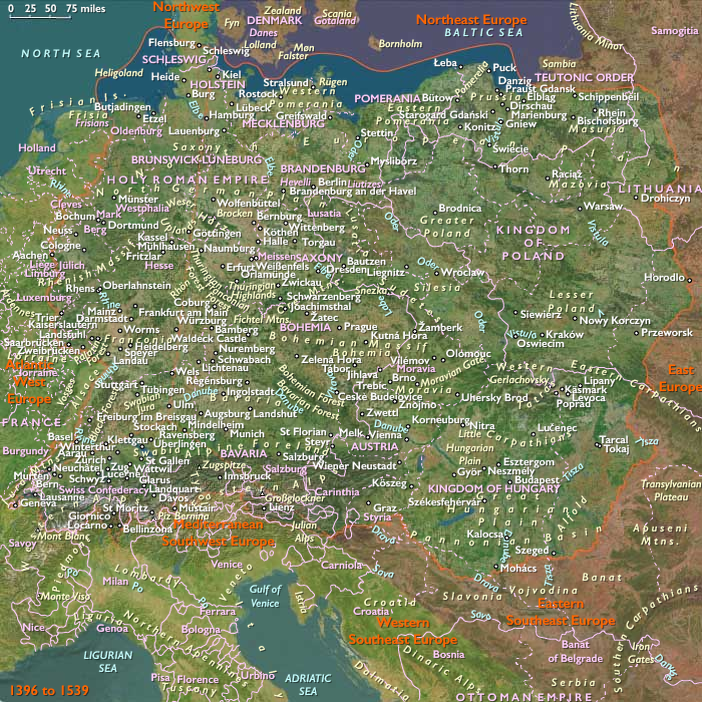
Johannes Gutenberg, a Mainz-born goldsmith member enrolled in the Strasbourg militia, had first experimented with metal typography in the early 1430s; legend has it that the idea had come to him "like a ray of light."
A few years later he had moved back to Mainz and set up a printing shop in partnership with the banker Johann Fust.
Another partner was Fust's son-in-law Peter Schoeffer, who had worked as a scribe in Paris; eventually he would design Gutenberg's typeface.
Fust had in 1436, at the beginning of their partnership, extended Gutenberg eight hundred guilders to set up his press.
Gutenberg had also lost a good bit of money around 1440 on a misadventure making mirrors for pilgrims to Aix-la-Chapelle.
Gutenberg has been counting on printing the Bible to repay Fust's loan, but this process had taken far longer than expected.
It had not been until 1455 that Gutenberg could bring out his first batch of the forty-two line Bible.
Expenses had proliferated, and his debt now exceeded two thousand guilders.
Fust had gone to court, and the ruling of November 1455 had effectively bankrupted Gutenberg and awarded control of the types and plates used in his Bible, plus much of the printing equipment, to Fust.
Subsequently the Fust-Schoeffer shop is the first to bring out a book with the printer's name and date, the Mainz Psalter of August 1457 (also the first example of color printing in Europe).
While proudly proclaiming the mechanical process by which it had been produced, the book makes no mention of Gutenberg.
Gutenberg does, however, publish the first printed almanac in 1457 at Mainz.
Locations
Groups
Subjects
Regions
Central Europe
View →Subregions
