
The Strengthening of the French Crown Under…
1360 CE to 1371 CE
The Strengthening of the French Crown Under Charles V (1360s–1380s)
By the 1360s, France began to develop a system of regular taxation, marking a crucial turning point in the consolidation of royal authority. This financial restructuring, combined with military and political reforms, enabled King Charles V (r. 1364–1380) to restore French fortunes in the Hundred Years' War and reinforce Valois ruleafter years of internal division and military setbacks.
The Establishment of Regular Taxation
The wars of the mid-14th century, particularly the disastrous French defeat at Poitiers (1356) and the Treaty of Brétigny (1360), had severely weakened the monarchy. To fund his efforts at recovery, Charles V:
- Stabilized royal finances by instituting permanent taxation, moving beyond the inconsistent levies of earlier reigns.
- Continued the taille, a direct tax primarily levied on peasants, which became a key source of royal income.
- Implemented indirect taxes, such as the gabelle (salt tax) and duties on trade, to reduce financial dependence on the nobility.
This systematic approach to taxation allowed the French monarchy to fund a standing army and regain control over war-ravaged regions.
Regaining the Loyalty of Northwestern Nobles
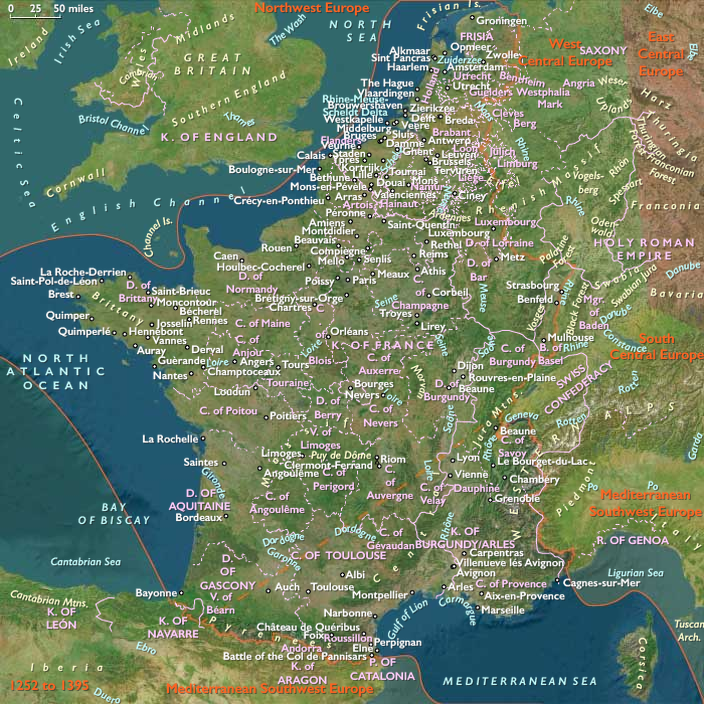
Charles V also succeeded in winning back the support of northwestern nobles, who had previously opposed the Valois dynasty, particularly during the rebellions of Charles the Bad of Navarre (a persistent thorn in French politics).
- By offering titles, lands, and financial incentives, Charles reintegrated powerful noble families into the royal administration.
- He strengthened ties with Brittany, Normandy, and Anjou, ensuring that these regions aligned more closely with the Valois cause.
Military and Political Strengthening
With stable finances and renewed noble support, Charles V launched a series of military campaigns to reverse English territorial gains:
- Under the leadership of Bertrand du Guesclin, the French gradually drove the English out of most territories gained under the Treaty of Brétigny.
- Charles adopted a war of attrition, using fortifications, targeted raids, and local resistance movements to wear down English forces.
By 1380, France had regained much of its lost territory, and the monarchy emerged far stronger than it had been in the wake of John II’s capture at Poitiers.
Legacy of Charles V’s Reforms
The policies of Charles V laid the foundation for a more centralized French monarchy, which would continue to consolidate power in the following centuries. His financial and military reforms ensured that the Valois dynasty survived the crises of the 14th century, making France more resilient in the later stages of the Hundred Years' War.
Locations
People
Topics
Commodities
Subjects
Regions
West Europe
View →Subregions
