
Francesco Squarcione teaches several leading painters, including …
Years: 1454 - 1454
Francesco Squarcione teaches several leading painters, including Andrea Mantegna, who comes to study with Squarcione in Padua.
His two (known) works, an altarpiece created at Padua in 1449-52, and his Madonna and Child, painted in about 1455, display Squarcione’s harsh, linear style and his interest in lively movement.
Squarcione, whose original vocation was tailoring, appears to have had a remarkable enthusiasm for ancient art, and a faculty for acting.
Like his famous compatriot Petrarca, Squarcione is something of a fanatic for ancient Rome: he has traveled in Italy, and perhaps Greece, collecting antique statues, reliefs, vases, and other works of art, forming a collection of such works, making drawings from them himself, and throwing open his stores for others to study from.
Based on this collection, he undertakes works on commission for which his pupils no less than himself are made available.
As many as 137 painters and pictorial students pass through his school, established towards 1440 and which becomes famous all over Italy.
Squarcione's favorite pupil is Mantegna, who Squarcione teaches the Latin language and instructs in the study of fragments of Roman sculpture.
While serving his apprenticeship to Squarcione, Mantegna had in 1454 married the daughter of Venetian artist Jacopo Bellini, whose designs he studies, but the art of the sculptor Donatello, who works in Padua from 1443 to 1453, is probably the greatest influence on young Mantegna.
Apparently fascinated by the perspective in Donatello's reliefs at San Antonio in Padua, he employs the new science of linear perspective in his first major project: the decoration, executed in 1449-55, of parts of the Ovetari Chapel in Padua's Eremitani Church.
Mantegna illustrates the “Martyrdom of St. James,” (destroyed in 1944) on the lower register of one wall, calculating a perspective on the basis of the spectator's eye level, which would be slightly below the bottom of the frame.
Figures and buildings thus loom above the ground line and appear to recede up and away from the observer.
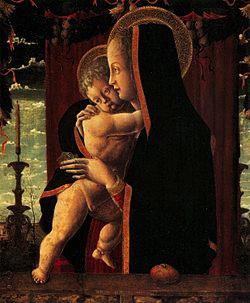
Francesco Squarcione: Virgin and Child (c. 1455-60), poplar wood, 82 x 70 cm, Staatliche Museen, Berlin
Locations
People
Groups
Topics
Subjects
Regions

Subregions

Years: 1454 - 1454
Francesco Squarcione: Virgin and Child (c. 1455-60), poplar wood, 82 x 70 cm, Staatliche Museen, Berlin
Locations
People
Groups
Topics
Subjects
Regions
Subregions