
Franco Sacchetti further develops the genre mastered…
1400 CE
Franco Sacchetti further develops the genre mastered by Boccaccio in his lively “Novelle,” or short stories, composed between around 1378 to about 1395.
Born in Florence or in Ragusa (modern Dubrovnik), he was the son of Benci di Uguccione, surnamed "Buono", Florentine merchant of the noble and ancient family of the Sacchetti.
While still a young man, he had achieved repute as a poet, and he appears to have traveled on affairs of more or less importance as far as to Genoa, Milan and Slavonia.
After 1363 he settled in Florence.
When a sentence of banishment was passed upon the rest of the house of Sacchetti by the Florentine authorities in 1380 (after the Ciompi revolt) it appears that Sacchetti was expressly exempted, per esser tanto uomo buono ("because he is a real good man"), and in 1383 he had been one of the Eight, discharging the office of prior for the months of March and April.
In 1386, he had been chosen ambassador to Genoa, but preferred to go as podestà to Bibbiena in Casentino.
In 1392 he was podestà of San Miniato, and in 1396 he had held a similar office at Faenza.
In 1398 he received from his fellow-citizens the post of captain of their province of Romagna, having his residence at Portico.
The date of his death is unknown; most probably it occurred about 1400, though some writers place it as late as 1410.
He writes sonnets, canzoni, madrigals, and other poems; his best known works are however his Novelle (short stories).
They were originally three hundred in number, but today only two hundred and fifty-eight remain, the rest having been lost.
They are not fitted into any framework like that of Boccaccio's Decameron.
The best of them are of a humorous character; and their style is more simple and colloquial than Boccaccio's.
The story given as a specimen probably exists (under one form or another) in the folk tales of every European nation.
People
Regions
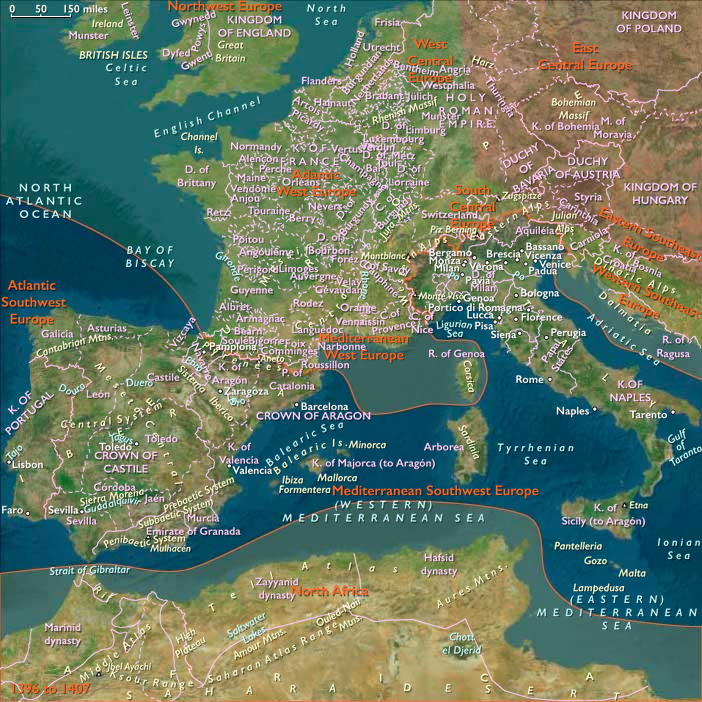
Southwest Europe
View →Subregions
