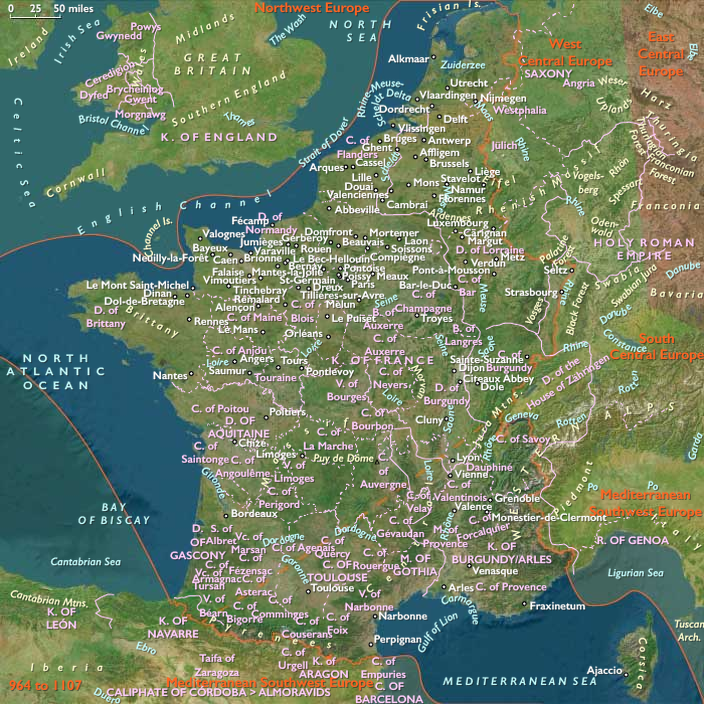
French Christian warriors, en route to Spain …
Years: 1065 - 1065
French Christian warriors, en route to Spain in 1065 to drive out the Muslims, stop in a number of towns along the way and kill any Jews they find.
Locations
People
Groups
Topics
Commodoties
Subjects
Regions
Subregions
Related Events
Filter results
Showing 5 events out of 5 total
Louis XI and the Forced Marriage of Louis of Orléans (1476)
In 1476, King Louis XI of France strategically arranged a politically motivated marriage between his own daughter, Joan of France (Jeanne de France), and his sixteen-year-old nephew Louis of Orléans, son and improbable heir of the recently deceased poet and duke, Charles of Orléans (1394–1465). This marriage, imposed upon the young Louis against his wishes, formed a critical part of Louis XI’s broader plan to neutralize the House of Orléans, a rival cadet branch of the royal House of Valois, which Louis XI deeply distrusted due to its historically close ties to Burgundy.
Political and Dynastic Context
Following the unlikely birth of Louis of Orléans in 1462, when Charles of Orléans was seventy, Louis XI grew increasingly wary of the Orléanist faction, recognizing in them a potential threat to royal authority. The Orléans family had historically enjoyed close political connections with the powerful Dukes of Burgundy, notably Charles the Bold, heightening Louis XI’s fears of potential Burgundian-Orléanist alliances against his centralized royal authority.
To preclude any possibility of the Orléans family ascending the throne or forming powerful external alliances, Louis XI sought to effectively extinguish the Orléans lineage by marrying young Louis of Orléans to his own daughter, Joan—widely regarded as physically impaired and, importantly for Louis’s strategy, thought to be sterile.
Marriage and Personal Unhappiness
Young Louis of Orléans was deeply displeased by the arrangement, viewing the forced marriage as a deliberate affront to his independence and future dynastic potential. His resentment toward Joan, reflected in his indifferent or openly negative treatment of her, profoundly impacted the couple’s private life, fostering personal misery for Joan and deepening familial animosity. Louis XI’s calculated political move thus came at significant personal cost, contributing to bitterness and unhappiness within the royal household.
Strategic and Dynastic Consequences
Despite Louis XI’s intentions, the forced marriage did not succeed in permanently extinguishing the Orléans line. Louis of Orléans ultimately sought and gained an annulment of this marriage after becoming king in 1498 as Louis XII, following the unexpected demise of Charles VIII, Joan’s brother. His subsequent remarriage to Anne of Brittanyrevitalized his dynastic prospects and significantly altered the French royal lineage, marking the ultimate failure of Louis XI’s carefully crafted plan.
Cultural and Historical Significance
The forced marriage between Louis of Orléans and Joan of France highlights the ruthless political pragmatism of Louis XI, a king renowned for prioritizing dynastic control and centralized monarchy above personal happiness and familial bonds. It vividly illustrates how late medieval rulers used marriage as a calculated political tool, sacrificing individual wellbeing for strategic advantage.
Long-Term Historical Legacy
Ultimately, the forced marriage had precisely the opposite effect from that intended by Louis XI. Rather than suppressing the Orléans branch, it inadvertently strengthened Louis of Orléans’s resolve and reinforced his political ambition, eventually positioning him as a central figure in the political turmoil following Louis XI’s death. Upon Louis XII’s accession, the annulment and remarriage reshaped the French monarchy and underscored the resilience of dynastic politics, profoundly influencing France’s royal lineage and political trajectory into the early modern era in Atlantic West Europe.

Regency and Queenship of Anne of Beaujeu and Anne of Brittany (1483–1495)
Anne of Beaujeu, who skillfully governed as regent for her brother Charles VIII from 1483 to 1491, reassumed a similar role when Charles embarked upon his Italian campaigns. Trusted and politically astute, she maintained stability within France during his prolonged absences, ensuring continuity of royal authority.
Anne of Brittany, though Queen of France, had limited political influence in both France and her native Brittany, and frequently endured separation from her children during their infancy. Her life was largely defined by her residency in royal castles such as Amboise, Loches, and Plessis, as well as in major towns including Lyon, Grenoble, and Moulins, particularly when Charles VIII conducted military operations in Italy.
At Amboise, Anne of Brittany often stayed at the nearby Clos Lucé, later famed as the residence of Leonardo da Vinci, where she commissioned the construction of her personal chapel. She attained additional titles, notably Queen Consort of Naples and Jerusalem, following Charles VIII's temporary conquest of Naples, further highlighting her prominence within European dynastic affairs of the late fifteenth century.
Anne of Brittany Assumes Administration of Brittany (1498)
At just twenty-one years old, Anne of Brittany, widow of the recently deceased King Charles VIII, finds herself without surviving children and swiftly asserts direct control over the governance of the Duchy of Brittany. Demonstrating political decisiveness and administrative skill, Anne immediately reestablishes her authority by reinstating trusted advisor Philippe de Montauban to the Chancellery of Brittany. She also names Jean de Châlon, Prince of Orange, as Hereditary Lieutenant General of Brittany, assembles the Estates of Brittany, commissions the minting of a gold coin inscribed with her name, and entrusts responsibility for the strategic Château de Brest to the loyal Philippe de Montauban.
Anne’s rule extends beyond political administration, reflecting her deep cultural sophistication and artistic patronage. She cultivates a celebrated court enriched by influential figures, including prominent humanists and literary scholars such as the Italian humanist Publio Fausto Andrelini—a significant conduit for Renaissance ideas in France—as well as historian Jean Lemaire de Belges and poet Jean Marot. She also secures the services of the era’s foremost composers and musicians, notably Johannes Ockeghem, Antoine de Févin, Loyset Compère, and Jean Mouton. Anne’s court becomes a vibrant center for intellectual exchange, artistic innovation, and cultural patronage, reflecting broader Renaissance trends influencing Atlantic West Europe.
Anne's assertive political role as both administrator and patron underscores her distinct historical status as one of France’s earliest queens to actively engage in independent political authority and extensive cultural patronage.
Consequences and Legacy:
Anne's administration signaled a unique phase of relative autonomy for Brittany within the French realm, demonstrating the Duchy's ongoing assertion of independent regional identity amid growing centralization. Her patronage notably advanced the spread of humanist culture in Atlantic West Europe, setting precedents for subsequent royal patronage of Renaissance arts and scholarship in France. Additionally, Anne's complex marital status—further complicated by the existing marriage between King Louis XII and Joan of France—foreshadowed significant political and dynastic tensions central to subsequent French and Breton history.
Queen Anne of Brittany Agrees to Marry Louis XII (1498)
On August 19, 1498, at Étampes, Anne of Brittany agreed to marry the newly crowned French king, Louis XII, contingent upon his securing an annulment from his wife, Joan of France, within one year. This strategic agreement marked Anne’s continued political maneuvering to safeguard Brittany’s autonomy and her personal influence within the shifting landscape of French politics.
Within days, Louis XII initiated annulment proceedings against Joan, officially on grounds of consanguinity and the marriage's alleged non-consummation. Meanwhile, Anne returned to Brittany, perhaps cautiously awaiting the outcome, mindful of the high stakes involved in aligning the Duchy of Brittany more closely with the French crown under favorable terms.
The annulment proceedings rapidly gained momentum, reflecting Louis XII's urgency in solidifying his legitimacy and succession by marrying Anne, whose personal and territorial inheritance provided significant strategic advantages. The swift action by Louis underscored the crown's increasing ability to leverage ecclesiastical authority in pursuit of political objectives.
Consequences and Significance:
Anne’s conditional agreement at Étampes set into motion critical changes in dynastic alliances, significantly affecting the balance of regional and national power. The annulment, if successful, promised to consolidate Brittany more firmly within the French realm, redefining Brittany’s political future and substantially altering the landscape of power across Atlantic West Europe.
The Annulment of Louis XII and His Marriage to Anne of Brittany (1499)
On January 1, 1499, after successfully securing the annulment of his marriage to Joan of France, King Louis XIIofficially contracted marriage to Anne of Brittany, widow of the late King Charles VIII. This event marked a crucial dynastic shift, profoundly reshaping the political landscape of Atlantic West Europe and uniting the Duchy of Brittany once again with the French crown.
The annulment of Louis XII's marriage to Joan—justified primarily by claims of consanguinity and non-consummation—had been swiftly pursued following Louis's accession to the throne in 1498. Louis, eager to strengthen his legitimacy and bolster royal authority through strategic marital alliances, secured an agreement with Anne at Étampes on August 19, 1498, conditioned upon successfully dissolving his marriage to Joan within one year. The marriage contract between Louis XII and Anne of Brittany was formally signed by Anne’s Chancellor and physician, Gabriel Miron, on January 1, 1499, sealing this politically significant alliance.
Anne's remarriage to Louis XII, occurring soon after Charles VIII’s sudden death, demonstrated both her political pragmatism and continued influence. This alliance underscored her determination to secure Brittany's autonomy and her influential position within the French monarchy, further solidified by her active administrative role and patronage of culture and the arts.
Consequences and Legacy:
The marriage of Anne and Louis XII secured the political reunification of Brittany with the French crown but preserved Brittany’s distinct identity and privileges through Anne's careful negotiations. This marital and political union had lasting implications, reinforcing central authority in France while maintaining certain Breton privileges. Anne’s continued patronage of art and culture, facilitated by her renewed position as Queen of France, sustained and enriched the intellectual and artistic environment at the French court, significantly influencing Renaissance developments throughout the region.