
French navigator Jacques Cartier had in the…
1541 CE
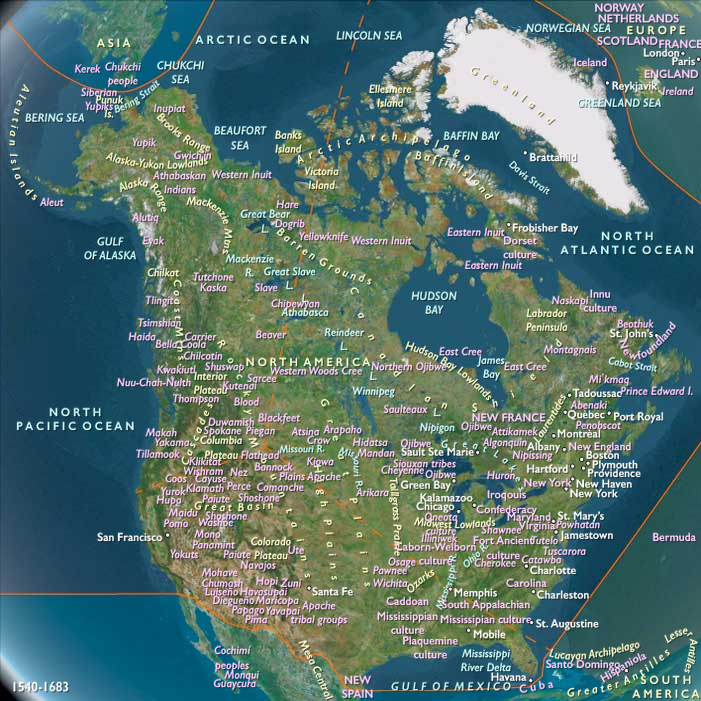
French navigator Jacques Cartier had in the mid-1530s become the first European to explore and describe the Gulf of St. Lawrence and the shores of the Saint Lawrence River, which he named Canada.
Obliged to serve under the nominal command of the Huguenot Jean Francois de la Rocque de Roberval, although the latter did not sail with him, Cartier departs Saint-Malo on his third voyage with five ships.
This time, any thought of finding a passage to the Orient is forgotten.
The goals are now to find the "Kingdom of Saguenay" and its riches, and to establish a permanent settlement along the St. Lawrence.
Anchoring at the Iroquoian village of Stadacona on August 23, Cartier again meets the Iroquoians, but finds their "show of joy" and their numbers worrisome, and decides not to build his settlement here.
Sailing nine miles upriver to a spot he had previously observed, Cartier decides to settle on the site of present-day Cap-Rouge, Quebec.
The convicts and other colonists are landed, the cattle that had survived three months aboard ship are turned loose, earth is broken for a kitchen garden, and seeds of cabbage, turnip and lettuce are planted.
A fortified settlement is thus created and is named Charlesbourg-Royal.
Another fort is also built on the cliff overlooking the settlement, for added protection.
The men also begin collecting what they think are diamonds and gold, but which will turn out to be quartz crystals and iron pyrites, respectively—which gives rise to a French expression: faux comme les diamants du Canada {"As false as Canadian diamonds").
Two of the ships are dispatched home with some of these minerals on September 2.
Having set tasks for everyone, Cartier leaves with the longboats for a reconnaissance in search of "Saguenay" on September 7.
Having reached Hochelaga, he is prevented by bad weather and the numerous rapids from continuing up to the Ottawa River.
Returning to Charlesbourg-Royal, Cartier finds the situation ominous.
The Iroquoians no longer make friendly visits or peddle fish and game, but prowl about in a sinister manner.
Groups
Commodities
Subjects
Regions
Northern North America
View →Subregions
