Generalleutnant Ludwig Yorck von Wartenburg had signed,…
February 1813 CE
According to the Treaty of Tilsit, Prussia had to support Napoleon's invasion of Russia.
This had resulted in some Prussians leaving their army to avoid serving the French, like Carl von Clausewitz, who had joined Russian service.
When Yorck's immediate French superior Marshal MacDonald had retreated before the corps of Diebitsch, Yorck had found himself isolated.
As a soldier, his duty was to break through, but as a Prussian patriot his position was more difficult.
He had to judge whether the moment was favorable for starting a war of liberation; and, whatever might be the enthusiasm of his junior staff-officers, Yorck had no illusions as to the safety of his own head, and had negotiated with Clausewitz.
The Convention of Tauroggen armistice, signed by Diebitsch and Yorck, had "neutralized" the Prussian corps without consent of their king.
The news had been received with the wildest enthusiasm in Prussia, but the Prussian Court dared not yet throw off the mask, and an order had been dispatched suspending Yorck from his command pending a court-martial.
Diebitsch had refused to let the bearer pass through his lines, and the general is finally absolved when the Treaty of Kalisch (February 28, 1813) definitely ranges Prussia on the side of the Allies.
Locations
People
Groups
Regions
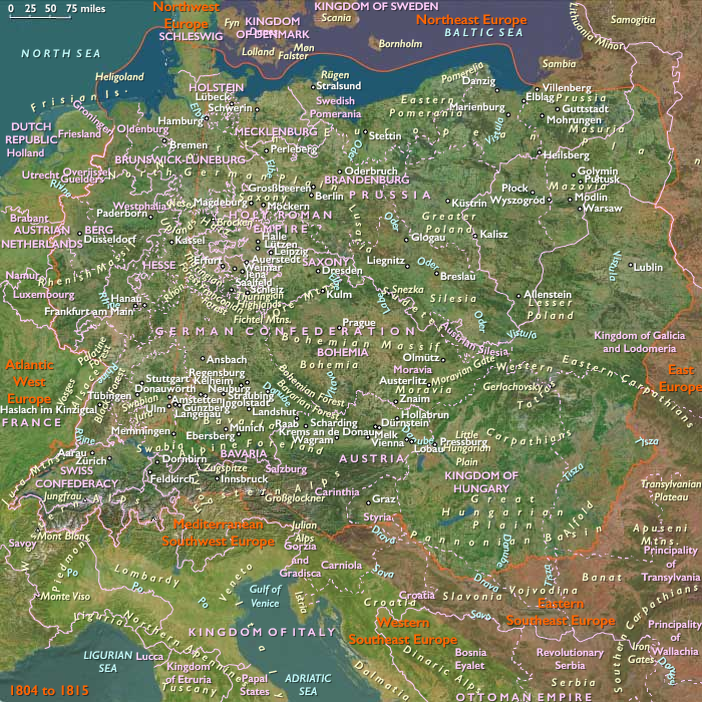
Central Europe
View →Subregions