Samuel Taylor Coleridge had attended Jesus College,…
September 1798 CE
Samuel Taylor Coleridge had attended Jesus College, Cambridge, from 1791 until 1794.
In 1792, he had won the Browne Gold Medal for an ode that he wrote on the slave trade.
In December 1793, he had left the college and enlisted in the Royal Dragoons using the false name "Silas Tomkyn Comberbache", perhaps because of debt or because the girl that he loved, Mary Evans, had rejected him.
His brothers had arranged for his discharge a few months later under the reason of "insanity" and he was readmitted to Jesus College, though he will never receive a degree from Cambridge.
At the university, he had been introduced to political and theological ideas considered radical, including those of the poet Robert Southey.
Coleridge had joined Southey in a plan, soon abandoned, to found a utopian commune-like society, called Pantisocracy, in the wilderness of Pennsylvania.
In 1795, the two friends had married sisters Sarah and Edith Fricker, in St. Mary Redcliffe, Bristol, but Coleridge's marriage has proved unhappy.
He has grown to detest his wife, whom he had only married because of social constraints.
He eventually separates from her.
Coleridge had made plans to establish a journal, The Watchman, to be printed every eight days in order to avoid a weekly newspaper tax.
The first issue of the short-lived journal was published in March 1796; it had ceased publication by May of that year.
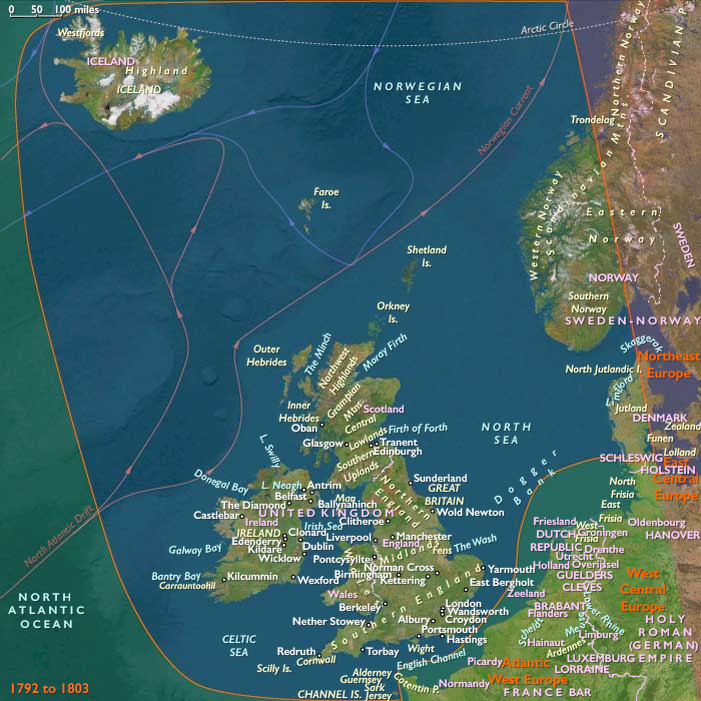
The years 1797 and 1798, during which he lives in what is now known as Coleridge Cottage, in Nether Stowey, Somerset, are among the most fruitful of Coleridge's life.
In 1795, Coleridge had met poet William Wordsworth and his sister Dorothy. (Wordsworth, having visited him and being enchanted by the surroundings, had rented Alfoxton Park, a little over three miles [five kilometers] away.)
Besides the Rime of The Ancient Mariner, he had composed the symbolic poem Kubla Khan, written—Coleridge himself claims—as a result of an opium dream, in "a kind of a reverie"; and the first part of the narrative poem Christabel.
The writing of Kubla Khan, about the Mongol emperor Kublai Khan and his legendary palace at Xanadu, is said to have been interrupted by the arrival of a "Person from Porlock" — an event that will be embellished upon in such varied contexts as science fiction and Nabokov's Lolita.
During this period, he also produces his much-praised "conversation" poems This Lime-Tree Bower My Prison, Frost at Midnight, and The Nightingale.
On September 18, 1798, Coleridge and Wordsworth publish a joint volume of poetry, Lyrical Ballads, which proves to be the starting point for the English Romantic movement in literature.
Wordsworth may have contributed more poems, but the real star of the collection is Coleridge's first version of The Rime of the Ancient Mariner.
It is the longest work and draws more praise and attention than anything else in the volume.
Subjects
Regions
North Europe
View →Subregions