
Konrad Witz paints his most important work,…
1444 CE
Konrad Witz paints his most important work, the Saint Peter Altarpiece, in 1444.
One of the two (surviving) wing panels, the dramatic representation of Christ Walking on the Water and the Miraculous Draught of Fishes represents one of the first examples in Western art of an actual landscape setting—a view of Lake Geneva.
Taking a characteristically Flemish interest in detail, Witz depicts not only the reflections of the garments on the surface of the water, but also bubbles rising from the bottom and rocks seen through the surface.
Witz is most famous for painting three altarpieces, all of which survive only partially.
The earliest is the Heilspiegel Altarpiece of about 1435 (today mostly in the Kunstmuseum, Basel, with isolated panels in other collections).
The next is the Altarpiece of the Virgin of around 1440), which has been associated with panels now in Basel, Nuremberg, and Strasbourg (Musée de l’Œuvre Notre-Dame).
Witz's final altarpiece is the St. Peter Altarpiece of 1444, painted for St. Peter's Cathedral, Geneva, and now in the Musée d'Art et d'Histoire, Geneva, which contains his most famous composition, the Miraculous Draught of Fishes.
Images
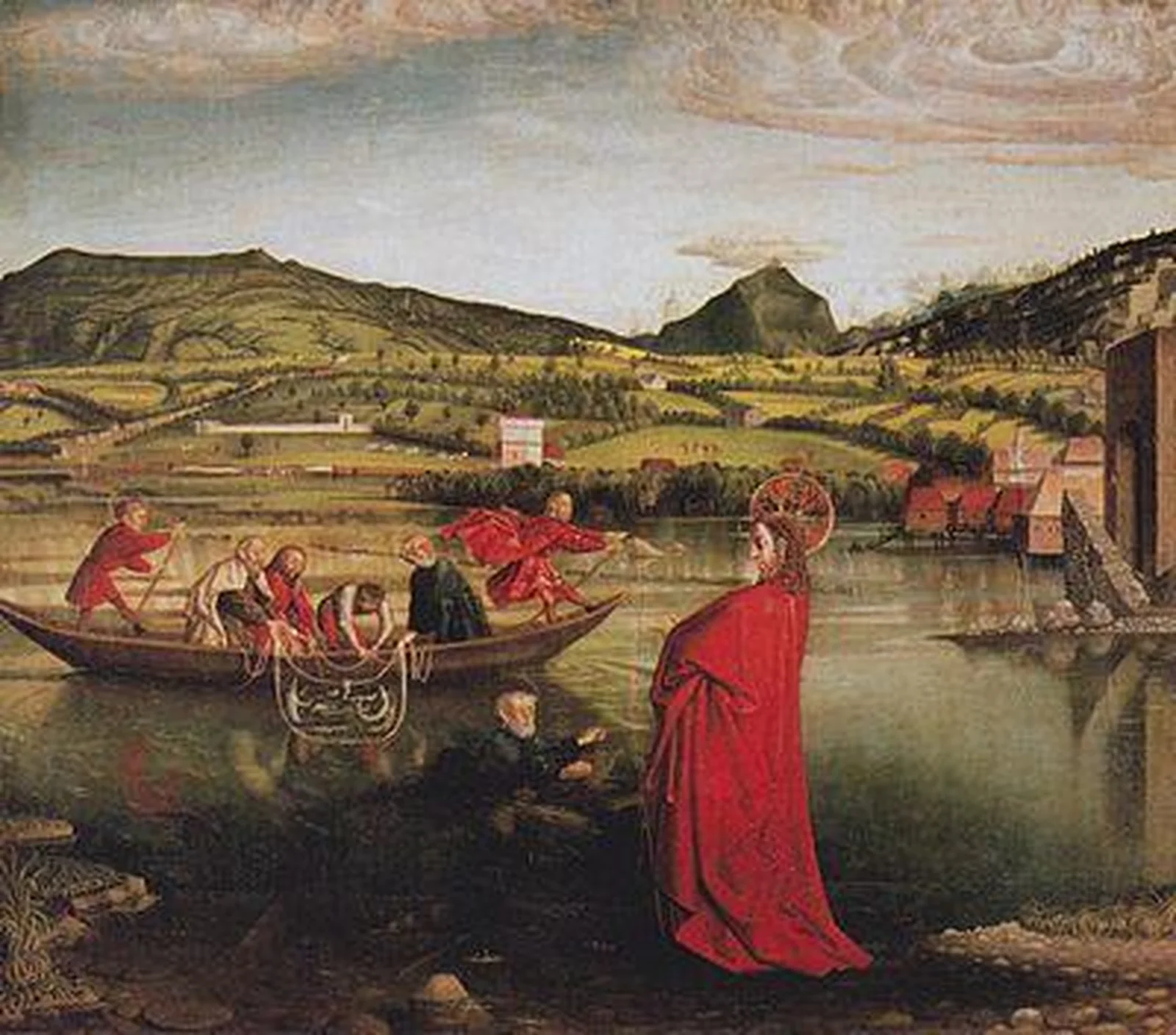
Konrad Witz: The Miraculous Draft of Fishes, 1444. 132cm x 154cm, Musée d'Art et d'Histoire, Geneva.
People
Groups
Regions

Central Europe
View →Subregions
