
Giambattista Vico, born to a bookseller and…
1710 CE
Giambattista Vico, born to a bookseller and the daughter of a carriage maker in Naples, Italy, had attended a series of grammar schools, but ill-health and dissatisfaction with Jesuit scholasticism had led to home schooling.
After a bout of typhus in 1686, Vico had accepted a tutoring position in Vatolla (a Frazione of the comune of Perdifumo), south of Salerno, that had lasted for nine years.
He had in 1696 married a childhood friend, Teresa Destito, and had taken a chair in rhetoric at the University of Naples.
Throughout his career, Vico will aspire to, but never attain, the more respectable chair of jurisprudence.
Vico's version of rhetoric is often seen as the result of both his humanist and pedagogic concerns.
In De Nostri Temporis Studiorum Ratione ("On the Order of the Scholarly Disciplines of Our Times"), presented at the commencement ceremonies of 1708, Vico had argued that whoever “intends a career in public life, whether in the courts, the senate, or the pulpit” should be taught to “master the art of topics and defend both sides of a controversy, be it on nature, man, or politics, in a freer and brighter style of expression, so he can learn to draw on those arguments which are most probable and have the greatest degree of verisimilitude”.
(However, in his Scienza Nuova, Vico will denounces as "false eloquence" one defending both sides in controversies.)
As Royal Professor of Latin Eloquence, it is Vico’s task to prepare students for higher studies in law and jurisprudence.
His lessons thus deal with the formal aspects of the rhetorical canon, including arrangement and delivery.
Yet, as the above oration also makes clear, Vico chooses to emphasize the Aristotelian connection of rhetoric with dialectic or logic, thereby reconnecting rhetoric to ends (or topics) as their center.
Vico's objection to modern rhetoric is that it cuts itself off from common sense (sensus communis), as the sense common to all men.
In his lectures and throughout the body of his work, Vico's rhetoric begins from a central argument or "middle term" (medius terminus), which it then sets out to clarify by following the order of things as they arise in our experience.
Probability and circumstance retain their proportionate importance, and discovery—reliant upon topics or loci—supersedes axioms derived through reflective abstraction.
In the tradition of classical Roman rhetoric, Vico sets out to educate the orator as the deliverer of the "oratio", a speech having "ratio" or reason/order at its heart.
What is essential to the oratory art (as the Greek rhetorike) is the orderly link between common sense and an end commensurate to it—an end that is not imposed upon the imagination from above (in the manner of the moderns and a certain dogmatic form of Christianity), but that is drawn out of common sense itself.
In the tradition of Socrates and Cicero, Vico's real orator or rhetorician will serve as midwife in the birth of "the true" (as a form or idea) out of "the certain" (as the confusion or ignorance of the student's particularized mind).
Vico's rediscovery of "the most ancient wisdom" of the senses (a wisdom that is "human foolishness" or humana stultitia), his emphasis on the importance of civic life, and his professional obligations remind us of the humanist tradition.
He calls for a maieutic or jurisprudential oratory art against the grain of the modern privileging of a dogmatic form of reason in what he terms the “geometrical method” of Descartes and the Port-Royal logicians.
Vico is best known for his verum factum principle, first formulated in 1710 as part of his De antiquissima Italorum sapientia, ex linguae latinae originibus eruenda (1710) ("The ancient knowledge in Italian population, to be search in the origin of Latin language").
The principle states that truth is verified through creation or invention and not, as per Descartes, through observation: “The criterion and rule of the true is to have made it.
Accordingly, our clear and distinct idea of the mind cannot be a criterion of the mind itself, still less of other truths.
For while the mind perceives itself, it does not make itself.” This criterion for truth will later shape the history of civilization in Vico’s opus, the Scienza Nuova (The New Science, 1725), because he will argue that civil life—like mathematics—is wholly constructed.
Locations
People
Groups
Regions
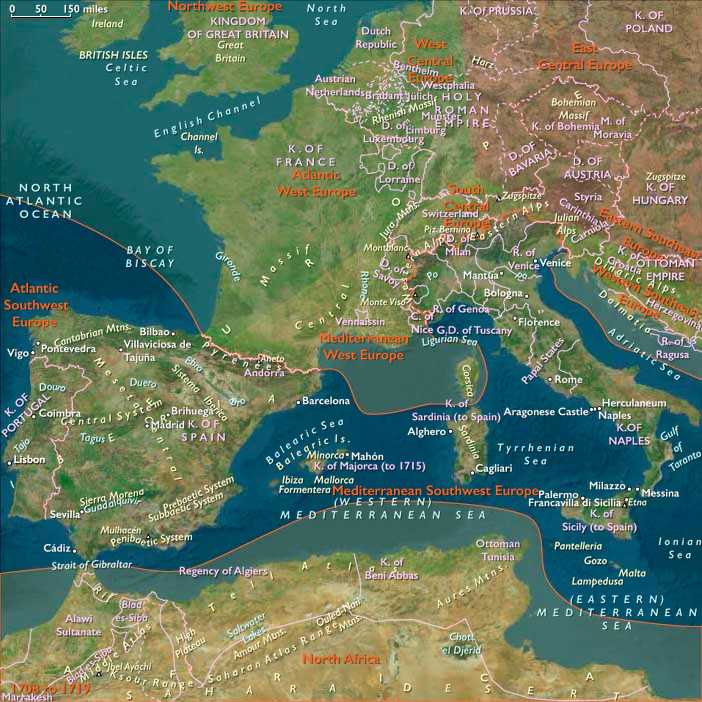
Southwest Europe
View →Subregions
