Greenland's west coast had been colonized from…
1444 CE to 1455 CE
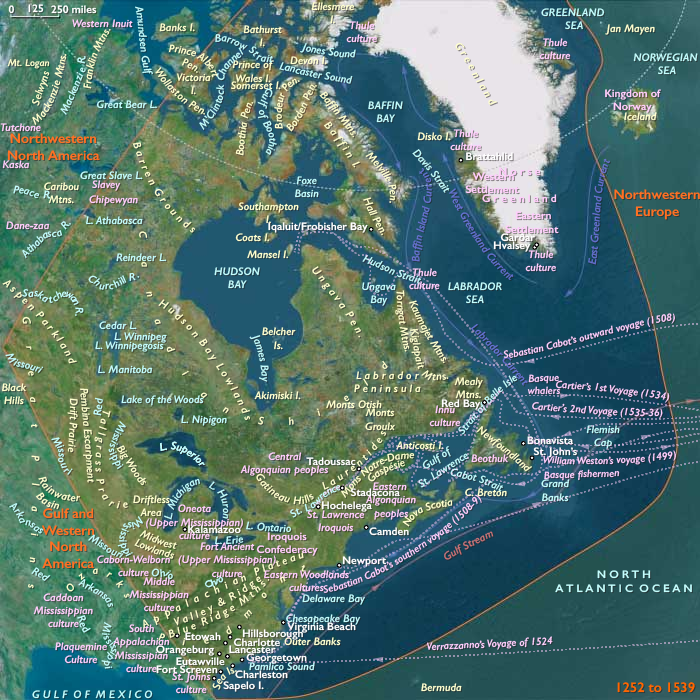
Greenland's west coast had been colonized from 986 by Icelanders and Norwegians in two settlements on fjords near the southwestern-most tip of the island.
They had shared the island with the late Dorset culture inhabitants who occupied the northern and western parts, and later with the Thule culture arriving from the north.
Norse Greenlanders had submitted to Norwegian rule in the thirteenth century, and the kingdom of Norway had entered into a personal union with Denmark in 1380, and from 1397 has been a part of the Kalmar Union.
The settlements, such as Brattahlíd, had thrived for centuries but disappear sometime in the fifteenth century, perhaps at the onset of the Little Ice Age.
Interpretation of ice core and clam shell data suggests that between 800 and 1300, the regions around the fjords of southern Greenland experienced a relatively mild climate several degrees celsius higher than usual in the North Atlantic, with trees and herbaceous plants growing and livestock being farmed.
Barley was grown as a crop up to the 70th parallel.
What is verifiable is that the ice cores indicate Greenland has experienced dramatic temperature shifts many times over the past one hundred thousand years.
Similarly, the Icelandic Book of Settlements records famines during the winters in which "the old and helpless were killed and thrown over cliffs".
Locations
Groups
Commodities
Subjects
Regions
Northern North America
View →Subregions