
Gulf and Western North America (1768–1779 CE): …
Years: 1768 - 1779
Gulf and Western North America (1768–1779 CE): Shifting Alliances and Indigenous Adaptations
Indigenous Populations and Epidemics
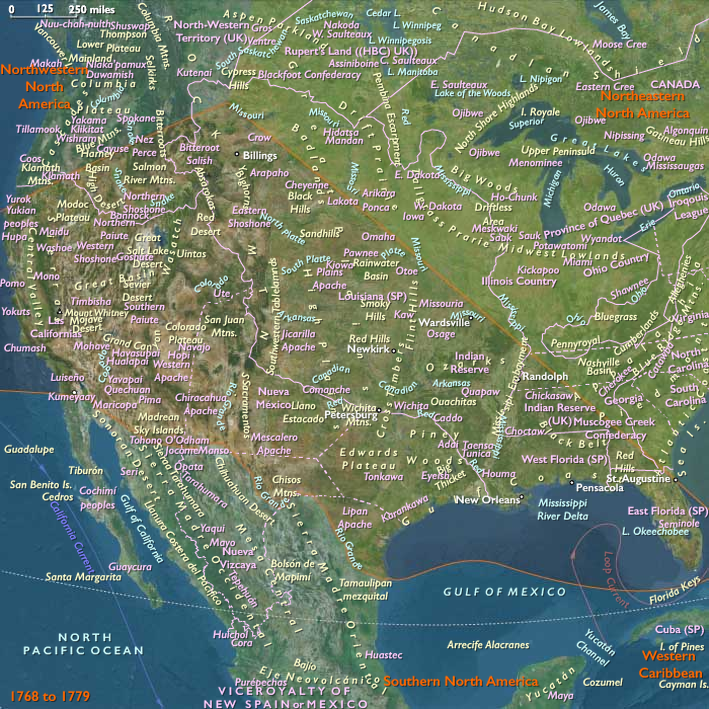
In the late 1770s, indigenous populations in Texas and surrounding regions face devastating impacts from European-introduced diseases. Notably, the Taovayas, a prominent subgroup of the Wichita people, experience a sharp decline in their power after a smallpox epidemic in 1777 and 1778 kills approximately one-third of their population. The epidemic significantly weakens their strategic influence and alliances in the region.
Realignment of Indigenous Alliances
The once-strong alliance between the Wichita, particularly the Taovayas, and the Comanche begins to deteriorate during this period as the Wichita seek closer relations with Spanish colonial authorities. Meanwhile, the Lipan Apache retreat southward towards the Rio Grande, and the Mescalero Apache move into Coahuila by 1777. The Comanche, whose numbers increase due to abundant buffalo herds, migration from Shoshone groups, and the assimilation of captives from rival tribes, expand their dominance and influence across the southern Plains. Despite their internal division into autonomous bands, the Comanche maintain cultural cohesion, shaping the dynamics of the region profoundly.
Expansion of Horse Culture
By the 1770s, the integration of horse culture has become widespread among the southern Plains tribes, as well as northern groups like the Blackfeet, Gros Ventre, Plains Ojibway, and Plains Cree. The adoption of horses significantly enhances the mobility, hunting capabilities, and intertribal communication among indigenous peoples, fostering the rise of a dynamic "Composite Nation of the Great Plains," characterized by increased trade, social interaction, and occasional conflict.
Spanish Colonization of California
Spanish colonial ambitions extend significantly into Alta California beginning in 1769. In response to perceived threats from Russian and potentially British fur traders exploring the Pacific Northwest, Spanish authorities establish a network of missions, forts (presidios), civilian settlements (pueblos), and ranches (ranchos) along the California coastline. Under orders received by Visitador General José de Gálvez in 1768, the Spanish found critical strategic outposts, such as San Diego and Monterey, "for God and the King of Spain."
By 1776, Alta California becomes part of the newly formed administrative division known as the Commandancy General of the Internal Provinces of the North (Provincias Internas), tasked with invigorating settlement and defending Spanish territorial claims. This period marks the beginning of a sustained effort to assert Spanish sovereignty over California, which will eventually result in the establishment of twenty-one missions along the coastline by 1833.
Key Historical Developments
-
Devastating smallpox epidemic severely weakens the Taovayas and reshapes indigenous alliances in Texas and Oklahoma.
-
Increased dominance and territorial expansion of the Comanche, reshaping the power dynamics across the southern Plains.
-
Widespread adoption of horse culture among Plains tribes, enhancing mobility, trade, and cultural exchanges.
-
Strategic Spanish colonization of Alta California in response to potential competition from Russian and British interests, establishing a lasting mission-presidio-rancho system.
Long-Term Consequences and Historical Significance
The period 1768–1779 signifies a major turning point characterized by shifting alliances, epidemic-induced demographic changes, and intensified Spanish colonial efforts in Gulf and Western North America. The Comanche rise as dominant equestrian warriors and traders, dramatically shaping the cultural and geopolitical landscape. Simultaneously, Spanish colonization of California initiates a period of profound transformation for indigenous societies along the Pacific coast, laying the groundwork for future settlement patterns and regional identities.
People
Groups
- Christians, Roman Catholic
- Blackfoot Confederacy
- Ojibwa, or Ojibwe, aka or Chippewa (Amerind tribe)
- Shoshone, Shoshoni, or Snakes (Amerind tribe)
- Gros Ventre or “Atsina” people (Amerind tribe)
- Cree (Amerind tribe)
- Lipan Apache people (Amerind tribe)
- New Spain, Viceroyalty of
- Spain, Habsburg Kingdom of
- Californias, the
- Britain, Kingdom of Great
- Russian Empire
- Mescalero Apache (Na-Dené tribe)
- Californias, the
Topics
Commodoties
Subjects
Regions
Subregions
Years: 1768 - 1779
People
Groups
- Christians, Roman Catholic
- Blackfoot Confederacy
- Ojibwa, or Ojibwe, aka or Chippewa (Amerind tribe)
- Shoshone, Shoshoni, or Snakes (Amerind tribe)
- Gros Ventre or “Atsina” people (Amerind tribe)
- Cree (Amerind tribe)
- Lipan Apache people (Amerind tribe)
- New Spain, Viceroyalty of
- Spain, Habsburg Kingdom of
- Californias, the
- Britain, Kingdom of Great
- Russian Empire
- Mescalero Apache (Na-Dené tribe)
- Californias, the
Topics
Commodoties
Subjects
Regions
Subregions