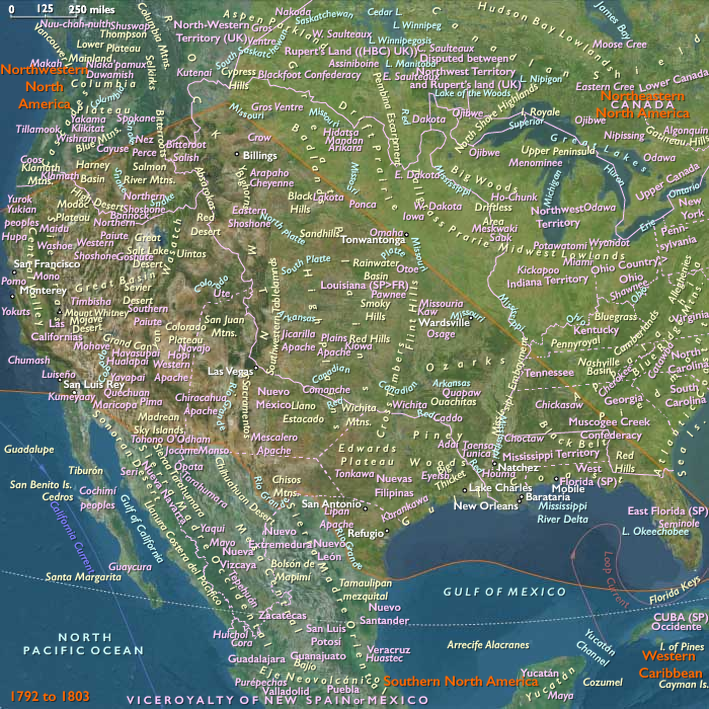
Gulf and Western North America (1792–1803 CE):…
1792 CE to 1803 CE
Gulf and Western North America (1792–1803 CE): Changing Colonial Dynamics and Indigenous Adaptations
British Maritime Fur Trade Restrictions
During this period, British maritime fur traders face significant restrictions due to monopolies held by the East India Company (EIC) and the South Sea Company (SSC). The SSC maintains exclusive trading rights along the western coast of the Americas, from Cape Horn to the Bering Strait, complicating British involvement in the lucrative fur trade. British traders often resort to bypassing regulations by flying foreign flags or obtaining limited licenses, severely impacting their ability to maximize profits from Chinese markets. The complex restrictions limit British traders to indirect routes, hindering the fur trade's full economic potential.
Osage Dominance and French Influence
The Osage tribe consolidates significant regional power around St. Louis and settlements along the Mississippi through an extensive fur trade network. Central to this trade is the French Creole trader René Auguste Chouteau, based in St. Louis. With Spanish colonial authority present but nominal, the Chouteau brothers establish Fort Carondelet in the Osage territory, gaining a monopoly on regional fur trade (1794–1802). This strengthens both the economic position of the Osage and their cultural influence over neighboring tribes, solidifying their dominance in the region.
Karankawa Adaptations and Resistance
The Karankawa in Texas demonstrate remarkable adaptability, fluently speaking Spanish and adopting Spanish names to ease interactions with settlers. Despite their assimilation strategies, Karankawa resistance intensifies toward the late eighteenth century, prompting the Spanish to regard them as a significant obstacle to full colonial control. While some Spanish officials consider drastic measures against the Karankawa, these plans are ultimately not enacted.
Plains Tribes and Increasing Conflicts
Tensions between the Crow and the Lakota escalate significantly. In the early nineteenth century, violent confrontations intensify, notably with the Crows killing around thirty Lakota warriors in 1800–1801. Retaliatory attacks follow swiftly, as Lakota and their Cheyenne allies decimate a Crow camp soon afterward. Such conflicts indicate rising tensions among indigenous groups driven by competition for hunting grounds and dominance on the Great Plains.
Louisiana's Demographic Shifts and African Slavery
Under Spanish rule, both free and enslaved populations in Louisiana increase substantially. By 1800, Lower Louisiana, including West Florida, records nearly 20,000 free persons and over 24,000 enslaved individuals. The slave population predominantly consists of Africans directly transported from Africa, reflecting Spanish and French plantation demands. Despite Spanish governance, francophone influence remains strong due to increased immigration, particularly from displaced Acadians (Cajuns) from Nova Scotia.
In 1799, Spain secretly agrees to return Louisiana to France in the Treaty of San Ildefonso. However, Napoleon Bonaparte's ambitions for a renewed American empire are thwarted by failures in Haiti, leading him to sell Louisiana to the United States in 1803 (the Louisiana Purchase).
Spanish Missions and Indigenous Conversion
Spanish mission activities in Texas see significant shifts. In 1793, Mission San Antonio de Valero is secularized, followed by partial secularization of other San Antonio missions the next year. By the close of the eighteenth century, most indigenous tribes within Texas have been Christianized, except for a few remaining hunter-gatherer communities.
Key Historical Developments
-
British maritime fur traders face significant economic restrictions due to monopolies held by the EIC and SSC.
-
Osage dominance expands through strategic alliances with French Creole traders.
-
Karankawa resistance grows despite Spanish assimilation attempts.
-
Intensifying conflicts between Plains tribes, notably the Crow and Lakota.
-
Rapid demographic shifts in Louisiana driven by plantation economy and slavery.
-
The transfer of Louisiana from Spain to France, eventually leading to the Louisiana Purchase by the United States in 1803.
Long-Term Consequences and Historical Significance
The period from 1792–1803 is pivotal, characterized by shifting colonial powers, significant indigenous adaptations, and demographic changes influenced by the transatlantic slave trade. The Louisiana Purchase of 1803 profoundly reshapes territorial and cultural dynamics, setting the stage for future American westward expansion.
People
Groups
Topics
Commodities
Subjects
Regions
Northern North America
View →Subregions