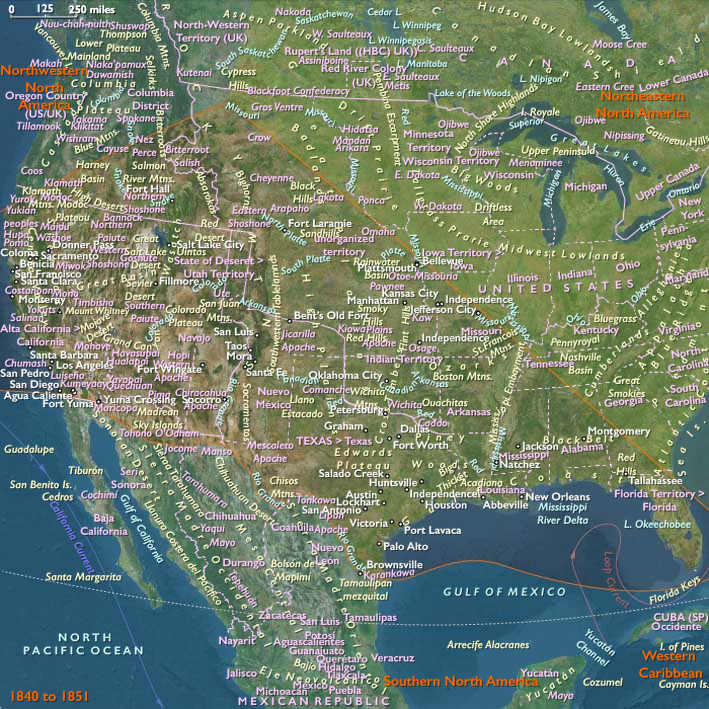
Gulf and Western North America (1840–1851 CE):…
1840 CE to 1851 CE
Gulf and Western North America (1840–1851 CE): Manifest Destiny and Rising Conflicts
The Oregon Trail and Westward Migration
Between 1840 and 1851, over 300,000 settlers journey westward via the Oregon Trail and its various offshoots, drawn by opportunities in California, Oregon, and the broader West. The discovery of gold in California in 1848 dramatically accelerates this migration, attracting more than 100,000 fortune-seekers in just months. Wagon trains traveling these trails require five to six months to reach their destinations, profoundly reshaping indigenous territories and natural resources along the way.
Expansionism and Manifest Destiny
The ideology of Manifest Destiny—the belief that American settlers are destined to expand across North America—dominates political and social attitudes during this era. President James K. Polk’s administration (1845–1849) aggressively pursues territorial expansion, resulting in the annexation of the Republic of Texas in 1845, the acquisition of the Oregon Territory through diplomacy with Britain in 1846, and the Mexican-American War (1846–1848).
Mexican-American War and its Aftermath
The Mexican-American War concludes with the Treaty of Guadalupe Hidalgo (1848), significantly expanding U.S. territory to include modern California, Nevada, Utah, Arizona, and parts of New Mexico, Colorado, and Wyoming. While many Americans consider annexing all of Mexico, opposition arises due to concerns about integrating Mexico's non-white population, emphasizing racial and cultural tensions underlying American expansionism.
Slavery, Sectionalism, and the Compromise of 1850
Slavery becomes the era’s central political issue, polarizing the nation into pro- and anti-slavery factions. Southern states vigorously defend slavery as crucial for their economy and culture, while northern opposition grows increasingly vocal, spurred by abolitionist sentiments. The Compromise of 1850 attempts to balance free and slave states by admitting California as a free state while strengthening fugitive slave laws—fueling further tensions.
Indigenous Conflicts and Adaptations
Increased settler migration leads to heightened conflicts with indigenous peoples, notably in the Great Plains and Southwest. The Cheyenne divide into Northern and Southern bands due to competition for resources and increasing pressure from westward migration. Similarly, the Kiowa, Wichita, Comanche, and Apache engage in frequent raids and defensive conflicts against settlers and other tribes, altering traditional territories and lifestyles significantly.
The Wichita, after numerous conflicts with Texans and Americans, sign a reservation treaty in 1846, eventually relocating to Oklahoma. Meanwhile, the Karankawa split into two groups: one settles on Padre Island, and another migrates to Mexico, where they face further violence and displacement.
Social Reforms and Religious Movements
The Second Great Awakening continues to influence American society into the 1840s, galvanizing movements for social reform, including abolitionism, temperance, and women's rights. Methodists, Baptists, Congregationalists, and Quakers lead these reforms in the North, deepening the cultural and moral divides between northern and southern states.
Disease and Demographic Impact
Cholera outbreaks, exacerbated by the California Gold Rush and increased migration along the Oregon and Mormon Trails, claim thousands of lives among settlers and indigenous populations. Poor sanitation and overcrowded conditions in mining camps further spread the disease, significantly impacting population dynamics in affected regions.
Key Historical Developments
-
Massive westward migration along the Oregon Trail and California Gold Rush.
-
The Mexican-American War (1846–1848) expands U.S. territory significantly.
-
Compromise of 1850 intensifies national debate over slavery and sectional divides.
-
Increased indigenous displacement and conflict, including division of Cheyenne and Wichita relocation.
-
Continued influence of the Second Great Awakening on social reform movements.
-
Devastating cholera outbreaks affecting migrants and indigenous communities.
Long-Term Consequences and Historical Significance
The period from 1840 to 1851 sees significant territorial expansion and rising national tensions over slavery, shaping the trajectory toward the American Civil War. Manifest Destiny not only expands U.S. territory but also exacerbates conflicts with indigenous peoples and deepens sectional divisions within American society. The consequences of these developments continue to resonate, fundamentally altering the demographic, cultural, and political landscapes of Gulf and Western North America.
People
Groups
Topics
Subjects
Regions
Northern North America
View →Subregions