Gustav Adolf, continuing his successful campaign against…
September 1631 CE
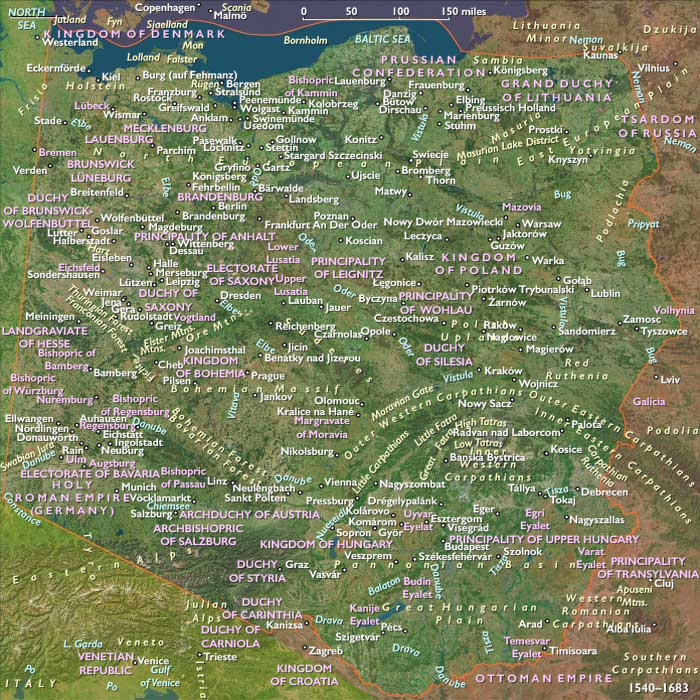
Gustav Adolf, continuing his successful campaign against the Empire’s armies, leads his troops in the against Tilly’s combined Bavarian and imperial armies at Breitenfield in September 1631.
This First Battle of Breitenfeld is overall a meeting engagement, with both combatants agreeing to battle on the field.
The forces all have different structural organization.
Mostly the technology is about the same level, with a slight advantage to the Swedish troops in newer and lighter cannon and matchlocks.
Both armies are well supplied and the terrain is relatively equivalent between the dispositions.
Key differences between the Swedish and imperial forces (and the Swedish allies) are in the training and structure of infantry troops, and the Swedish different philosophy in using their cavalry.
After several hours of punishment, nearing sunset, the Catholic line finally breaks.
Tilly himself is injured twice by a so-called "piece of battle"—artillery propelled debris, such as a careening pikehead.
Although the first time he remounted his horse, the second wound was more severe; unconscious, he is carted off to safety under the cover of night during the ensuing retreat, which quickly becomes a rout as the Catholic forces reach the nearby woods.
The totally disorganized and demoralized Imperial and Catholic League force effectively loses all cohesion with the fall of night, and the desertion rate is consequently higher than the battle losses themselves.
In effect, Gustav has entirely destroyed the only army the Catholics have in the field, placing the Imperial side on the defensive.
The outcome of the battle is to have a significant impact, in the short, intermediate, and long term.
In the short term, the Catholic and imperial forces are significantly hampered by the loss of most of the force.
The totality of the victory confirms Gustav's military innovations, and guarantees that the Swedes will remain engaged in the war for the foreseeable future.
In the long term, the significant loss of force, the shift in command, the realignment of alliances creating a strong Protestant, or anti-imperial force, requires the Emperor and the Protestant and Catholic princes, to rethink on the operational conduct of the warfare, and the diplomatic avenues they will pursue prior to using armed force.
After the battle, the Catholic League or Imperial army under Tilly can field an army of only seven thousand men.
The army has to be rebuilt.
Gustavus Adolphus, on the other hand, has a larger army after the battle than before.
The battle's outcome has the political effect of persuading Protestant states to join his cause and convinces France to throw its wholehearted support to the militarily strong but economically weak Sweden.
Finally, with the seventy-two year old Tilly's recovery far from certain (and he will indeed die within six months while crossing the Lech river), and with no alternative commander at hand, Ferdinand has no choice but to rehire Wallenstein.
Locations
People
Groups
Topics
Commodities
Subjects
Regions
Central Europe
View →Subregions