
Hallur, South India's earliest Iron Age site,…
1053 BCE to 910 BCE
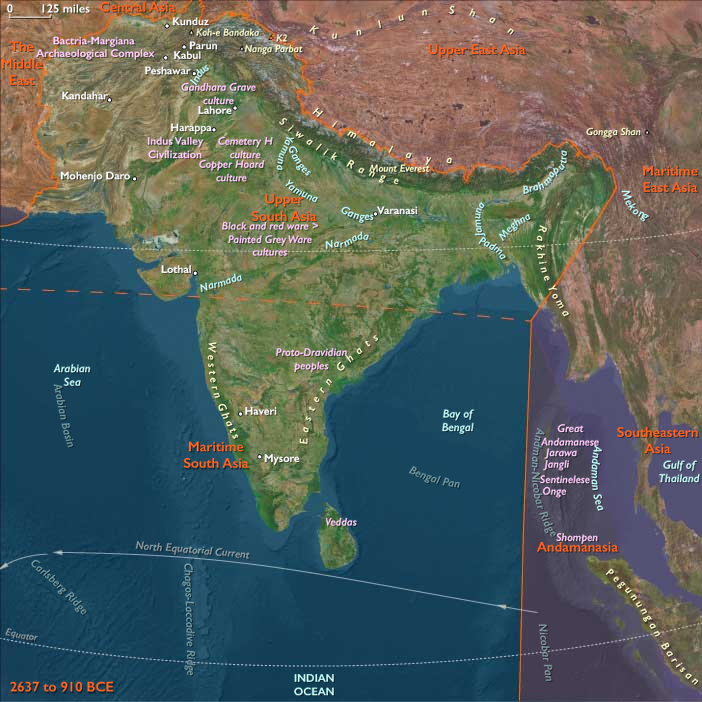
Hallur, South India's earliest Iron Age site, lies in a semiarid region with scrub vegetation, located on the banks of the river Tungabhadra.
Located in the present Haveri district (which was carved out of Dharwad district), in the Indian state of Karnataka, the site is a low mound about six point four meters high.
The excavations at Hallur by Nagaraja Rao revealed two periods of occupation, Period I: Neolithic-Chalcolithic and Period II: An overlapping period between the Neolithic-Chalcolithic andthe early Iron Age.
Period I consisted of two sub-phases of human occupation dating between 2000 BCE and 1200 BCE.
The transition to the Iron Age in South India took place between 1200 and 1000 BCE.
The original interpretation after the 1960s excavations was that Period II represented a new set of humans who arrived at this site with iron arrowheads, daggers and knives.
Pottery in this period was generally black-and-red ware with lines and patterns in white drawn over them.
More recent scholarship, however, argues for the indigenous cultural development from the Neolithic to the Iron Age and population continuity.
The iron found in this site was subjected to radiocarbon dating by the Tata Institute of Fundamental Research and it was found that these iron objects belonged to about 1000 BCE.
Further excavations by archaeozoologist K. R. Alur in 1971 led to the discovery of horse bones (Equus caballus Linn), which were dated to a period before the presumed Aryan invasion.
Archaeobotanical findings at Hallur indicated that the Neolithic staples consisted of browntop millet (Brachiaria ramosa), bristly foxtail (Setaria verticillata), mung bean, black gram, and horsegram.
This site also produced some of the earliest evidence for crops of African origin in South India, including both hyacinth bean and pearl millet.
In the later Iron Age period, the site features finger millet, kodo millet, and rice.
Ornaments made of carnelian, ceramic, gold and antler were also found.
Apart from the bones of the horse, bones of cattle, sheep, goat and dog were found.
The housing structures found here consist of circular floors, composed of schist chips and mud pounded hard to make a hard surface.
The walls are made of bamboo and mud, providing support to a conical thatched roof One of the houses was found to have a circular fireplace containing ash and charcoal.
The region below the floors is a burial chamber consisting of urns used for child burials Chalcolithic blade tools of black quartzite, small copper axes and fish hooks were also found.
The transition to the Iron Age period is marked by the presence of megaliths and iron implements.
Locations
Commodities
Regions
South Asia
View →Subregions
