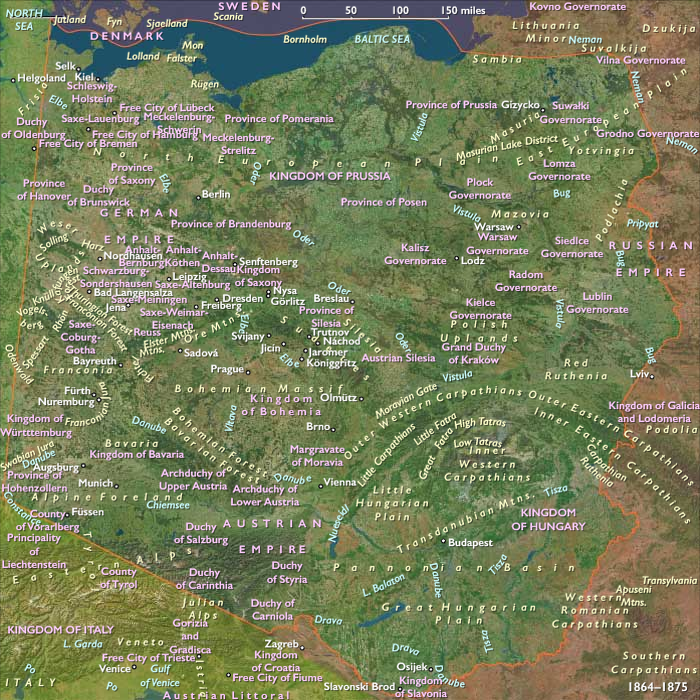
Hanover had begun in an excellent position,…
June 1866 CE
Hanover had begun in an excellent position, as the Prussian attack happened to occur during Hanoverian summer exercises and their army is already mobilized.
Realizing the vast size of the total Prussian force, King George directs his nineteen thousand-man army under General Alexander von Arentschildt to quickly withdraw and march south to link up with Bavarian allies.
Prussia presses forty thousand total troops into Hanover, which then split into four detachments under Generals Falckenstein, Goeben, Flies, and Beyer.
General von Falckenstein, recognizing the absence of an army to fight, marches unopposed into the Hanoverian capital, north of the marching Hanoverians.
General Helmuth von Moltke, the Prussian theater commander, also orders Goeben to the north, and in turn deploys Beyer to the Hanoverians’ south and Flies, with nine thousand troops, quickly marches around to the west.
This forms a box around the Hanoverian army with Prussia itself forming the Eastern side Moltke orders Flies to hold fast and intercept Hanoverians trying to break through westward as Falckenstein’s force perform he main Prussian assault from the north.
In direct defiance of his orders, General Flies gathers his detachment and directly attacks the Hanoverian army.
Following a feint toward Thamsbruck to the North, the Prussian forces under Flies make a concentrated assault toward Merxleben.
The much larger Hanoverian force and artillery fire drives them back toward the actual city of Langensalza.
Having a force more than twice the Prussian detachment’s size, Arentschildt severely routs Flies’ troops, capturing more than nine hundred men.
Although the Hanoverians attain a decisive victory in the actual battle, the fighting halts their movement and allows the other Prussian forces from the north and south to converge on the battle site.
Out of options, King George and the Hanoverians pull back to the East, further from their Bavarian allies.
Locations
People
Groups
Topics
Regions
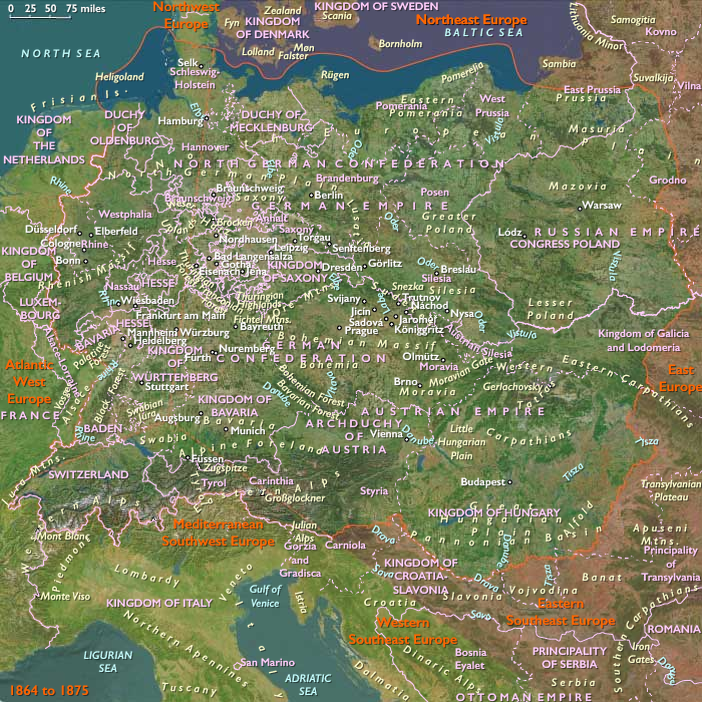
Central Europe
View →Subregions