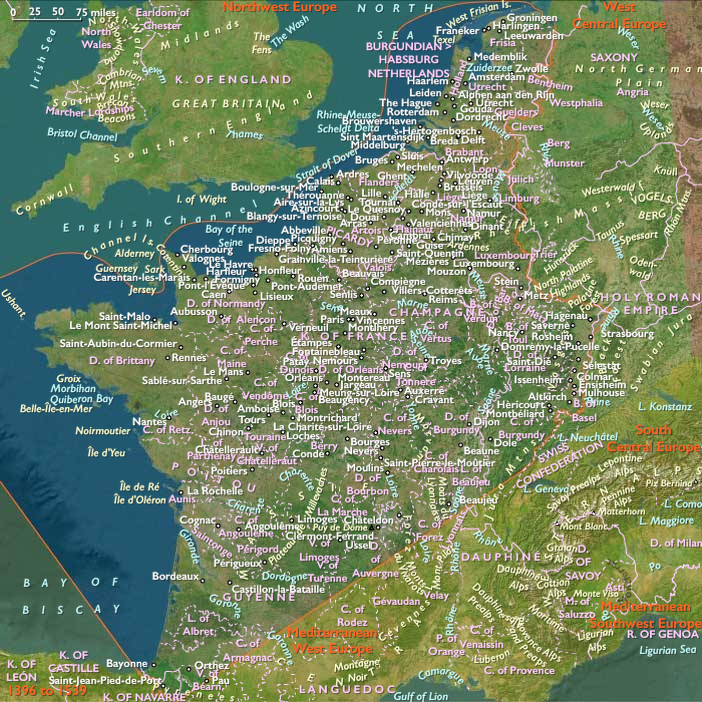
Hans Memling’s Masterpieces for the Hospital of…
1480 CE to 1491 CE
Hans Memling’s Masterpieces for the Hospital of Saint John (1487–1489)
In the final decades of the fifteenth century, the Flemish painter Hans Memling continued to refine his characteristic style of elegant spirituality, meticulous realism, and sophisticated composition. Among his most celebrated commissions were two significant works completed for the Hospital of Saint John in Bruges: the diptych portrait Martin van Nieuwenhove (1487), and the intricately crafted Shrine of Saint Ursula (1489), a painted reliquary depicting the legendary martyrdom of Saint Ursula and her companions.
Context and Patronage
By the late 1480s, Memling had firmly established himself as Bruges’ leading artist, attracting commissions from prestigious local institutions and prominent individuals. The Hospital of Saint John, an influential charitable institution and religious community, became one of Memling’s most important patrons, commissioning multiple devotional and commemorative works, reflecting Bruges’ continuing economic and cultural vitality.
The Diptych of Martin van Nieuwenhove (1487)
Memling’s diptych Martin van Nieuwenhove exemplifies his skill in combining portraiture with devotional themes. This diptych portrays the young Bruges nobleman, Martin van Nieuwenhove, at prayer, gazing reverently towards the Virgin Mary holding the infant Christ. Memling’s precise attention to detail in the portrayal of textures—fabrics, jewels, and architectural elements—along with his use of subtle, carefully modulated light to unify the scene, underscores his mastery in harmoniously blending secular portraiture with religious devotion.
The Shrine of Saint Ursula (1489)
In 1489, Memling completed one of his most ambitious and significant commissions: the Shrine of Saint Ursula, a lavishly decorated reliquary designed as a miniature Gothic chapel, adorned with six panels illustrating scenes from the martyrdom of Saint Ursula and her legendary retinue of companions. Each panel demonstrates Memling’s characteristic style: meticulous realism, narrative clarity, sophisticated composition, and harmonious use of color and lighting to create vivid, lifelike imagery.
The panels narrate the story of Ursula’s pilgrimage, martyrdom, and subsequent reverence, with rich visual detail and emotional sensitivity. Memling’s precise rendering of landscapes, urban settings, and the elegant figures in these scenes vividly brings the narrative to life, exemplifying Flemish artistry’s extraordinary capacity for realism and visual storytelling.
Stylistic Innovations and Characteristics
Memling’s devotional works, including the diptych and Saint Ursula’s Shrine, reveal his distinctive artistic approach, defined by refined naturalism, compositional balance, and harmonious spatial arrangement. He skillfully unifies complex narrative and devotional imagery through meticulous rendering of figures and scenes, subtle and realistic lighting effects, and a refined aesthetic that blends Gothic elegance with emerging Renaissance sensibilities.
Long-term Historical and Artistic Significance
The commissions for the Hospital of Saint John reflect Memling’s exceptional talent, continuing popularity, and the deep religious devotion characteristic of late medieval Bruges. The Shrine of Saint Ursula, in particular, was acclaimed not only for its artistic excellence but also for its religious significance, reinforcing Memling’s lasting influence on religious art across Europe.
Memling’s late masterpieces significantly influenced Flemish painting, notably shaping subsequent generations’ devotional imagery and portraiture practices. His innovative blending of realism and spirituality directly impacted European art, influencing later artists in both Northern and Southern Europe.
Thus, Memling’s works for the Hospital of Saint John encapsulate the height of Flemish artistic achievement during this pivotal period in Atlantic West Europe, exemplifying the sophisticated interplay between religious devotion, artistic innovation, and patronage in late medieval Europe.
People
Groups
Regions

West Europe
View →Subregions