Heraclius instructs his general Vahan not to…
August 636 CE
Heraclius instructs his general Vahan not to engage in battle with the Muslims before receiving explicit orders; however, fearing more Arab reinforcements, Vahan attacks the Muslim army in the Battle of Yarmouk.
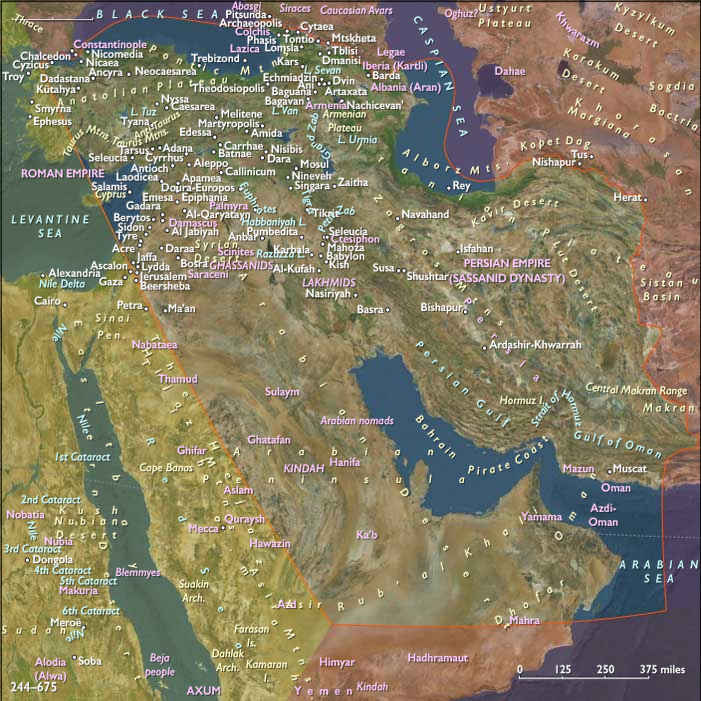
Khalid had early in 636 withdrawn south of the Yarmouk, the eastern tributary of the Jordan River, before a powerful Roman force under Theodorus Trithurius that advances from the north and from the coast of Palestine.
The Roman armies are composed mainly of Christian Arab, Armenian, and other auxiliaries, however; and when many of these desert the Romans, Khalid, reinforced from Medina and possibly from the Syrian Arab tribes, attacks and destroys the remaining Roman forces along the ravines of the Yarmuk valley on August 20, 636.
Almost fifty thousand Roman troops are slaughtered, opening the way for many other Islamic conquests.
The defeat forces the empire to surrender most of Syria; the Muslims gain control of Homs in 636.
This battle, which effectively completes the Muslim conquest of Syria, will be regarded as one of the most decisive battles in military history, marking the first great wave of Muslim conquests after the death of Muhammad.
Locations
People
Groups
Topics
Commodities
Subjects
Regions

The Near and Middle East
View →Subregions