West Africa (909 BCE–819 CE) Inland Rivers,…
909 BCE to 819 CE
West Africa (909 BCE–819 CE)
Inland Rivers, Sahelian Exchange, and Emerging Regional Kingdoms
Geographic and Environmental Context
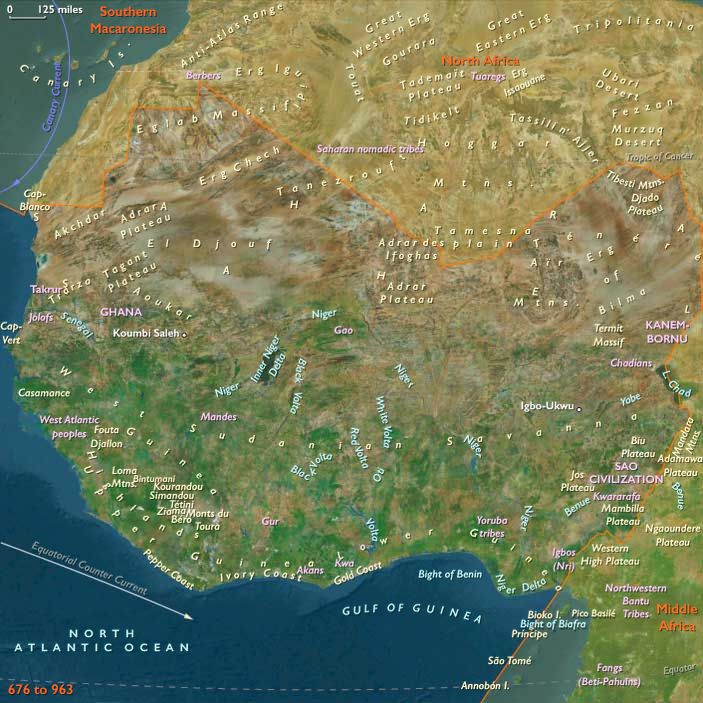
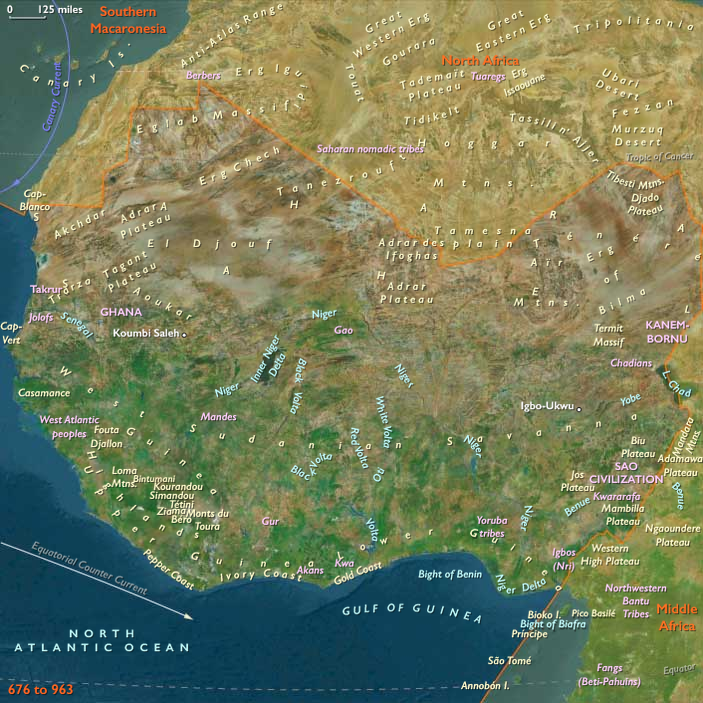
West Africa encompasses the Atlantic and inland belt extending from Senegal and Mauritania eastward through Mali, Burkina Faso, Niger, western and central Nigeria, and the forest–savanna transition zones of Guinea, Sierra Leone, Liberia, Côte d'Ivoire, Ghana, Togo, and Benin.
The region united several of western Africa's great ecological provinces: the Senegal and Gambia river valleys, the Inland Niger Delta, the Middle Niger Basin, the Upper Volta drainage, the Futa Jallon Highlands, the Jos Plateau, Hausaland, the Gold Coast forest margins, and the Dahomey Gap.
Seasonal flooding of the Niger River, together with broad gradients between Sahara, Sahel, savanna, and tropical forests, organized agriculture, fisheries, grazing, woodland resources, and long-distance movement across the region.
Climate and Environmental Shifts
Recurring aridity pulses periodically altered rainfall across the Sahel, yet the Niger River system, Senegal Valley, and associated wetlands buffered many environmental fluctuations. Seasonal flooding continued sustaining highly productive floodplains whose ecological diversity allowed communities to adapt successfully through changing climatic conditions.
Societies and Political Developments
Communities increasingly organized themselves around productive river valleys, floodplains, grazing lands, and forest margins.
Along the western Sahel, increasingly coordinated lineage communities gradually developed into the foundations of later regional kingdoms. Throughout Hausaland and the Middle Niger Basin, permanent farming towns expanded while remaining closely integrated with surrounding agricultural landscapes. Forest–savanna transition zones supported numerous dispersed farming communities linked through exchange rather than centralized authority.
Political organization remained largely regional, with lineage leaders, clan councils, ritual specialists, and local rulers coordinating access to water, farmland, grazing, fisheries, and exchange.
Economy and Trade
Mixed farming, livestock keeping, fishing, woodland resource management, and regional craft production formed highly diversified economies.
Salt, gold, iron, livestock, grain, forest products, kola nuts, and prestige goods circulated through expanding riverine and overland exchange systems. The Inland Niger Delta increasingly functioned as one of western Africa's principal ecological and commercial crossroads connecting savanna, forest, and Sahara.
Technology and Material Culture
Iron metallurgy became widespread throughout much of the region. Agricultural tools, weapons, pottery, weaving, leatherworking, canoe construction, and regional craft traditions diversified alongside expanding urban and village economies. Defensive earthworks, compounds, and increasingly specialized production characterized many larger settlements.
Belief and Symbolism
Ancestors, rivers, fertility, sacred groves, agricultural cycles, and local spirits remained central to religious life. Shrines, ritual specialists, divination traditions, and seasonal ceremonies reflected enduring relationships between communities and their environments.
Environmental Adaptation and Resilience
Communities maintained resilience through diversified farming, fishing, herding, woodland gathering, and exchange. The ecological diversity linking floodplains, savannas, forests, and highlands allowed populations to respond flexibly to periodic drought while maintaining expanding regional interaction.
Legacy and Transition
By 819 CE, West Africa had become an interconnected ecological mosaic of floodplains, savannas, forests, grazing corridors, and river systems whose communities organized agriculture, fishing, metallurgy, exchange, and ritual around enduring environmental rhythms. Expanding regional exchange, increasingly coordinated river-centered societies, and resilient local political organization established the environmental and social foundations upon which the great Sahelian kingdoms and forest states of the medieval centuries would later emerge.
Groups
Commodities
Subjects
Regions
West Africa
View →Subregions