
Hunyadi provisions and arms the fortress of…
1455 CE
Hunyadi provisions and arms the fortress of Semendria, collects a considerable army of mercenaries funded by the first tax ever levied on Hungary's nobles, and is joined by a poorly equipped and ragged army of peasants.
Locations
Groups
Commodities
Subjects
Regions
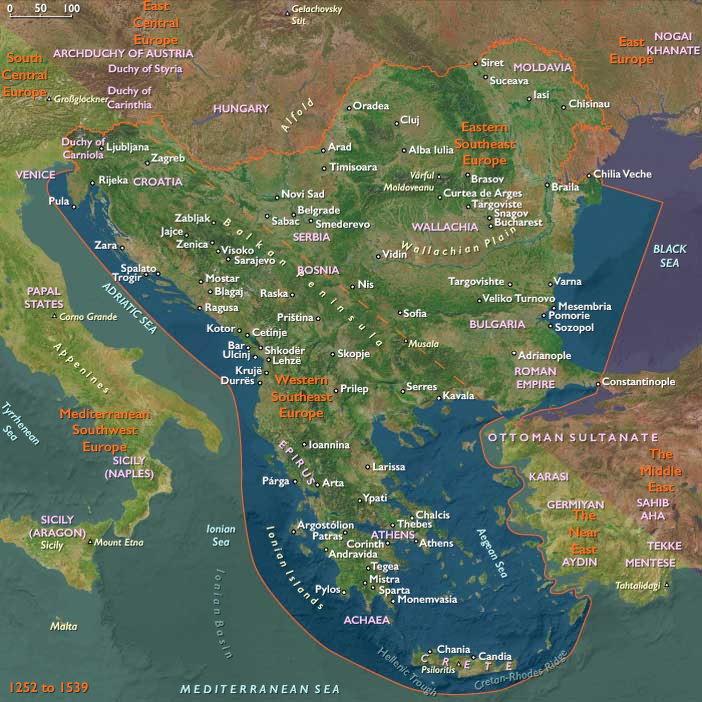
Southeast Europe
View →Subregions
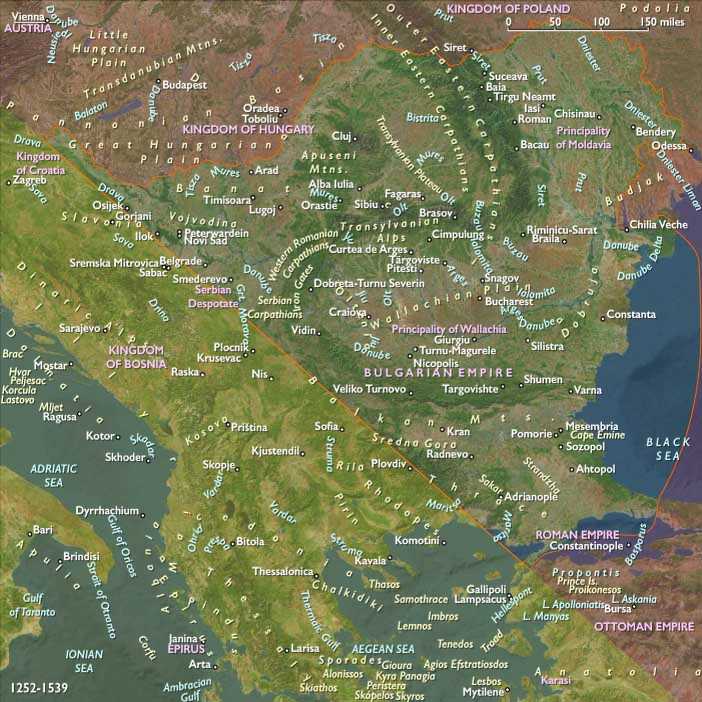
Eastern Southeast Europe
View →Related Events
Showing 10 events out of 3129 total
Philip the Good and Burgundian Luxury: Patronage, Taste, and Manuscript Culture (Mid-15th Century)
By the mid-15th century, the court of Philip the Good, Duke of Burgundy, had emerged as a leading center of cultural refinement and artistic patronage, setting trends in taste and luxury that reverberated throughout Atlantic West Europe. Philip’s court, itinerant among major Burgundian cities—Bruges, Brussels, and Lille—became widely renowned for extravagant festivities, artistic innovation, and sophisticated courtly fashion, significantly influencing broader European elite tastes.
Philip's passionate interest in the arts, particularly manuscript illumination, dramatically transformed the cultural landscape of northern Europe. An avid collector and bibliophile, Philip added approximately six hundred manuscripts to the Burgundian ducal library, making him the most influential manuscript patron in northern Europe at this time. Under his reign, wealthy English and European patrons increasingly favored Netherlandish illuminated manuscripts over traditional English or Parisian styles, reflecting the Burgundian region's growing artistic prestige.
Among the most prestigious and lavish manuscripts were those produced under Philip’s personal direction, often facilitated by his secretary and translator, Jean Miélot, and by key figures such as Jean Miélot (sometimes spelled Miélot), who specialized in translating texts into French. Manuscripts intended for Philip underwent a meticulous process: first a draft version or “minute,” complete with sketches for illumination and initial lettering, was prepared. If approved at court readings, these drafts would then be produced as luxurious manuscripts on high-quality vellum, richly illuminated by the finest Netherlandish artists.
The international prestige of Philip’s manuscripts shifted elite European demand toward Flemish and Netherlandish illuminators, eclipsing previous centers of manuscript production. Wealthy English patrons, who had previously favored English or Parisian illumination, turned increasingly to Burgundian and Netherlandish artists, reflecting the broader European recognition of the artistic and cultural preeminence of Philip’s court.
Philip's sophisticated patronage fostered a lasting shift in European artistic taste and manuscript culture, underscoring Burgundy’s status as a nexus of cultural innovation, luxury, and refined artistic sensibility during the later stages of the medieval period.
François Villon: Poetry, Violence, and Exile (1455)
In 1455, the celebrated French poet François Villon became embroiled in a violent incident that drastically reshaped his life and literary career. Born in Paris and deeply connected to its vibrant urban underworld, Villon was renowned for his poetic wit, biting social commentary, and intimate portrayals of Parisian street life. However, in June of that year, Villon’s turbulent lifestyle culminated in tragedy when he fatally stabbed a priest during a brawl. As a consequence, Villon was banished from Paris, marking a pivotal turning point in both his life and literary work.
During this period of exile and personal turmoil, Villon likely composed his significant early poem, Le Petit Testament("The Small Testament"), also known as Le Lais (“The Legacy”). A poetic meditation structured as a satirical will, the work vividly portrays the realities of urban poverty, personal regret, and existential introspection. Villon's distinctive voice emerges forcefully, blending playful irony and deep pathos, setting the stage for his later, more famous work, Le Grand Testament.
The expulsion from Paris and the subsequent period of itinerancy profoundly shaped Villon’s poetic identity, enhancing his literary reputation as a figure symbolic of the restless and uncertain social conditions in mid-fifteenth-century France. His exile, reflective of a broader context of social unrest and strict urban judicial practices, positioned Villon as a poignant voice capturing the fragility, violence, and humanity of Atlantic West Europe’s urban landscape at the threshold between the medieval and early modern worlds.
Atlantic West Europe: Shifting Alliances, Economic Expansion, and Artistic Flourishing (1456–1467)
The era 1456–1467 in Atlantic West Europe during the Upper Late Medieval Age (1396–1539) is defined by intensified political realignments, robust economic development, artistic innovation, and influential cultural exchange, laying the groundwork for transformative regional changes.
Political and Military Developments
This decade witnesses major shifts in alliances and power structures. In France, King Charles VII successfully reasserts royal authority, diminishing the power of independent nobles. After Charles’s death in 1461, his son Louis XI ascends the throne, initiating a policy of strategic diplomacy, alliances, and centralized governance, frequently clashing with Burgundy under Philip the Good and later Charles the Bold. England plunges deeper into the conflict of the Wars of the Roses, profoundly affecting its continental ambitions and shifting its attention inward. Meanwhile, Burgundy continues to consolidate its territorial and diplomatic influence, positioning itself as a major rival to the French crown.
Economic Developments
Economic prosperity continues across the region, particularly in the wealthy cities of Bruges, Ghent, Antwerp, and along the Loire Valley. Textiles, luxury goods, and maritime trade flourish, expanding the wealth and influence of powerful merchant families and guilds. Increased trade between Atlantic West Europe and the Mediterranean, driven by Flemish and Portuguese merchants, enhances economic diversity and establishes the region as a commercial hub for Northern and Southern European exchange. The rising prosperity of the middle classes contributes significantly to urban development and infrastructural expansion.
Cultural and Artistic Trends
Artistic innovation and cultural patronage reach new heights, particularly under the sophisticated Burgundian court. Philip the Good continues to support artists, musicians, and intellectuals, making Burgundy a center of European cultural life. Masterworks by Rogier van der Weyden and Petrus Christus exemplify the rich emotional expression, detailed realism, and technical mastery characteristic of Flemish painting in this period. In France, increased royal patronage under Louis XI encourages the flourishing of intellectual and humanist traditions, fostering literary advancements and greater academic prestige.
Technological and Societal Changes
Improvements in naval technology, particularly advances in shipbuilding and navigation, contribute significantly to expanding Atlantic trade routes. The use of more effective firearms and cannons continues to reshape military tactics and fortification design. Societal change is evident as urban centers grow increasingly influential, with merchants and artisans attaining greater economic and social power. Literacy rates steadily rise due to improved educational access among urban middle classes.
Long-term Consequences and Significance
The period from 1456 to 1467 solidifies fundamental shifts in power dynamics within Atlantic West Europe. The assertive centralization under Louis XI and Burgundian diplomatic ambition set the stage for future conflicts and alliances. Economically, this era reinforces the region's growing importance as a nexus of European trade, integrating Atlantic West Europe into broader commercial networks. Culturally, the artistic excellence fostered under Burgundian patronage profoundly influences subsequent European artistic traditions.
This decade thus represents a crucial era of transition and expansion, enhancing political stability, accelerating economic integration, and cementing the region’s cultural influence within late medieval Europe.
The Liège Wars: Revolts Against Burgundian Expansion (1465–1468)
The Wars of Liège were a series of rebellions occurring between 1465 and 1468 in the city of Liège (in present-day Belgium). The revolts were driven by local opposition to the territorial ambitions of the increasingly powerful Duchy of Burgundy, then under the rule of Charles the Bold.
Burgundian forces decisively defeated the rebels in each of the conflicts. Charles the Bold himself commanded the Burgundian troops, and in punitive retaliation, the city of Liège was twice razed, inflicting devastating losses and leaving the town in ruins. The episodes underscored Burgundy's military dominance in the region, though they also highlighted growing resentment toward its aggressive expansionist policies.
Warwick’s Appointment to the Captaincy of Calais (1456)
Richard Neville, Earl of Warwick, reached a pivotal moment in his political and military career with his appointment as Captain of Calais in 1456. This strategic posting provided Warwick not only with considerable military resources but also control of England’s primary gateway to Continental Europe, serving as a critical power base during the tumultuous years ahead.
Political and Military Context
Calais was far more than a mere administrative position—it represented a linchpin in English diplomacy and warfare. Its fortress and surrounding lands offered a powerful stronghold from which military campaigns into France could be launched, or threats from the continent repelled. Warwick’s control of Calais granted him authority over a key strategic stronghold, enabling him to influence English politics significantly at a time when internal tensions—particularly between the factions loyal to the houses of Lancaster and York—were escalating toward civil war.
Economic and Military Significance
Beyond its military significance, Calais was economically vital as a thriving trade center and a critical source of revenue through customs duties and trade levies. As Captain, Warwick could leverage this wealth to fund his military operations, sustain his armies, and further solidify his political position at home. Additionally, the Calais garrison, largely loyal to Warwick personally, provided him a dependable military force that would prove instrumental in future conflicts.
Political and Cultural Impact
Warwick’s command of Calais strengthened his reputation as one of England's most powerful magnates, known as "the Kingmaker," and gave him leverage to negotiate directly with continental powers, enhancing his diplomatic influence. Calais under Warwick's leadership became a center of political intrigue and diplomatic exchange, significantly influencing the ongoing power struggles within England itself.
This appointment laid the foundations for Warwick's later role in the Wars of the Roses, dramatically affecting England's political landscape and marking a turning point in his career and the broader trajectory of Atlantic West European history.
Warwick’s Piratical Raids of 1458
In May 1458, Richard Neville, Earl of Warwick, acting independently of royal authority, boldly launched a series of highly successful maritime raids from his stronghold at Calais. Defying King Henry VI’s directives, Warwick first attacked a significant Castilian fleet, capturing valuable ships and cargo, and soon afterward targeted the influential Hanseatic League’s fleet. Both actions were executed with remarkable precision and daring, reinforcing Warwick’s formidable military reputation.
Military and Political Implications
Warwick’s unauthorized attacks significantly strained England’s diplomatic relationships, particularly with Castile and the powerful Hanseatic League—a northern European commercial alliance crucial to England’s economy. By openly defying royal authority, Warwick underscored the weakening influence of King Henry VI's government, signaling to domestic rivals and foreign powers alike that royal control over England’s nobility was tenuous at best.
Economic and Geopolitical Context
The piracy against Castilian and Hanseatic fleets highlighted Warwick's independence, underlining the strategic importance of Calais as a military and economic power base. These raids, though controversial, enriched Warwick and provided him with additional resources and influence, further consolidating his power independently from the English crown. Meanwhile, his piracy exacerbated existing tensions between England and European maritime powers, complicating future trade and diplomatic interactions.
Cultural and Diplomatic Consequences
Warwick’s aggressive maritime campaigns vividly demonstrated his disregard for royal authority, deepening the divide between himself and the Lancastrian court. Internationally, the actions damaged England’s standing among European trading powers and demonstrated the fragile nature of royal control during the buildup to the Wars of the Roses.
Ultimately, Warwick’s piracy underscored his role as a key political player willing to challenge royal authority directly, significantly contributing to the volatile political climate of Atlantic West Europe during the late medieval period.
Commissioning of the “Story of Alexander” Tapestries (1459)
In 1459, Philip the Good, Duke of Burgundy, further solidified his reputation as a sophisticated patron of the arts by commissioning a grand series of tapestries depicting the "Story of Alexander the Great." Crafted by the finest weavers in the Burgundian territories, these lavish tapestries symbolized the duke's cultural prestige and ambition. The commission, notably executed in the renowned workshops of the Low Countries, emphasized the region's flourishing textile industry, particularly in the cities of Bruges and Tournai.
Artistic and Economic Significance
This elaborate tapestry cycle was purchased from workshops in Tournai, where skilled craftsmen, including those overseen by prominent master weaver Pasquier Grenier, transformed luxurious wool and silk into works of immense artistic sophistication. The tapestries’ depiction of Alexander the Great, a classical figure emblematic of power and military valor, drew clear parallels to the duke's own aspirations and underscored the cultural exchange and artistic innovation flourishing in Atlantic West Europe during the late medieval period.
Cultural and Political Context
The commissioning of the Alexander tapestries not only affirmed the Burgundian Court’s commitment to artistic patronage but also articulated a potent political message: drawing parallels between Alexander’s legendary empire and Burgundian dynastic ambition. Such artistic projects were thus as much statements of political power as they were demonstrations of cultural sophistication, helping to legitimize dynastic power in a volatile period marked by political rivalries and shifts in power.
Long-Term Impact
The “Story of Alexander” tapestries reinforced the Burgundian court’s position as a hub of European artistic and cultural excellence, significantly influencing tapestry design throughout Europe. These masterpieces served as both political symbols and cultural treasures, demonstrating the broader integration of art, commerce, and politics in the complex tapestry of late medieval society in Atlantic West Europe.
The Transfer of Béarn's Capital to Pau (1459)
In 1459, the sovereign principality of Béarn, a strategically significant territory in the foothills of the Pyrenees, shifted its capital from Orthez to ...
...the burgeoning town of Pau. This pivotal relocation, spearheaded by Gaston IV of Foix-Béarn, marked a decisive moment in Béarn's assertion of its autonomy during a period when powerful neighbors—particularly the English, Spanish, and French crowns—were increasingly encroaching upon its independence.
Political and Military Context
Moving the capital to Pau allowed Béarn to assert greater administrative and military control at a crucial geographic crossroads, fortifying the principality’s defensive position against rival regional powers. The new capital, strategically positioned near the mountains, facilitated more effective governance and stronger defense networks, crucial for Béarn's continued autonomy amidst the shifting alliances and territorial ambitions of England, France, and Castile-Aragon.
Cultural and Economic Impact
The establishment of Pau as the new administrative center encouraged cultural and economic growth. It quickly evolved into a regional hub for commerce and diplomacy, drawing merchants, artisans, and scholars from throughout Atlantic Southwest Europe. This shift fostered cultural development and economic prosperity, enhancing Béarn’s reputation as a stable, influential entity amid the fractious political landscape of late medieval Europe.
Artistic and Cultural Significance
The relocation to Pau prompted significant cultural developments, transforming the city into a dynamic cultural and intellectual center. Enhanced patronage led to architectural expansions, including the construction of significant structures such as the fortified Château de Pau, later famous as the birthplace of future French King Henry IV. This period laid foundations for Pau's later prominence in art, architecture, and cultural identity within the region.
Long-Term Consequences
The principality's choice to relocate its capital to Pau solidified Béarn's autonomy and resilience during a turbulent period, shaping its distinctive regional identity. Béarn would continue to navigate complex relationships with neighboring powers, including France, Spain, and England, maintaining its cultural and political distinctiveness into subsequent centuries. This historical shift in 1459 remains emblematic of Béarn’s enduring determination to retain its independence amid broader geopolitical transformations in Atlantic West Europe.
Dirk Bouts and The Entombment (c. 1456–1459)
Around 1456–1459, Flemish painter Dirk Bouts completed one of his influential early masterpieces, The Entombment. This painting, often previously identified as The Lamentation or The Entombment of Christ, demonstrates Bouts's meticulous attention to emotional depth and striking realism, characteristic of the Northern Renaissance artistic tradition in Atlantic West Europe. Notably, this work has occasionally been confused or conflated with another painting attributed to him, commonly but inaccurately known as The Pirna Altarpiece or the "Lamentation Triptych."
Artistic and Cultural Context
Bouts's painting emphasizes emotional intensity, realism, and the delicate use of color, representative of Northern European artistic innovations of the mid-fifteenth century. The work's stark yet poignant depiction of grief highlights a profound devotional spirituality characteristic of Bouts and his contemporaries, marking a shift from stylized medieval iconography to more personal, humanized religious expression.
Economic and Social Significance
Commissioned for affluent patrons in the Low Countries, paintings such as The Entombment reflect a growing market among wealthy merchants and nobility who sought works with both devotional and aesthetic value. The increasing prosperity of cities like Leuven, where Bouts maintained his workshop, fueled demand for sophisticated religious artworks, aligning with broader economic trends within Atlantic West Europe.
Long-Term Impact
This painting established Bouts’s reputation as a master of devotional art, influencing subsequent generations of Northern Renaissance artists. His unique synthesis of realism and emotional expression would shape Flemish painting traditions well into the following decades, positioning him among key figures—such as Rogier van der Weyden and Hans Memling—influencing Northern Renaissance art.
Bouts's meticulous technique and emotional nuance continued to influence artistic trends across Europe for generations, firmly situating him among the pivotal Flemish painters of his era.