The expansion of a colonial administrative apparatus…
1540 CE to 1683 CE
The expansion of a colonial administrative apparatus and bureaucracy parallels the economic reorganization.
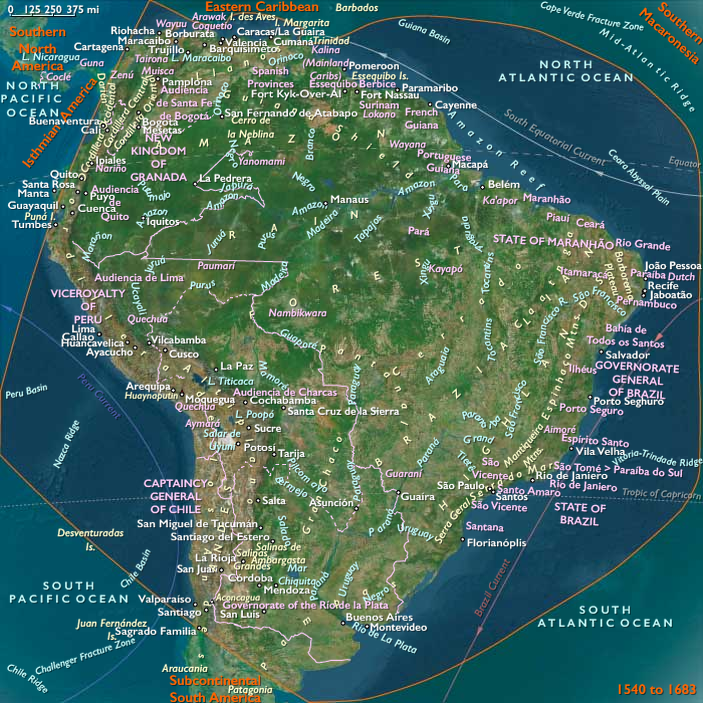
The vice-royalty is divided into audiences (audiencias), which are further subdivided into provinces or districts (corregimientos) and finally municipalities.
The latter includes a city or town, which is governed by a town council (cabildo) composed of the most prominent citizens, mostly encomenderos in the early years and later hacendados.
The most important royal official is the viceroy, who has a host of responsibilities ranging from general administration (particularly tax collection and construction of public works) and internal and external defense to support of the church and protection of the native population.
He is surrounded by a number of other judicial, ecclesiastical, and treasury officials, who also report to the Council of the Indies, the main governing body located in Spain.
This configuration of royal officials, along with an official review of his tenure called the residencia, serves as a check on viceregal power.
In the early years of the conquest, the crown is particularly concerned with preventing the conquistadors and other encomenderos from establishing themselves as a feudal aristocracy capable of thwarting royal interests.
Therefore, it moves quickly to quell the civil disturbances that had racked Peru immediately after the conquest and to decree the New Laws of 1542, which deprived the encomenderos and their heirs of their rights to native American goods and services.
The early administrative functions of the encomenderos over the indigenous population (protection and Christianization) are taken over by new state-appointed officials called corregidores de indios (governors of Indians).
They are charged at the provincial level with the administration of justice, control of commercial relations between native Americans and Spaniards, and the collection of the tribute tax.
The corregidores (Spanish magistrates) are assisted by curacas, members of the native elite, who had been used by the conquerors from the very beginning as mediators between the native population and the Europeans.
Over time the corregidores use their office to accumulate wealth and power.
They also dominate rural society by establishing mutual alliances with local and regional elites such as the curacas, native American functionaries, municipal officials, rural priests (doctrineros), landowners, merchants, miners, and others, as well as native and mestizo subordinates.
As the crown's political authority is consolidated in the second half of the sixteenth century, so too is its ability to regulate and control the colonial economy.
Operating according to the mercantilistic strictures of the times, the crown seeks to maximize in- vestment in valuable export production, such as silver and later other mineral and agricultural commodities, while supplying the new colonial market with manufactured imports, so as to create a favorable balance of trade for the metropolis.
However, the tightly regulated trading monopoly, headquartered in Seville, is not always able to provision the colonies effectively.
Assadourian shows that most urban and mining demand, particularly among the laboring population, was met by internal Andean production (rough-hewn clothing, foodstuffs, yerba mate tea, chicha beer, and the like) from haciendas, indigenous communities, and textile factories (obrajes).
According to him, the value of these Andean products amounted to fully sixty to seventy percent of the value of silver exports and elite imports linking Peru and Europe.
In any case, the crown is successful in managing the colonial export economy through the development of a bureaucratic and interventionist state, characterized by a plethora of mercantilistic rules that regulate the conduct of business and commerce.
In doing so, Spain leaves both a mercantilist and export-oriented pattern and legacy of "development" in the Andes that has survived up to the present day, and which remains a problem of contemporary underdevelopment.
Locations
People
Groups
Topics
Commodities
Subjects
Regions
South America
View →Subregions