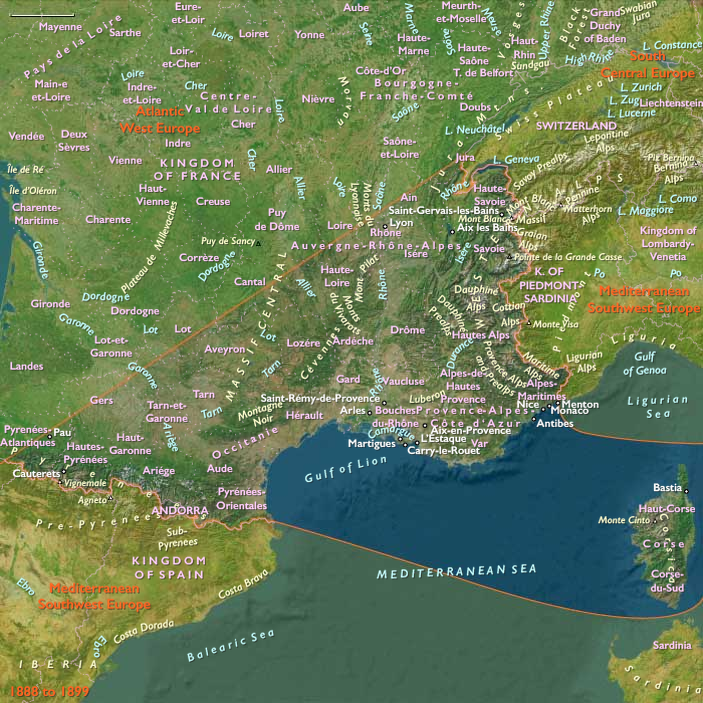
Van Gogh rents a studio, the "Yellow…
1888 CE
Inspired by the bright colors and strong light of Provence, he enters a period of sustained creative activity.
He has little to distract him from his painting, for he knows almost no one: "Whole days go by without my speaking a single word to anyone."
He befriends the local postman, Joseph Roulin, and paints portraits of his entire family as well as of his few other acquaintances.
In the pictures he creates over the following twelve months—depicting blossoming fruit trees, views of the town and surroundings, self-portraits, portraits of Roulin and other friends, interiors and exteriors of the house, sunflowers, and landscapes—he strives to respect the external, visual aspect of a figure or landscape but finds himself unable to suppress his own feelings about the subject, which find expression in emphatic contours and heightened effects of color.
Painting outdoors, often in a single long session, he identifies each season and subject with characteristic colors: "The orchards stand for pink and white, the wheatfields for yellow."
For Bedroom in Arles, he depicts his room with a stark simplicity, using uniform patches of complementary orange and blue, yellow and violet, red and green.
He writes to Paul Gauguin: "I wanted all these different colors to express a totally restful feeling."
Late in October 1888, Gaugin accepts van Gogh's invitation to travel to Arles to stay with him (partly as a favor to van Gogh's brother, Theo, who has agreed to represent him).
In anticipation of his arrival, van Gogh paints still lifes of sunflowers to decorate Gauguin's room.
The flowers represent the sun, the dominant feature of the Provencal summer (Gauguin will later describe the paintings as "completely Vincent.").
However, as soon as Gauguin arrives, the two volatile artists begin often to engage in heated exchanges about art's purpose.
The style of the two men's work from this period (which the English art critic Roger Fry will later classify as Post-Impressionist) shows an individual, personal development of Impressionism's use of color, brushstroke, and non-traditional subject matter.
For example, Gauguin's Old Women of Arles (1888, the Art Institute of Chicago) portrays a group of women moving through a flattened, arbitrarily conceived landscape in a solemn procession.
As in much of his work from this period, Gauguin applies thick paint in a heavy manner to raw canvas; in his rough technique and in the subject matter of religious peasants, the artist finds something approaching his burgeoning "primitive" ideal.
The two men exchange portraits: Gauguin makes a portrait of Vincent in front of one of his sunflower canvases, which Vincent describes as "certainly me, but me gone mad."
Gauguin had planned to remain in Arles through the spring, but his relationship with van Gogh grows even more tumultuous.
While each influences the other to some extent, their relations rapidly deteriorate because they have opposing ideas and are temperamentally incompatible.
Van Gogh, physically and emotionally exhausted, snaps under the strain.
He argues on Christmas Eve 1888, with Gauguin, reportedly chasing him with a razor, and then cuts off the lower half of his own left ear.
A sensational news story reports that a deranged van Gogh then visited a brothel near his home and delivered the bloody body part to a woman named Rachel, saying, "Guard this object carefully."
Whatever has transpired, Gauguin leaves for Paris after the incident, and van Gogh is admitted to the local hospital in Arles.
People
Subjects
Regions

West Europe
View →Subregions