
Vincent van Gogh
Dutch painter
1853 CE to 1890 CE
Vincent Willem van Gogh, or English: ˌvæn ˈɡɒx, 30 March 1853 – 29 July 1890) is a Dutch post-Impressionist painter whose work has a far-reaching influence on 20th century art for its vivid colors and emotional impact.
He suffers from anxiety and increasingly frequent bouts of mental illness throughout his life, and dies largely unknown, at the age of 37, from a self-inflicted gunshot wound.
Little appreciated during his lifetime, his fame grows in the years after his death.
Today, he is widely regarded as one of history's greatest painters and an important contributor to the foundations of modern art.
Van Gogh does not begin painting until his late twenties, and most of his best-known works are produced during his final two years.
He produces more than 2,000 artworks, consisting of around 900 paintings and 1,100 drawings and sketches.
Although he is little known during his lifetime, his work is a strong influence on the modernist art that follows.
Today many of his pieces—including his numerous self portraits, landscapes, portraits and sunflowers—are among the world's most recognizable and expensive works of art.
Van Gogh spends his early adulthood working for a firm of art dealers and travels between The Hague, London and Paris, after which he teaches in England.
An early vocational aspiration is to become a pastor and preach the gospel, and from 1879 he works as a missionary in a mining region in Belgium.
During this time he begins to sketch people from the local community, and in 1885 paints his first major work The Potato Eaters.
His palette at the time consists mainly of somber earth tones and shows no sign of the vivid coloration that distinguishes his later work.
In March 1886, he moves to Paris and discovers the French Impressionists.
Later he moves to the south of France and is taken by the strong sunlight he finds there.
His work grows brighter in color and he develops the unique and highly recognizable style which becomes fully realized during his stay in Arles in 1888.
The extent to which his mental illness affected his painting has been a subject of speculation since his death.
Despite a widespread tendency to romanticize his ill health, modern critics see an artist deeply frustrated by the inactivity and incoherence brought about by his bouts of sickness.
According to art critic Robert Hughes, Van Gogh's late works show an artist at the height of his ability, completely in control and "longing for concision and grace".
World
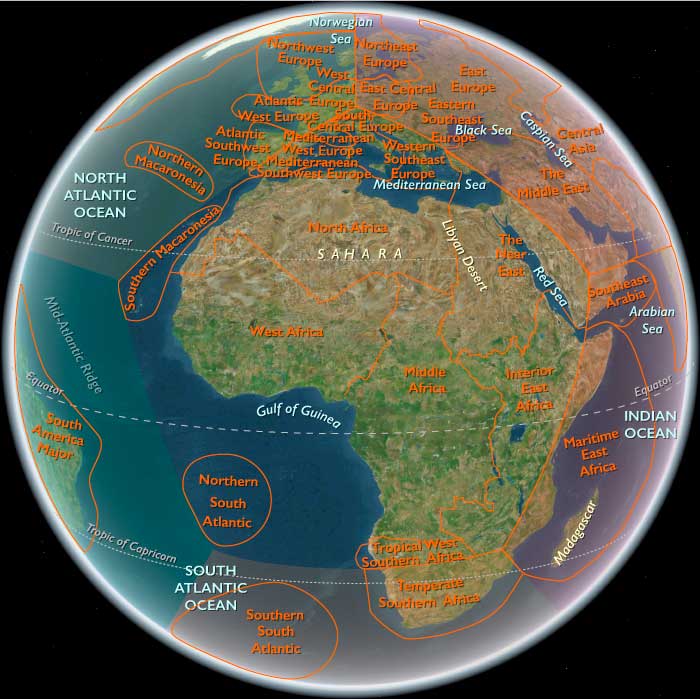
The Middle of The Earth
View →Related Events
Showing 10 events out of 27 total
It is now that Vincent van Gogh begins to draw seriously, thereby discovering in 1880 his true vocation as an artist.
Van Gogh decides that his mission from now on will be to bring consolation to humanity through art.
“I want to give the wretched a brotherly message,” he explained to his brother Theo. “When I sign [my paintings] 'Vincent,' it is as one of them.”
This realization of his creative powers restores his self-confidence, and he goes to study drawing at the Brussels Academy.
Born and reared in a small village in the Brabant region of the southern Netherlands, Vincent van Gogh, had been a quiet, self-contained youth, spending his free time wandering the countryside to observe nature.
At sixteen, he was apprenticed to The Hague branch of the art dealers Goupil and Co., of which his uncle was a partner.
Van Gogh had worked for Goupil in London from 1873 to May 1875 and in Paris from that date until April 1876.
Daily contact with works of art had aroused his artistic sensibility, and he had soon formed a taste for Rembrandt, Frans Hals, and other Dutch masters, although his preference is for two contemporary French painters, Jean-François Millet and Camille Corot (whose influence is to last throughout his life.)
Van Gogh disliked art dealing.
Moreover, his approach to life had darkened when a London girl rejected his love in 1874.
His burning desire for human affection thwarted, he has become increasingly solitary.
He had worked as a language teacher and lay preacher in England and, in 1877, worked for a bookseller in Dordrecht, The Netherlands.
Impelled by a longing to serve humanity, he envisaged entering the ministry and took up theology; however, he abandoned this project in 1878 for short-term training as an evangelist in Brussels.
A conflict with authority had ensued when he disputed the orthodox doctrinal approach.
Failing to get an appointment after three months, he left to do missionary work among the impoverished population of the Borinage, a coal-mining region in southwestern Belgium.
There, in the winter of 1879-80, he had experience the first great spiritual crisis of his life.
Living among the poor, he had given away all his worldly goods in an impassioned moment, and was thereupon dismissed by church authorities for a too-literal interpretation of Christian teaching.
Penniless and feeling that his faith had been destroyed, he had sunk into despair and withdrawn from everyone.
“They think I'm a madman,” he tells an acquaintance, “because I wanted to be a true Christian. They turned me out like a dog, saying that I was causing a scandal.”
Vincent van Gogh moves in 1881 to his father's parsonage at Etten, The Netherlands, and begins to work from nature.
Now twenty-eight, he works hard and methodically but soon perceives the difficulty of self-training and the need to seek the guidance of more experienced artists.
Van Gogh settles at The Haguelate in 1881 to work with Dutch painter Anton Mauve, whose wife is a cousin of his.
Vincent van Gogh, visiting museums and meeting with other painters, thereby extends his technical knowledge and experiments with oil paint, under Anton Mauve's tutelage, in the summer of 1882.
Vincent van Gogh's he urge to be “alone with nature” and with peasants takes him to Drenthe, an isolated part of the northern Netherlands frequented by Mauve and other Dutch artists, where he spends three months in 1883 before returning home, which is now at Nuenen, another village in the Brabant.
Artists not backed by the official Académie de peinture et de sculpture in charge of the exhibits at the annual Salon, or without support supplied by actual political constellations, had little chance to advance during the Second Empire.
From year to year the number of artists working in Paris, the number of artists submitting works to the official Salon and the number of works refused by the jury increased, but neither the Second Empire nor the Third Republic had found an answer to this situation.
For years, the artists had counted on official support.
In 1884, finally, the artists begin to organize themselves, and a "Group of independent artists" is authorized by the Ministry of Fine Arts to arrange an exhibition, while the City of Paris agrees to supply rooms for the presentation.
So, from May 15 through July 15, the first "free" exhibition of contemporary art shows more than five thousand works by more than four hundred artists.
Paul Signac, not yet twenty-one, helps found the Salon des Artistes Indépendants, an association “with neither jury nor prizes,” in 1884.
Here, he meets Seurat, whom he initiates into the broken-color technique of Impressionism.
Other founding members of the Société des Artistes Indépendants, which will accept the work of any artist who wishes to participate in its annual Salon, include Camille Pissarro, Henri-Edmond Cross, Albert Dubois-Pillet, Maximilien Luce, and Théo Van Rysselberghe.
The group's first show, held in the pavilion of the city of Paris, includes paintings by Odilon Redon, Paul Cézanne, Paul Gauguin, Henri de Toulouse-Lautrec, Vincent van Gogh, Cross, Seurat, and Signac.
Signac had given up the study of architecture for painting when he was eighteen, and, through Armand Guillaumin, had became a convert to the coloristic principles of Impressionism.
Vincent van Gogh remains at Nuenen during most of 1884 and 1885, and during these years his art has grown grow bolder and more assured.
He paints three types of subjects—still life, landscape, and figure—all interrelated by their reference to the daily life of peasants, to the hardships they endure, and to the countryside they cultivate.
Zola's Germinal (1885), a novel about the coal-mining region of France, greatly impresses van Gogh, and sociological criticism is implicit in many of his pictures from this period —e.g., Weavers and The Potato Eaters (1885, the Van Gogh Museum, Amsterdam, Netherlands).
Tensions develop when Vincent accuses his brother Theo of not making a sincere enough effort to sell the paintings Vincent has begun to send him.
Theo admonishes Vincent that his darkly colored paintings are not in the current Parisian style, where Impressionist artists are now using a bright palette.
Eventually, Vincent comes to feel too isolated in Nuenen.
His understanding of the possibilities of painting is evolving rapidly; from studying Hals, he has learned to portray the freshness of a visual impression, while the works of Paolo Veronese and Eugéne Delacroix have taught him that color can express something by itself.
This leads to his enthusiasm for Peter Paul Rubens and inspires his sudden departure for Antwerp, Belgium, where the greatest number of Rubens's works can be seen.
Van Gogh, invigorated by Antwerp's urbane atmosphere, writes, “I find here the friction of ideas I want.”
Taking account of the advice of the paint manufacturer, Tyck, whom he had met in early December, van Gogh buys a set of brighter colors in Antwerp, where the revelation of Rubens's mode of direct notation and of his ability to express a mood by a combination of colors proves decisive in the development of van Gogh's style.
Vincent van Gogh, newly arrived in Antwerp from the Netherlands and not yet thirty-three, now has access to better art supplies, the opportunity to draw from nude models, and exposure to the substantial collections of Dutch and Belgian art in the city's museums and galleries, particularly the paintings of Peter Paul Rubens.
Among the exotic goods entering Europe through Antwerp are Japanese woodblock prints, which van Gogh begins to collect.
The revelation of Rubens's mode of direct notation and of his ability to express a mood by a combination of colors proves decisive in the development of van Gogh's style.
All these sources influence him more than the academic principles taught at the Ecole des Beaux-Arts in Antwerp, where he had enrolled at the beginning of the year, and where he probably paints the humorous Skull of a Skeleton with Burning Cigarette (1886, Van Gogh Museum, Amsterdam).
His refusal to follow the academy's pedantic dictates leads to disputes, and at the end of February he leaves precipitately for Montmartre, Paris, to join his twenty-eight-year-old brother Theo, now director of the Boussod and Valadon gallery.