
Daun had slipped out of Silesia in…
November 1760 CE
When his government orders him to stand and fight the Prussians, Daun selects a position on the Süptitzer Höhen (Heights) just west of Torgau.
The plateau had been used by Prince Henry of Prussia in 1759 and is protected on the west by abatis and on the south by a small stream.
The Austrians face south with Lacy's corps nearest Torgau and Daun's army further west.
Altogether, Daun and Lacy marshal forty-two thousand infantry, ten thousand cavalry, and two hundred and seventy-five cannons.
Frederick determines to send General Hans Joachim von Zieten to hold Daun's attention from the south, while his main effort circles around the western end of the Austrian line to attack from the north.
Zieten's corps comprises twenty-one infantry battalions and fifty-four cavalry squadrons, while Frederick's main army deploys forty-one battalions and forty-eight squadrons.
In total, the Prussians have thirty-five thousand infantry, thirteen thousand five hundred cavalry, and three hundred and nine artillery pieces.
Noon finds Frederick's main army floundering in the woods to the north of Daun's position.
At this time, Zieten's advance guard becomes embroiled with the Croatian light infantry belonging to Lacy's corps.
Daun alertly detects the Prussian maneuver and he shifts his first line to the north side of the heights.
Soon an artillery duel erupts between Lacy and Zieten.
Hearing the cannon fire and fearing that Zieten is being mauled, the Prussian king decides to launch his attack prematurely, with ten battalions of grenadiers.
Concentrated Austrian cannon fire and musketry causes the loss of five thousand Prussians in the span of one half-hour.
When the main body of infantry arrives on the scene, it is also sent into the uphill assault.
Daun is forced to commit his reserves to defeat the second attack.
The Prussian cavalry led by General the Duke of Holstein tries to break the Austrian line, but it also fails.
A spent canister round hits Frederick in the chest and he withdraws to the village of Elsnig in considerable distress.
The king spends the night sitting on the bottom step of the church altar waiting for news from the battlefield.
Daun has been wounded in the foot and around sunset goes to Torgau to have his wound dressed.
The Austrian commander sends General Charles Flynn to deliver a preliminary victory dispatch to Empress Maria Theresa of Austria in Vienna.
The tide of the battle turns at dusk, when Zieten's columns, who had been engaged pointlessly with Lacy, finally launch a major assault.
Shifting his corps to the west, he finds an unguarded causeway between two ponds and throws five battalions into the gap.
Zieten follows up the initial breach with the balance of his infantry and soon his corps gains a foothold on the heights.
Hearing Zieten's battle, Lieutenant General J. D. von Hülsen leads the survivors of the main army in a final attack.
Taken from the north and south, the Austrian lines finally begin to crumble.
Zieten's men capture the Austrian gun battery and turn the cannons on their former owners, who twice try unsuccessfully to regain the lost battery.
By 9:00 p.m. the battle winds down with the Prussians still in control of the heights.
Results
The Prussians win the battle but at a heavy cost.
They admit losses of sixteen thousand six hundred and seventy, while the Austrians have lost eleven thousand six hundred and ninety-seven, including some seven thousand men and forty-nine guns captured.
The battle leaves both sides exhausted.
After losing as much if not more men than its enemy, Prussia is again severely weakened.
However, without the prospect of a decisive victory against the Prussians, and with dwindling financial resources, Austria is also losing much of its offensive power.
After the campaign of 1760, it has to reduce the size of its army, which leaves little hope of crushing Prussia without the help of Russia, which will withdraw in 1762.
For the Austrians, the battle is hence a severe psychological blow that decreases their hope of winning a decisive victory.
Locations
People
Subjects
Regions
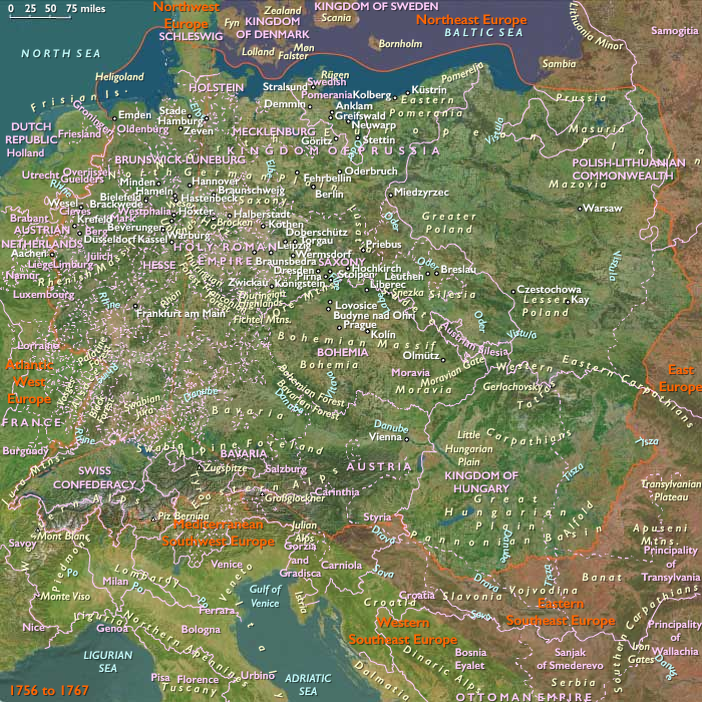
Central Europe
View →Subregions
