
The most saliently liberal aspect of Jagiellon…
1540 CE to 1683 CE
This tolerance prevails in Poland even during the religious upheavals, war, and atrocities associated with the Protestant Reformation and its repercussions in many parts of sixteenth-century Europe.
The Reformation arrives in Poland between 1523 and 1526.
The small Calvinist, Lutheran, and Hussite groups that spring up are harshly persecuted by the Roman Catholic Church in their early years.
Then in 1552 the Sejm suspends civil execution of ecclesiastical sentences for heresy.
Poland will remain solidly Roman Catholic for the next one hundred and thirty years, while refusing to repress contending faiths and providing refuge for a wide variety of religious nonconformists.
Such broad-mindedness derives as much from practical necessity as from principle, for Poland-Lithuania governs a populace of remarkable ethnic and religious diversity, embracing Roman Catholics, Eastern Orthodox, Protestants, and numerous non-Christians.
In particular, after the mid-sixteenth century the Polish lands support the world's largest concentration of Jews, whose number is estimated at one hundred and fifty thousand in 1582.
Under the Jagiellons, Jews suffer fewer restrictions in Poland-Lithuania than elsewhere in Europe while establishing an economic niche as tradesmen and managers of noble estates.
Locations
Groups
Jews
View →
Germans
View →
Poles (West Slavs)
View →
Christians, Roman Catholic
View →
Christians, Eastern Orthodox
View →
Poland of the Jagiellonians, Kingdom of
View →
Lithuania, Grand Duchy of
View →
Hussites
View →
Unity of the Brethren (Moravians)
View →
Lutheranism
View →
Protestantism
View →
Calvinists
View →
Regions
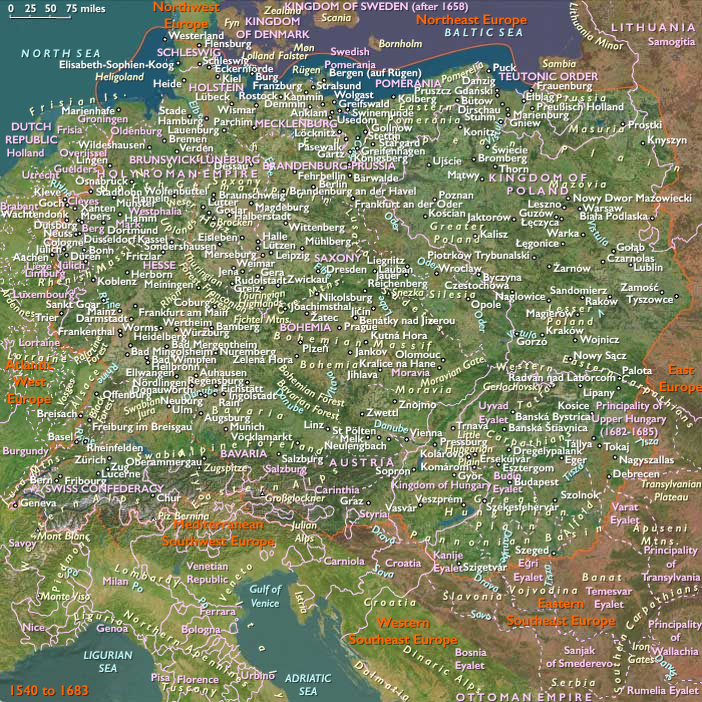
Central Europe
View →Subregions
