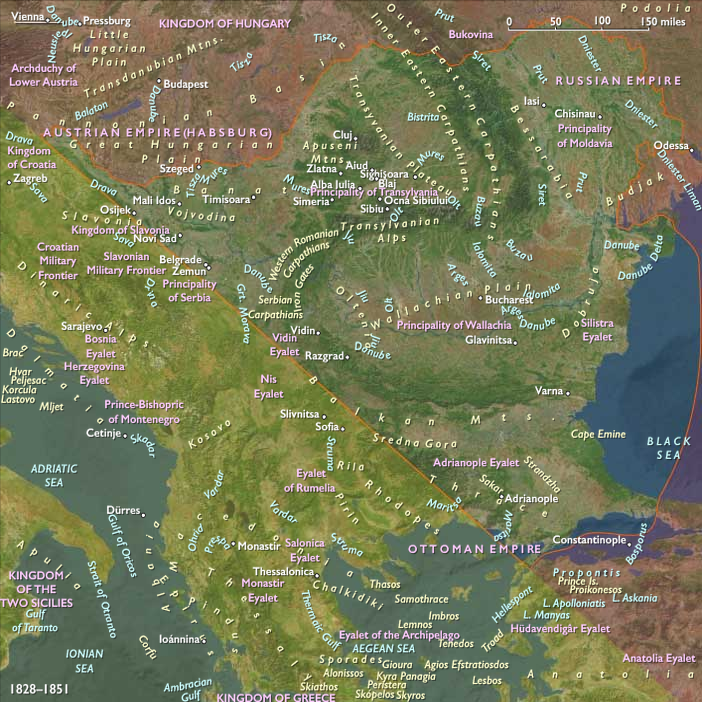
A majority of Wallachia's younger generation is…
June 1848 CE
A majority of Wallachia's younger generation is averse to Russian and boyar dominance.
Revolutionary platforms call for universal suffrage, equal rights, unification of the two principalities, and freedom of speech, association, and assembly.
Prince Gheorghe Bibescu, although he sympathizes with the revolutionary movement, lacks the courage to lead it.
After naming a revolutionary cabinet and signing a new constitution in June, he flees into Transylvania.
The new government of Wallachia quickly affirms its loyalty to the Porte and, hoping to avert a Russian invasion, appeals to Austria, France, and Britain for support.
The government also forms a committee composed equally of boyars and peasants to discuss land reform.
Romanian nationalists form an armed force to fight for the liberation and unification of the principalities into a modern state.
Russia and the Habsburgs, recognizing the challenge that this development implies, mobilize armies to forestall unification.
The tsar, shocked by the revolution's success in Europe and fearful that it might spread into Russia, invades Moldavia and pressures the Porte to crush the rebels in Bucharest.
Dissatisfied with Turkey's weak resolve, Russia next invades Wallachia and restores the Règlement.
The unsuccessful revolution of 1848 shows that there will not be a Romanian nation-state, independent of control by any empire, until the military power needed to defend it is established.
Locations
People
Groups
Topics
Commodities
Subjects
Regions
Southeast Europe
View →Subregions